
Book Review: Sarah’s Key

Sarahs Key

In 1942, Sarah, ten years old, was frightened when she and her parents were rounded up in the middle of the night by French police. Her younger brother, only four years old, refused to go and Sarah helped him hide in their secret hiding place, believing they’d only be gone for a short while and then return home.

A multi-layered, well-crafted novel, Sarah’s Key by Tatiana De Rosnay alternates between 1942 France and present day. The story evolves around the true events of the dark period in France’s history where thousands of Jewish families were rounded up and forcibly kept in the Velodrome d’Hiv, eventually taken to transit camps and finally packed off to Auschwitz.

Even before the roundup, Sarah realizes grim changes in her homeland. Jews are required to wear yellow stars on their clothing, even to school. They are no longer allowed in some stores and restaurants, places of business are closed, leaving many Jews without income. The year 1942 signaled dark times for Jews, but they had no idea of the horrors that awaited them.

Julia Jarmound, a present-day American journalist living in France with her French husband and daughter, investigates the little known Vel’ d’Hiv Roundup of Jews, conducted and enforced by French authorities in the heart of occupied Paris under Nazi Germany command.

When Julia uncovers truths that took place in 1942, she is consumed by Sarah’s story. Even when she discovers secrets about her husband’s family and stirs up resentment of repressed guilt, she is compelled to seek the truth about Sarah.

Sarah’s Key is a moving novel that delves into a little known piece of history now often referred to as France’s Dark Years. The author’s handling of the two time periods is flawless, her characterizations vivid.

For more information about the author and her work, visit http://www.tatianaderosnay.com/


Book Review: Dare to Dream

Dare to Dream, the third novel in Heidi Thomas’s Cowgirl Dreams trilogy, brings a satisfying conclusion to the story of Nettie Moser, a strong woman who dares to fulfill a life-long dream of becoming a champion rodeo steer rider.

Dare Cover Final 1.5x2Now in her thirties, Nettie’s time has finally arrived. She and her husband Jake are eager to sign up as riders at a Cheyenne RAA (Rodeo Association of America) rodeo, Jake as a bronc rider, Nettie as a steer rider. Since she was fourteen it had been her dream to be a professional rodeo rider and she had found success. Much to the surprise of the audience, and to the dismay of her family, this tiny 105-pound girl had sat atop of a half ton of writhing steer muscle and bone and rode it to the end.

Nettie had held on to her dream through the years though for a while had to put it aside because of injury, family illness, the tragic death of another woman contestant, starting her own family, and working with her husband and young son on their horse ranch. But now her dream is again becoming a reality. The time is right for her to resume her rodeo competition.

But her dream is shattered when in 1941 RAA refuses to let women compete in rough stock riding. Sometimes dreams take a detour. It’s up to Nettie’s creativity to find a way to be a part of rodeo.

Dare to Dream is the continuing story of ranch life in the early forties. WWII is threatening and Nettie and Jake’s son is approaching draft age. Love and sorrow is a part of life and it takes courage to handle them with grace. The war years bring sorrow and hardship and it’s left to those at home to carry on.

Author Heidi M. Thomas grew up on a Montana cattle ranch. Her first two books of the series, Cowgirl Dream and Follow the Dream are based on Thomas’s grandmother who rode rough stock in the 1920s heyday of rodeo. Dare to Dream follows a historical timeline, but is more a work of fiction than the first two. I found the trilogy a worthy and fulfilling account of the early days of ranch life and rodeo. Thomas brings warmth and believability to her characters and to the countryside in which they live.

For more information about the author and her work, visit www.HeidiMThomas.com

Book Review: Killing Jesus

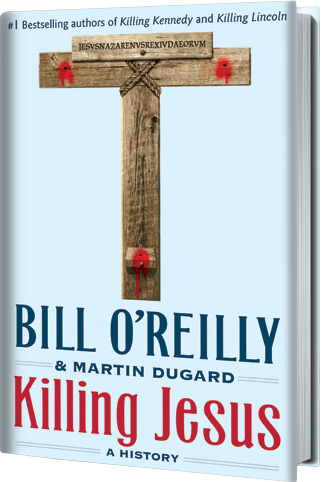
killingjesus-3dKilling Jesus: A History by co-authors Bill O’Reilly and Martin Dugard is an extraordinary account of the most influential man who ever lived: Jesus of Nazareth.

Jesus is born surrounded by fear, fear that the baby boy will be slaughtered like other baby boys in the small town of Bethlehem and surrounding area. King Herod will kill anyone who threatens his throne. For centuries, Jewish prophets have predicted the coming of a new king to rule their people. What people of power don’t realize is that the “power” is not of this world.

Jesus’s parents, Mary and Joseph, strive to keep a low profile. As the baby Jesus is presented in the temple, it becomes obvious that he is a special child. He leads a fairly normal childhood, learning his father’s trade as a carpenter. He often shows signs of wisdom beyond his age.

As he becomes an adult, it is clear to Jesus that he must see to his Heavenly Father’s work. He acquires a following, and he acquires enemies, people who fear they will lose their political power.

Killing Jesus is not a religious book, it is a study of a man “who galvanized a remote area of the Roman Empire and made very powerful enemies while preaching a philosophy of peace and love.” Many familiar people play roles in the political and historical events that made Jesus’s death inevitable: Julius Caesar, Cleopatra, Caesar Agustus, Herod the Great, Pontius Pilate and John the Baptist.

Throughout the book extensive footnotes support facts presented. In the forward, Bill O’Reilly states, “To understand what Jesus accomplished and how he paid with his life, we have to understand what was happening around him.” O’Reilly and Dugard do a thorough job of helping the reader understand the political mind-set of the time.

I found Killing Jesus riveting. No matter what religious beliefs the reader follows, this book brings to light the meaning of Jesus’s life. The book is quite graphic in describing extremely cruel executions. Life was cheap and political power safe-guarded at all costs.

Authors Bill O’Reilly and Martin Dugard have also co-authored two other notable books, Killing Lincoln and Killing Kennedy. To learn more about these books and the authors, visit http://killingjesusthebook.com/

Book Review: Nights in Rodanthe

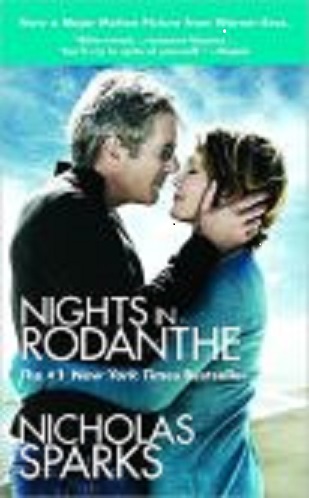
Nights in Rodanthe2Nights in Rodanthe by Nicholas Sparks is a poignant, heart-warming novel that I couldn’t put down.

Adrienne Willis’ daughter has suffered the death of her husband, leaving her with two small sons to raise alone. Adrienne is concerned that her daughter’s grief is consuming her, leaving her sons adrift without their mother’s attention. Adrienne decides to share with her grieving daughter an experience that happened years before.

In a flashback to fifteen years earlier, Adrienne is raising her three children alone since her husband left her for a younger woman.

Dr. Paul Flanner was a highly sought-after physician who poured all his energy into his practice. After their son leaves for college, his wife leaves him. Dr. Flanner sells his practice and plans to attempt to reconcile with his son who is now practicing medicine in Ecuador.

While her children are visiting their father, Adrienne is taking care of a friend’s bed and breakfast for a few days in the small coastal town of Rodanthe, North Carolina. Only one guest is expected for the weekend, a Dr. Paul Flanner. Also expected is a fierce nor’easter. As residents prepare for the worst storm in years, another type of storm is brewing at the bed and breakfast.

When love goes bad or is neglected, it so often involves many more lives than the two directly involved. When new love is again found, it is a gift to be treasured, but invariably involves other people as well.

The novel seamlessly switches from present-day to fifteen years earlier, making for an enjoyable, exciting novel which keeps the reader guessing at each juncture.

A gifted novelist, Nicholas Sparks writes with deeply moving tenderness. He manages to keep suspense dangling while writing with detailed clarity. Nights in Rodanthe is a bitter-sweet story of the healing power of love.

Book Review: A Better Way of Dying

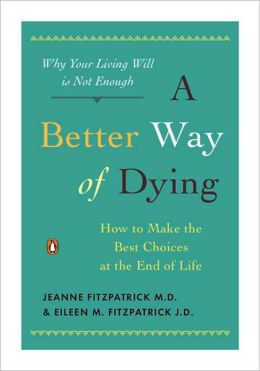
A Better Way of DyingMost people would say the ideal way to die is one where they’ve been able to a tie up loose ends, say farewell to loved ones and leave this world without plunging their family into dept with huge medical bills. A Better Way of Dying: How to Make the Best Choices at the End of Life, co-authored by sisters Jeanne Fitzpatrick, M.D. and Eileen M. Fitzpatrick, J.D. provides a logical method of making realistic end-of-life decisions.

The authors guide readers through various scenarios discussing usual medical procedures. We learn about choices we have the right to make to ensure control over our own end-of-life experience.

Having a Living Will and Do Not Resuscitate order are steps in the right direction, but inadequate to fully protect us from unwanted aggressive medical treatment when we are ready to die.

A long slow death in a nursing home is a nightmare most of us would avoid if given the chance. Whether the cause of death is the result of a terminal illness, dementia, an accident, or just old age, there are steps we can take to ensure our end-of-life experience is what we want it to be, not what insurance companies dictate, or what hospitals can do to prolong life with various life-support equipment.

A Better Way of Dying introduces The Compassion Protocol, a step-by-step guide that helps people experience a natural death in a timely fashion. The suggestions introduced in this book are practical and ethical.

I consider this compassionate book an important read for the young, old and everyone in between. Although we have already signed Living Will and Do Not Resuscitate forms, my husband and I now realize that we have more to do. From Doctor Jeanne Fitzpatrick we learn how end-of-life treatments are carried out unless patients have taken steps to avoid it. From attorney Eileen M. Fitzpatrick we learn how we can legally protect ourselves and our loved ones from expensive treatment that only prolongs the evitable.

For more information, visit www.compassionprotocol.com

The Pieces We Keep

The Pieces 1The Pieces We Keep by Northwest writer Kristina McMorris is a gripping multilayered story steeped in rich details and deep emotions. Newly widowed Audra Hughes hopes to get a fresh start by leaving Portland and accepting a veterinary job in Philadelphia. When she and her son Jack, seven, attempt to fly to Boston for her interview, Jack has a panic attack. Jack’s fears continue in the form of violent nightmares that threaten to consume him. An Afghanistan veteran Sean Malloy, struggling with his own injuries, becomes a part of their lives, but triggers in Jack memories that would be impossible for him to have.

The book alternates from present day to the war years, beginning in 1939 London, England. Vivian James is having a clandestine affair with Isaak, an American of German decent. As the war rages on, Vivian’s life becomes more complicated as she attempts to help Isaak extricate his relatives from Nazi Germany. Vivian finds herself embroiled in an FBI investigation involving German saboteurs in the United States.

Alternating between time periods, it becomes clear that there is a link between present day, World War II and Jack’s vivid nightmares.

The Pieces We Keep emphasizes the importance of family bonds and loyalty. Kristina McMorris does an excellent job of developing her characters in their respective time periods. Her research in many aspects of this novel was extensive and the story she weaves is believable. I highly recommend this book.

Book Review: The Divinity of Dogs

Divinity DogsJennifer Skiff has gathered a precious collection of stories about dogs and their people in The Divinity of Dogs, True Stories of Miracles Inspired by Man’s Best Friend. Skiff, an award-winning television producer, journalist and author, is personally and professionally involved with dogs in the U.S. and Australia.

The book is divided into sections: Love, Comfort, Intuition, Healing, Gratitude, Loyalty, Passing, Compassion and Forgiveness. Skiff begins each section with a personal story, followed by stories written by other people inspired by their own experiences with dogs. Each story has a picture of the dog involved and some of the pictures are so captivating I viewed them time and again.

As with many books of this nature, I gained insight into my own dog, Toby, a chocolate lab. This book has further opened my eyes as to the depth of a dog’s intuition, love and loyalty. Even when rejected, a dog will often rise above it and fill a human’s need.

Many of the stories carry messages of desperation, many of sadness, some of joy. No matter. You’ll come away enlightened, inspired, and enriched.

The Divinity of Dogs is a great read, compiled with the perfect balance of the many facets of the divine essence of dogs.

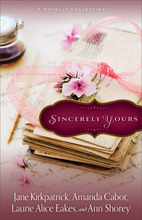
Book Review: Sincerely Yours

Sincerely Yours

Sincerely Yours is a collection of four novellas with a common thread of love.


A Moonlight Promise by Laurie Alice Eakes
English born Camilla Renfrew is desperate, not only to find a new life, but to bury the old. She receives a letter from a friend that could answer her prayers. Camilla manages to hitch a ride on Nathaniel Black’s steamboat in her rush to get to Albany to meet her friend. When the steamboat is sabotaged, Camilla and Nathaniel recognize in each other what is important, what true faith is, and how it can shape their lives. A Moonlight Promise is not only a lovely story, it offers an intriguing glimpse of steamboat life on the Hudson River in the early 1800’s.

Lessons in Love by Ann Shorey
It’s 1858 and Merrie Bentley has a secret passion. More than anything, she wants to be a writer. She is of marriageable age and her aunt dutifully tries to fulfill the promise she made to Merrie’s parents that she would encourage the young woman to seek a suitable husband. When Merrie receives a letter addressed to Mr. Bentley, an invitation from a publisher to discuss her work, her joy is shattered. Confident that as a woman she won’t be published, she convinces Colin Thackery, her piano teacher, to act as Mr. Bentley for the meeting. The plan takes an unusual turn and so do social expectations of marrying within one’s station in life. Lessons in Love is a fun read and especially enlightening about social expectations in the mid-1850’s.

One Little Word by Amanda Cabot
Lorraine Caldwell was trained to be the wife of a wealthy man. Her uncle and guardian since her parents’ death has her future husband all picked out. Unfortunately she has no love for the man. When Lorraine receives a letter from her brother asking her to visit him at a resort some distance from New York City, she is thrilled, yet mystified. Arriving at the train station she is met by English-born Jonah Mann, a carousel maker. The purpose for Lorraine’s visit opens her eyes to a new kind of life. Besides the well-drawn characters in One Little Word, the story is enhanced by carousel lore, history and traditions. The story takes place in 1892.

A Saving Grace by Jane Kirkpatrick
Music teacher Grace Hathaway receives two letters in the same envelope. One, a letter from her young godchild, Carolyn, asking for help, the other from an attorney writing on behalf of Carolyn’s caretaker. Carolyn’s mother, a recent widow, is in a sanatarium and cannot be convinced to leave. Grace leaves her teaching position in Oregon’s ranch country and travels to Olalla, a small community on Puget Sound. At the hotel where she stays, Grace is attracted to another guest, Claude Millikan, a pharmacist who is temporarily working at the sanitarium. When she visits the sanatarium she’s appalled by her friend’s condition and the treatment given other patients. Grace devises a ruse to save her friend, but finds herself in danger when her plan backfires. Although fiction, the story is based on a real Olalla sanatarium that operated with questionable medical practices in 1911, when this story is set. A Saving Grace offers interesting views of health and social norms of the era.

Each of the novellas in Sincerely Yours ends with a letter from the author to the reader adding authenticity and interest to the 1800’s and early 1900’s, particularly as they pertain to women’s lives today compared to expectations in the past. The well-crafted collection of stories is highly recommended.


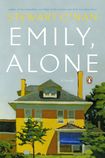
Book Review: Emily, Alone

Emily AloneStewart O’Nan’s Emily, Alone touched my heart as it follows Emily Maxwell on her final journey, alone. The novel is a sequel to the acclaimed Wish You Were Here.

Now 80, Emily manages to fill her days maintaining the home where she and her late husband raised their children. She hires a few things done, but she has her rigid housekeeping rituals, her music, her garden and her old dog, Rufus.

Emily’s children live a distance from her Philadelphia home, so visits with them and her grandchildren are infrequent. In any event, she finds their relationship as distant as the miles that separate them.

When Arlene, Emily’s best friend and sister-in-law, faints at their favorite breakfast buffet, Emily finds herself without transportation. She dusts off her husband’s old, treasured Oldsmobile, and drives to the hospital where Arlene has been admitted. Emily is intimidated with the huge car, but for now she can’t rely on Arlene for transportation.

Another vehicle sideswipes the car where it’s parked on the street and Emily feels compelled to replace it with a new, smaller car. The new car paves the way toward a new independence. Arlene is discharged from the hospital and now Emily is often the driver for their excursions. She discovers she can go places and do things on her own and she savors these new possibilities.

Emily, Alone follows the daily life of a woman used to an orderly life. The novel goes into the sort of detail that brings Emily into the reader’s world. It’s a rare glimpse into the life of a person in her twilight years with typical anxieties, hopes and frustrations. I found myself holding my breath as Emily braves the freeway by herself to visit the graves of her parents, an errand she feels duty-bound to fulfill.

Emily, Alone isn’t a fast-paced novel with a breath-taking plot. It’s a quiet story of a lovable woman who faces life with dignity, hope and wry, sometimes quirky humor. I loved this story and its humane, intricate details.

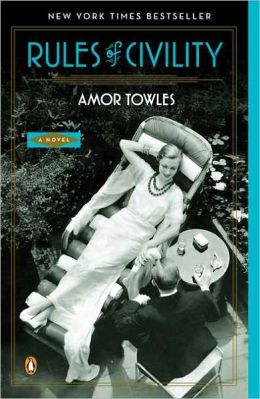
Book Review: Rules of Civility

Rules of CivilityAmor Towles’ debut novel, Rules of Civility is a captivating period piece that takes place in New York City, particularly in Manhattan. The story begins in 1966 but quickly turns back to New Year’s Eve, 1939.

Kate Kontent and her roommate Eve meet wealthy Tinker Gray at a jazz club on New Year’s Eve. A solid friendship forms and the three of them share many enjoyable times together. An accident abruptly changes their relationship and the direction of their lives.

Kate, who narrates the novel, is at first in a secretarial pool at a successful law firm, but quickly moves on to become a secretary at a trendy magazine. The daughter of a Russian immigrant, she never denies her background and that she is among “the working class,” but finds herself socializing with a privileged group of people (white, rich and sophisticated). Kate, extremely well-read and intelligent, remains grounded, but finds herself involved in the social activities of the well-to-do with their well-kept secrets and expensive life-style.

As we ride along with Kate, we learn about the lives of the New York rich. The book takes place toward the end of the depression and the wealthy portrayed don’t seem to have suffered unduly. It’s an era of surprisingly aimless goals among the rich, smoking, drinking martinis, rarely cooking one’s own meal, living exclusively in apartments, and commuting in cabs or chauffeured limousines. The dialog is fast-paced and witty, the sense of New York rich in detail.

Rules of Civility takes its name after the 110 rules that George Washington crafted during his teenage years, “Rules of Civility & Decent Behaviour in Company and Conversation.” Towles ends the book with the complete list of rules, often mentioned in the novel as either rules to be followed in a civilized society, or possibly rules no longer relevant. Here’s Washington’s 6th Rule of Civility:

“Sleep not when others Speak, Sit not when others stand, Speak not when you Should hold your Peace, walk not on when others Stop.”

I enjoyed Rules of Civility. I marveled at the differences between New York and the mid-west or west. The novel concentrates on either the very rich and the poor working class. There must have been some “middle class” but this novel does not touch on what most of us recognize as normal. The author’s descriptions of scenes and scenery feel realistic and vibrant. The book gave me a glimpse of an era and place now changed forever. I recommend Rules of Civility and look forward to reading more of this author’s work.