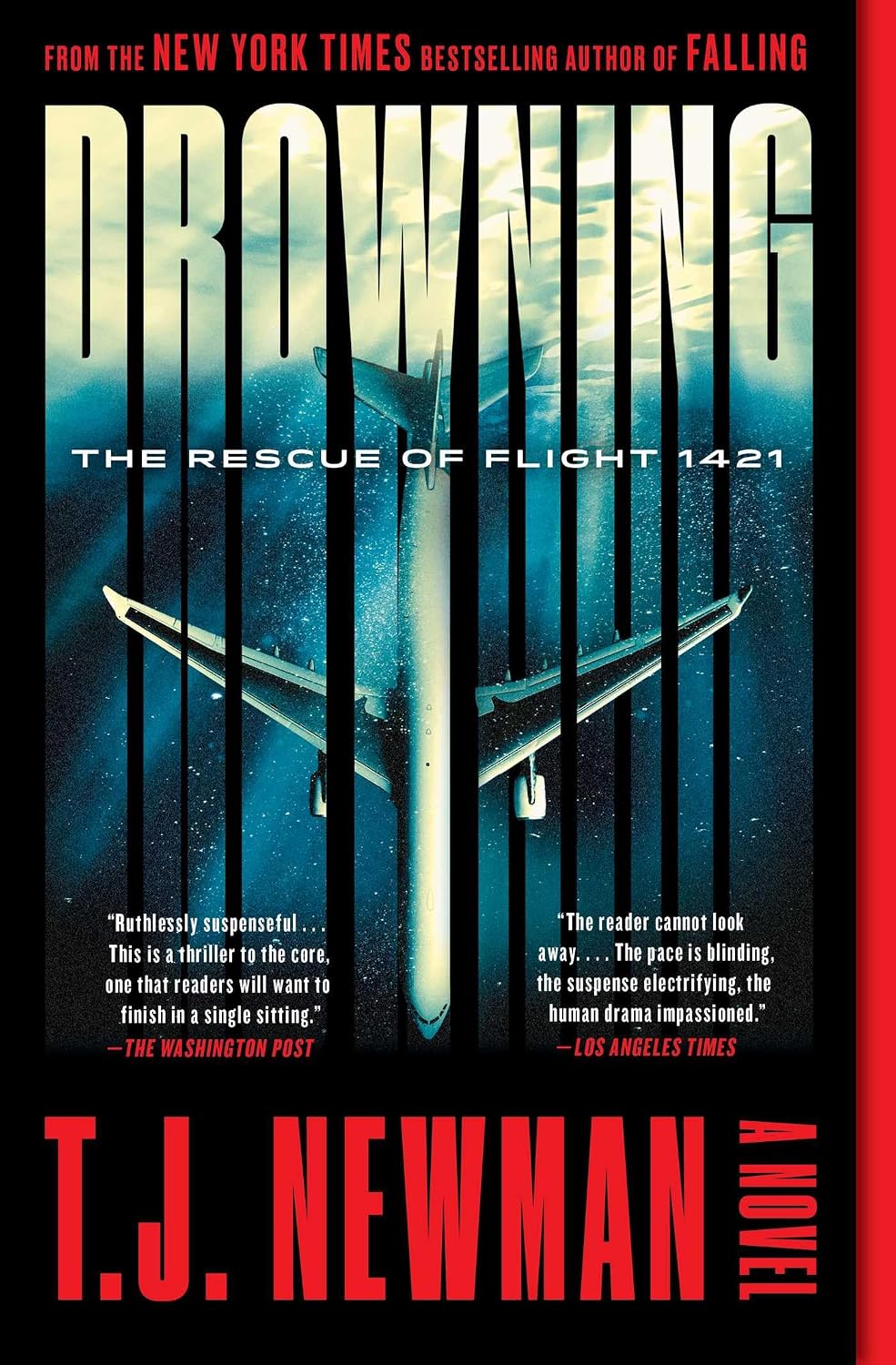
Drowning: The Rescue of Flight 1421, a novel by T. J. Newman, is rich with suspense in the face of almost certain death.
When Flight 121 takes off from Honolulu’s Daniel K. Inouye International Airport, it carries passengers with hopes and dreams. Included in the passenger list are Will Kent and his eleven-year-old daughter, Shannon. Will is accompanying his daughter to summer camp on the mainland. Will and his wife, Chris, have separated. They’ve never healed after the tragic accidental death of their oldest daughter six years earlier.
Six minutes after takeoff, the plane malfunctions, one engine catches fire, and the aircraft crashes into the ocean, just off the rugged coast of Molokai. Some people manage to exit the aircraft, only to be met with fire from burning fuel. Those remaining in the aircraft close the doors, but it’s too late. The plane quickly sinks to the bottom with twelve passengers and six crew trapped inside.
More than two hundred feet below the surface Will and Shannon and the other passengers and crew are struggling with rising water with a limited amount of air, fighting panic. As an engineer, Will is acutely aware of the danger they’re in, but he fights to concentrate on helping solve their dire situation.
On shore, an elite rescue team led by professional diver Chris Kent is desperately at work to save the passengers and remaining crew. Chris’s company is known for their expertise in fixing large metallic vessels. To make the situation even more harrowing, Chris is Will’s ex-wife and Shannon’s mother. She must fight the panic and terror she feels for her family and concentrate on her expertise to save them.
Drowning:The Rescue of Flight 1421 is a gripping novel from beginning to end. Author T. J. Newman, a former flight attendant, writes with authenticity. I especially appreciated the rescue scenes and the expertise of the team to save the passengers and crew of the downed aircraft. Both my husband and I are certified Open Water Divers and are familiar with much of what this rescue operation, using Self-Contained Underwater Breathing Apparatus (SCUBA) would entail. I thought the passengers’ angst realistic and the rescue teams’ expertise believable. I would highly recommend this novel, though if you plan to travel by air any time soon, you might want to read this one after your trip.