
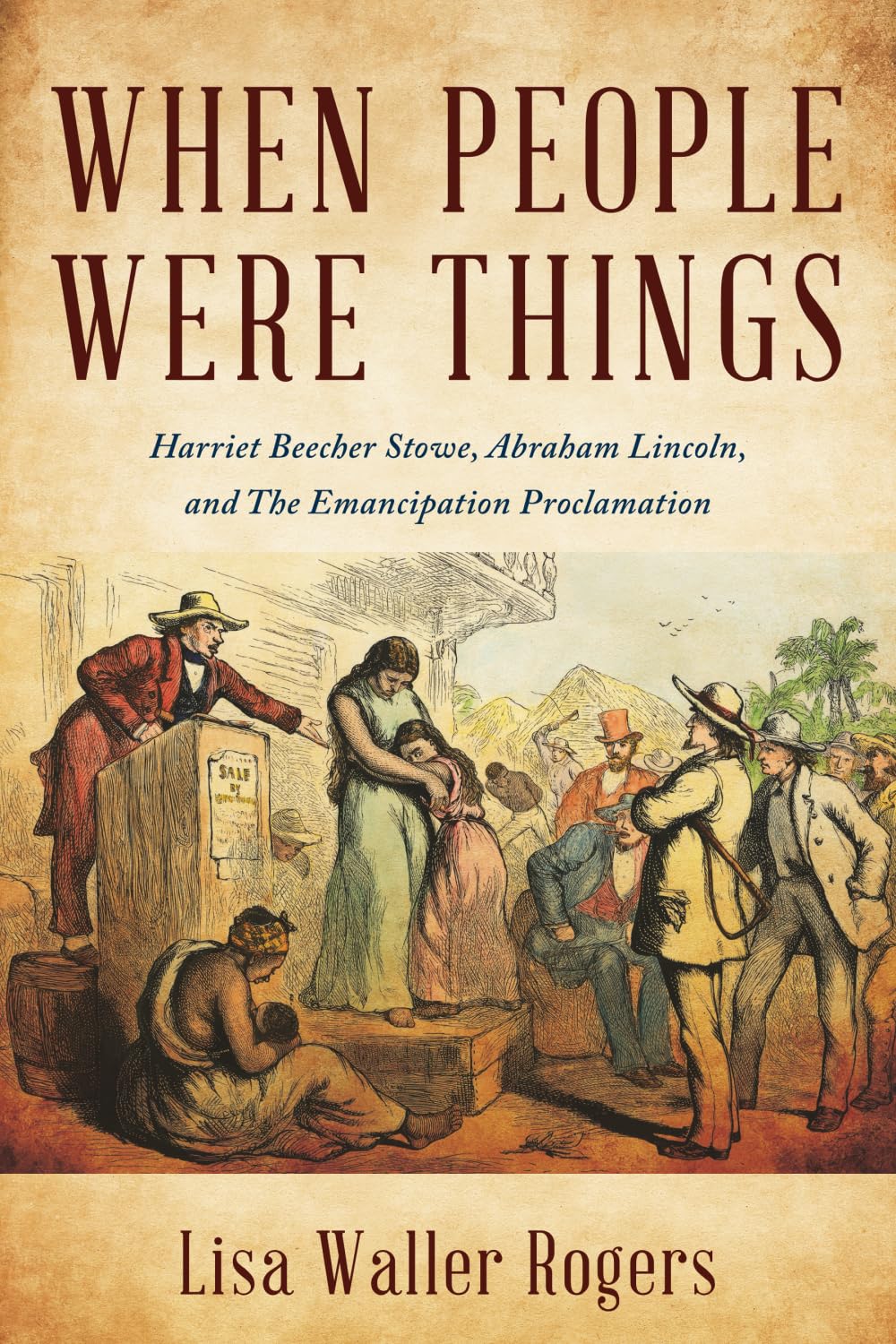
When People Were Things: Harriet Beecher Stowe, Abraham Lincoln, and the Emancipation Proclamation by Lisa Waller Rogers is an extraordinary book that brings history to life.
The story begins when Abraham Lincoln was twenty-two. It tells of his early years and struggles. He had a curious mind, but his formal education was limited to a month here, a month there, amounting to about a year of institutional education. Piece by piece Lincoln taught himself about law. He earned a law degree and was admitted to the Illinois bar in 1836. He practiced law for about twenty-five years before becoming President of the United States in 1861.
When People Were Things discusses other important people who helped shape America’s attitudes toward slavery. Of particular interest to me was the story of Harriet Beecher Stowe, author of Uncle Tom’s Cabin, an anti-slavery novel that had a profound effect on attitudes toward African Americans and slavery. The book was first published in forty-one serial newspaper segments, then later published as a wildly popular book.
When People Were Things humanizes historical figures and their struggles with moral complexities. President Lincoln had a clear vision of the country’s moral obligations, but he constantly had to defend his positions with his cabinet. His presidency was often one of criticism, strife and doubt. He was battered from all sides: too radical for Democrats and not radical enough for Republicans.
Many people were involved in the abolitionist movement to end slavery and liberate enslaved individuals. Harriet Tubman, an African-American abolitionist and social activist born around March 1822, was best known for her role as a “conductor” on the Underground Railroad, where she led approximately 70 enslaved people to freedom.
In the meantime, Lincoln had his hands full with his wife, Mary. The two had nothing in common. Lincoln loved to read, contemplate. Mary loved to socialize, needed constant attention and excitement. She purchased extravagant clothes and furnishings for the White House, far exceeding their budget. They had four sons, but after their son, Willie, died Lincoln feared for his wife’s sanity.
When People Were Things is a lengthy volume at 680 pages, packed with fascinating stories and insights of the Civil War era. Author Lisa Waller Rogers highlights the moral complexities of the times, particularly about abolitionists who played significant roles in advocating for the emancipation of enslaved people. This book would be ideal reading for history students and anyone interested in this period of our nation’s history.