
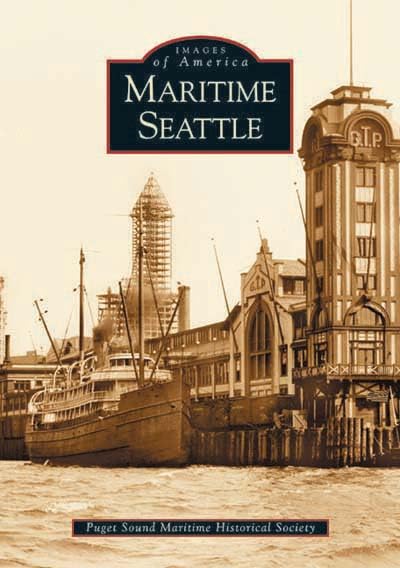
Maritime Seattle by the Puget Sound Maritime Historical Society, from the “Images of America” series, is a well-illustrated chronicle of Seattle’s waterfronts, beginning in 1850 through today’s thriving shoreline.
In 1851 the Denny Party, ten adults and twelve children, arrived in the schooner Exact landing at Alki Beach on the shores of Puget Sound at what is now called West Seattle. As the group grew in numbers and intentions, Seattle’s waterfront moved in the 1850s from Alki to its current location in Elliot Bay. The city developed and expanded along Elliott Bay with the primary focus on shipping and trade.
Seattle was named in honor of Chief Si’ahl, a prominent leader of the local Duwamish and Suquamish tribes. The name was officially adopted in 1853 when the town’s first plats were filed.
The book is rich with maritime and local history. In 1889, an exploding glue pot started what is known as “Seattle’s Great Fire” which consumed buildings, piers, warehouses and trestles. Aid came to Seattle from all over the nation, and people stayed. Slowly Seattle’s waterfront developed into a bustling port, its waterfront evolving from a marsh to a prosperous complex of industrial sites.
Seattle’s waterfront played a crucial role during the Klondike Gold Rush in the late 1800s as it served as a major embarkation and supply hub for gold seekers heading to Alaska. This activity transformed Seattle from a small town into a flourishing city.
Settlers to the Seattle area wanted an easy and cheap way to move logs, coal, and other resources directly from the east side of Lake Washington to Elliott Bay. The Lake Washington Ship Canal began operation in 1917 and links the fresh water of Lake Washington to the salt water of Puget Sound. The Hiram M. Chittenden Locks accommodate the approximately twenty-foot difference in water level between Lake Washington and Puget Sound.
Through photographs, illustrations and explanations of Seattle’s growth, Maritime Seattle features its early days, the war years, the depression years, it’s bitter labor disputes, to today’s Port of Seattle, one of the largest container ship terminals on the West Coast. The Washington State Ferries system, officially formed in 1929, is the largest auto/passenger ferry system in the United States. The Port of Seattle also operates a booming cruise ship business taking passengers north to Canada and Alaska, and south to California.
I was delighted to see a ship featured in the book that was familiar to me. The MS Explorer, built in 1904, originally served for the U.S. Coast and Geodetic Survey. In 1976 I was the purser and ship’s diver on the Explorer that sailed from the Pacific Coast, through the Panama Canal and on to New York for the Bicentennial Tall Ships parade. As the purser I managed the ship’s finances. The MS Explorer was an old wooden vessel, so as the ship’s diver I performed underwater repairs. Serving on this ship was one of the highlights of my life.
Maritime Seattle is an engaging book that would be enlightening to those interested in Seattle’s colorful maritime history and its struggle to become one of the country’s premier centers for global trade.