Today’s Guest: Anne Schroeder

Last week I featured Anne Schroeder’s novel, Cholama Moon and today have the pleasure of reading her first-hand account of writing a historical western.

Anne Schroeder:

Anne croppedWriting an Historical Western, as with other historical romances, involves two equally important processes—research and story. I recall seeing Isabel Allende posed beside dozens of books she used to research one of her novels. At the time I was impressed. Now, not so much because I realize that all historical fiction writers do the same. We’re just not all savvy enough to have our publicist capture the pile of oversized books we lug home.

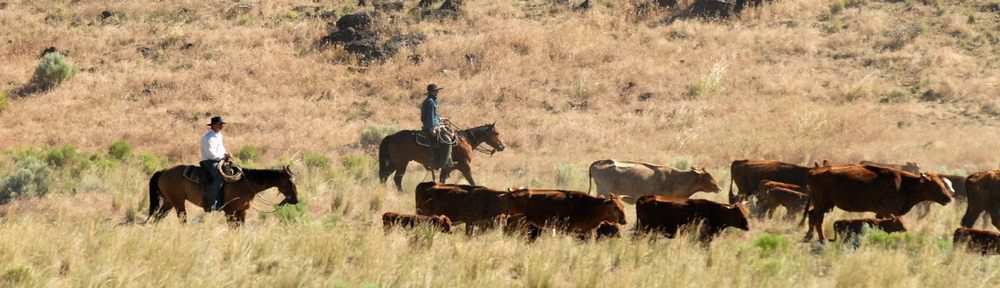
As with every genre, storytelling is king, but historical authors rely on actual places, people and events to provide a stage for the storytelling. It’s part of the fun for both reader and author. Because setting has such a prominent place in Westerns, it’s tempting to let the scenery steal the scene. One of my reviews on Amazon  http://www.amazon.com/Cholama-Moon-Anne-Schroeder/product-reviews/1610091299 mentions that very thing about Cholama Moon, my first historical western. In this story a fictional pioneer family settles in a remote section of Central California bordering the GreatValley. Ginny Nugent’s mother dies young and her father emotional abandons her in a downward spiral of addiction. In 1870s Central California, amid Mexican vaqueros, desperados and earthquakes, young Ginny fends for herself with a little help from an Indian cook and a half-crippled cowboy until a Southern gentleman sends her on a journey of self-discovery.

The young girl’s struggle to find family and belonging begins with her Cholama Valley roots and  takes her by stage, railroad and streamer through coming-of-age Central California to the coast at Santa Cruz and San Francisco—and home again. Although Ginny is a make-believe character, the historical figures, homesteaders, politicians, events and the times she lives in are true.

I have great passion for this era and setting. The nineteenth century saw great changes for the few inhabitants who called Alta California home. By 1878, Ginny is 11 years old. The great Mexican land grants are being broken off. Public land is being offered to homesteaders and preemptors. Discouraged Yankee miners replace the native Indians and the Californios Mexican land grants are nullified by the American courts, just as, fifty years earlier, the Mexican government secularized the Spanish Mission system and evicted Spaniards when they were unable to produce written proof of their Spanish land grants. Under American rule, population brings a railroad, which means towns, trade and transportation. Within seven years Ginny’s world changes from strict isolation to relative social opportunity.

CholameValley –pronounced Show-lam Valley—is only five miles wide. In 1878 it was a three day trip by horse, mail stage and train from San Francisco or Los Angeles. Rugged, remote and filled with natural beauty, the valley has played host to Indian tribes, Spanish land grants, Mexican bandits, wild mustangs and earthquakes. It is today known as the epicenter for the San Andreas Fault.

At the edge of Ginny’s valley a small mountain called the MiddleRange was born—technically, the southwest slippage of the North American plate against the Pacific plate at a rate of six centimeters a year.  To a girl of the nineteenth century, tectonic science was unknown—its results, mere curiosity. Her world was bounded by her DevilMountains and La Luna Cholama, the moon that illuminates her fractured valley.

My writing explores the social and political events of an era. But as with all novels, the story is key. Romance is important in the context of the challenges that the heroine must overcome. The sequel to Cholama Moon is a novel entitled Maria Ines. It traces the Salinan Indian cook in Cholama Moon back to her roots at the Mission San Miguel de Arcángel in Alta California where she was born. A third novel, Son of the Troubles, is already underway.

My hope is that the emotional scenes in this fictional series will leave a permanent impression on readers that will create curiosity about California’s turbulent and colorful history, its Missions and historical places.

http://anneschroederauthor.blogspot.com/
www.readanneschroeder.com
www.facebook.com/anneschroederauthor


Book Review: Cholama Moon

Cholama MoonWhen she was three years old, Ginny Nugent’s mother died, and so did her loving home. Cholama Moon by Anne Schroeder tells Ginny’s story in this late 1800’s novel which takes place in a remote section of southeastern Monterey County, California.

Ginny has a loyal friend in an old cowhand, Sancho Roos. When her father, Charlie Nugent, doesn’t provide the nurturing his daughter needs, Sancho is there for her. What is lacking–a well-kept home, proper clothes, schooling, the things a growing girl needs– is at least partially compensated by Sancho’s attention and teaching.

When Jeremy Larsen, a stranger from Virginia, comes along bearing greetings from Ginny’s mother’s relatives and friends, he’s appalled by Ginny’s lack of education and refinement. The ranch is in ruins and her father absent much of the time.

Cholama Moon brings to life how homesteaders struggled amid harsh conditions. When the burden becomes too great the weak succumb, but the strong rise above the hardships. Sometimes change takes a creative approach and Jeremy may be just the person to change Ginny’s destiny.

Author Anne Schroeder has the gift of bringing the reader into the grit and dust of a run-down ranch, of rocking with the frequent earthquakes in what was and still is the center of the San Andreas Fault. Schroeder shows how a caring person can change the course of what could be a hopeless life.

Cholama Moon is an excellent novel written by a writer with an obvious passion for the West and its people. This is the first of the Central Coast Series.

Book Review: Nights in Rodanthe

Nights in Rodanthe2Nights in Rodanthe by Nicholas Sparks is a poignant, heart-warming novel that I couldn’t put down.

Adrienne Willis’ daughter has suffered the death of her husband, leaving her with two small sons to raise alone. Adrienne is concerned that her daughter’s grief is consuming her, leaving her sons adrift without their mother’s attention. Adrienne decides to share with her grieving daughter an experience that happened years before.

In a flashback to fifteen years earlier, Adrienne is raising her three children alone since her husband left her for a younger woman.

Dr. Paul Flanner was a highly sought-after physician who poured all his energy into his practice. After their son leaves for college, his wife leaves him. Dr. Flanner sells his practice and plans to attempt to reconcile with his son who is now practicing medicine in Ecuador.

While her children are visiting their father, Adrienne is taking care of a friend’s bed and breakfast for a few days in the small coastal town of Rodanthe, North Carolina. Only one guest is expected for the weekend, a Dr. Paul Flanner. Also expected is a fierce nor’easter. As residents prepare for the worst storm in years, another type of storm is brewing at the bed and breakfast.

When love goes bad or is neglected, it so often involves many more lives than the two directly involved. When new love is again found, it is a gift to be treasured, but invariably involves other people as well.

The novel seamlessly switches from present-day to fifteen years earlier, making for an enjoyable, exciting novel which keeps the reader guessing at each juncture.

A gifted novelist, Nicholas Sparks writes with deeply moving tenderness. He manages to keep suspense dangling while writing with detailed clarity. Nights in Rodanthe is a bitter-sweet story of the healing power of love.

Book Review: A Better Way of Dying

A Better Way of DyingMost people would say the ideal way to die is one where they’ve been able to a tie up loose ends, say farewell to loved ones and leave this world without plunging their family into dept with huge medical bills. A Better Way of Dying: How to Make the Best Choices at the End of Life, co-authored by sisters Jeanne Fitzpatrick, M.D. and Eileen M. Fitzpatrick, J.D. provides a logical method of making realistic end-of-life decisions.

The authors guide readers through various scenarios discussing usual medical procedures. We learn about choices we have the right to make to ensure control over our own end-of-life experience.

Having a Living Will and Do Not Resuscitate order are steps in the right direction, but inadequate to fully protect us from unwanted aggressive medical treatment when we are ready to die.

A long slow death in a nursing home is a nightmare most of us would avoid if given the chance. Whether the cause of death is the result of a terminal illness, dementia, an accident, or just old age, there are steps we can take to ensure our end-of-life experience is what we want it to be, not what insurance companies dictate, or what hospitals can do to prolong life with various life-support equipment.

A Better Way of Dying introduces The Compassion Protocol, a step-by-step guide that helps people experience a natural death in a timely fashion. The suggestions introduced in this book are practical and ethical.

I consider this compassionate book an important read for the young, old and everyone in between. Although we have already signed Living Will and Do Not Resuscitate forms, my husband and I now realize that we have more to do. From Doctor Jeanne Fitzpatrick we learn how end-of-life treatments are carried out unless patients have taken steps to avoid it. From attorney Eileen M. Fitzpatrick we learn how we can legally protect ourselves and our loved ones from expensive treatment that only prolongs the evitable.

For more information, visit www.compassionprotocol.com

The Pieces We Keep

The Pieces 1The Pieces We Keep by Northwest writer Kristina McMorris is a gripping multilayered story steeped in rich details and deep emotions. Newly widowed Audra Hughes hopes to get a fresh start by leaving Portland and accepting a veterinary job in Philadelphia. When she and her son Jack, seven, attempt to fly to Boston for her interview, Jack has a panic attack. Jack’s fears continue in the form of violent nightmares that threaten to consume him. An Afghanistan veteran Sean Malloy, struggling with his own injuries, becomes a part of their lives, but triggers in Jack memories that would be impossible for him to have.

The book alternates from present day to the war years, beginning in 1939 London, England. Vivian James is having a clandestine affair with Isaak, an American of German decent. As the war rages on, Vivian’s life becomes more complicated as she attempts to help Isaak extricate his relatives from Nazi Germany. Vivian finds herself embroiled in an FBI investigation involving German saboteurs in the United States.

Alternating between time periods, it becomes clear that there is a link between present day, World War II and Jack’s vivid nightmares.

The Pieces We Keep emphasizes the importance of family bonds and loyalty. Kristina McMorris does an excellent job of developing her characters in their respective time periods. Her research in many aspects of this novel was extensive and the story she weaves is believable. I highly recommend this book.

Book Review: The Divinity of Dogs

Divinity DogsJennifer Skiff has gathered a precious collection of stories about dogs and their people in The Divinity of Dogs, True Stories of Miracles Inspired by Man’s Best Friend. Skiff, an award-winning television producer, journalist and author, is personally and professionally involved with dogs in the U.S. and Australia.

The book is divided into sections: Love, Comfort, Intuition, Healing, Gratitude, Loyalty, Passing, Compassion and Forgiveness. Skiff begins each section with a personal story, followed by stories written by other people inspired by their own experiences with dogs. Each story has a picture of the dog involved and some of the pictures are so captivating I viewed them time and again.

As with many books of this nature, I gained insight into my own dog, Toby, a chocolate lab. This book has further opened my eyes as to the depth of a dog’s intuition, love and loyalty. Even when rejected, a dog will often rise above it and fill a human’s need.

Many of the stories carry messages of desperation, many of sadness, some of joy. No matter. You’ll come away enlightened, inspired, and enriched.

The Divinity of Dogs is a great read, compiled with the perfect balance of the many facets of the divine essence of dogs.

Thar She Blows! Whale Watching in the Northwest

Whale Frank A

Photo courtesy of Frank Alishio. Taken from boat on south side of Camano Island, WA.


It’s whale watching time! Each year from March throughout the summer months, the fascination of whale watching begins in Puget Sound.

So where can you spot these gigantic mammals? The gray, a baleen whale, is regularly spotted in the Saratoga Passage and other shallow, muddy beaches around Camano Island. Another baleen whale, the minke, also is seen in Puget Sound.

Baleen whales are identified by horny, elastic material that forms a fringed mesh in their mouth, used for trapping food.

The orca, a toothed whale, is most commonly seen in the waters of the San Juan Islands. One popular place on San Juan Island is Lime Kiln State Park, just 8 miles from Friday Harbor overlooking Haro Strait. This day-use park is the nation’s first whale-watching park.

Orcas, also known as “killer” whales because of their voracious appetite for salmon, porpoise, or even whales, reside in Puget Sound year round but sightings are more common beginning in March.

The orca is not really a whale at all but is the largest member of the dolphin family. However, it is commonly called a whale because of its size and habits. The distinctive black and white orcas are probably the most studied group of marine mammals in the world.

Gray whales, once nearly extinct, have made a remarkable comeback and can be seen making their north-bound migration from March through June. These giants can reach 45 feet in length, compared to the orcas’ 30 feet, and gray whales have a blotchy pattern of light and dark gray coloration.

It is estimated that gray whales consume about seven percent of their body weight each day. Grays feed primarily on bottom-dwelling amphipods (shrimp like animals), clams and worms, and suck up several cubic feet of sediment at a time, filtering it through their baleen plates. They are often seen surfacing with mud streaming from their heads.

The minke whale ranges between 25 and 30 feet long and has dark coloring on its back and small dorsal fin. Because of their coloring, minke whales are often mistaken for female orca. One distinction between them is that the minke travels alone, unlike the female orca who normally travel in groups. Minke whales come to the Puget Sound area during summer time and return to the Pacific Ocean in winter.

What do you watch for when on the lookout for whales? Whether you’re on shore or on a boat, watch for the whale’s blow which consists of vapor, water, or condensation blown into the air up to 12 feet when the whale exhales. Once a blow is located, keep watching. Where you’ve seen one, you’ll see others.

Whales breathe rhythmically and normally follow a pattern of three to five shallow dives in a row followed by a deep dive, to a depth of up to 500 feet. When you see tail flukes come out of the water, it usually means a whale is starting a deep dive. The Orca may stay submerged 3 to 5 minutes while the gray and minke may not surface for 8 to 15 minutes. When whales surface, they blow.

Sometimes whales lift their heads straight out of the water, a maneuver called spyhopping. Some whale experts believe this activity allows the animal to visually find out where it is in relationship to the shoreline.

Another thrilling sight is breaching, when a whale leaps into the air exposing up to three fourths of its body length. The whale then falls on its side or back with a tremendous splash. Whales will sometimes breach several times in a row.

If you’re fortunate enough to be near waters where whales are passing through, enjoy the show. Whale watching is one of the Northwest’s splashiest spectacles.
These giant mammals will give you a show to remember.

For more information on whales, visit www.WhaleResearch.com

Blue: A Special Gift

Group at well GOODWhile in the Peace Corps, I frequently went on trek, sometimes with Sainabou or another auxiliary nurse, sometimes alone. An orderly/driver took me from the Basse Health Center to a distant village where a family lived whose child had been hospitalized. I wanted to call on the family to see how the child was doing and perhaps offer nutrition counseling.

As was so often the case, several people crowded around the Land Rover as we arrived, all talking and laughing and extending their hands to greet us. A man, a leper with badly deformed hands and feet, greeted me. He extended his stub of a hand and I felt no choice but to shake it, quickly realizing, at least hoping, that he was no longer contagious. As I grasped his hand, I saw in his eyes a warmth toward me, a look that I’ll always remember.

A man standing near us left and returned, carrying a live chicken and gave it to me. “Abaraka.” Thank you, he said quietly. I wondered if this man was the leper’s relative, perhaps his brother.

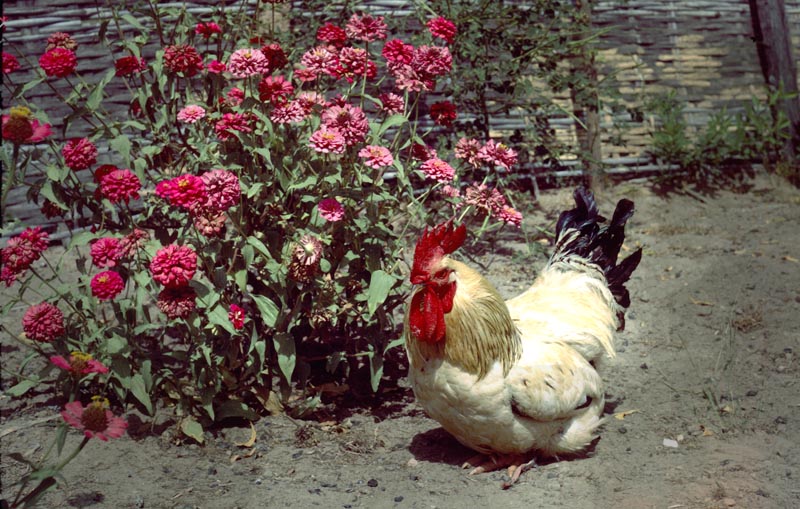
Binta had shown me how to carry a chicken in the crook of my arm and I did so now as I made my follow-up call. No one blinks an eye when someone carries a live chicken, not even the chicken. I named her Blue, for her unique color. She would be a welcomed addition to our flock, adding to our daily egg collection.

We’d heard the expression “pecking order” without realizing its full significance. Mosalif had bought our first four birds all at the same time, so if there was any adjustment, it wasn’t obvious. But when I arrived home from trek and could finally set Blue down, I couldn’t believe the ruckus. The other chickens flew at her, pecking at the poor thing. She defended herself as best she could. Feathers flew, the noise was unbelievable. By nighttime they seemed to have it all sorted out and Blue filed in with the rest of them, at the end of the line. The next morning it was as though she’d lived there all her life.

From: TUBOB: Two Years in West Africa with the Peace Corps


Book Review: Sincerely Yours

Sincerely Yours

Sincerely Yours is a collection of four novellas with a common thread of love.


A Moonlight Promise by Laurie Alice Eakes
English born Camilla Renfrew is desperate, not only to find a new life, but to bury the old. She receives a letter from a friend that could answer her prayers. Camilla manages to hitch a ride on Nathaniel Black’s steamboat in her rush to get to Albany to meet her friend. When the steamboat is sabotaged, Camilla and Nathaniel recognize in each other what is important, what true faith is, and how it can shape their lives. A Moonlight Promise is not only a lovely story, it offers an intriguing glimpse of steamboat life on the Hudson River in the early 1800’s.

Lessons in Love by Ann Shorey
It’s 1858 and Merrie Bentley has a secret passion. More than anything, she wants to be a writer. She is of marriageable age and her aunt dutifully tries to fulfill the promise she made to Merrie’s parents that she would encourage the young woman to seek a suitable husband. When Merrie receives a letter addressed to Mr. Bentley, an invitation from a publisher to discuss her work, her joy is shattered. Confident that as a woman she won’t be published, she convinces Colin Thackery, her piano teacher, to act as Mr. Bentley for the meeting. The plan takes an unusual turn and so do social expectations of marrying within one’s station in life. Lessons in Love is a fun read and especially enlightening about social expectations in the mid-1850’s.

One Little Word by Amanda Cabot
Lorraine Caldwell was trained to be the wife of a wealthy man. Her uncle and guardian since her parents’ death has her future husband all picked out. Unfortunately she has no love for the man. When Lorraine receives a letter from her brother asking her to visit him at a resort some distance from New York City, she is thrilled, yet mystified. Arriving at the train station she is met by English-born Jonah Mann, a carousel maker. The purpose for Lorraine’s visit opens her eyes to a new kind of life. Besides the well-drawn characters in One Little Word, the story is enhanced by carousel lore, history and traditions. The story takes place in 1892.

A Saving Grace by Jane Kirkpatrick
Music teacher Grace Hathaway receives two letters in the same envelope. One, a letter from her young godchild, Carolyn, asking for help, the other from an attorney writing on behalf of Carolyn’s caretaker. Carolyn’s mother, a recent widow, is in a sanatarium and cannot be convinced to leave. Grace leaves her teaching position in Oregon’s ranch country and travels to Olalla, a small community on Puget Sound. At the hotel where she stays, Grace is attracted to another guest, Claude Millikan, a pharmacist who is temporarily working at the sanitarium. When she visits the sanatarium she’s appalled by her friend’s condition and the treatment given other patients. Grace devises a ruse to save her friend, but finds herself in danger when her plan backfires. Although fiction, the story is based on a real Olalla sanatarium that operated with questionable medical practices in 1911, when this story is set. A Saving Grace offers interesting views of health and social norms of the era.

Each of the novellas in Sincerely Yours ends with a letter from the author to the reader adding authenticity and interest to the 1800’s and early 1900’s, particularly as they pertain to women’s lives today compared to expectations in the past. The well-crafted collection of stories is highly recommended.


A Rare Outing: Gambia’s Stone Circles

Stone CirclesFrom: TUBOB: Two Years in West Africa with the Peace Corps

Peter Moore, our friend with the British Medical Research Counsel (MRC) invited us to go with him and Keith, his live-in work partner, to look for the locally famous Stone Circles in the Mid-River Division in what is called the North Bank area. Peter insisted on preparing our picnic lunch, which was a treat for me. We crossed the river at Georgetown, riding on an “arm-strong” ferry, meaning we pulled ourselves across, vehicles and all. The men pitched in, pulling on the cable hand-over-hand. It was actually quite efficient.

Traveling northwest into the bush in Peter’s Land Rover for about twenty miles, we found the Stone Circles near the village of Wassu. These impressive remains are a group of cut laterite, a cementation of sandstone in the shape of posts, arranged in a partial circle. The Stone Circles are believed to have been protection for ancient burial grounds and are reminiscent of Stonehenge in England. Afterwards, we explored the area further, enjoying the luxury of having a vehicle to get around.

We spread a cloth on the ground in the shade of a baobob tree and enjoyed the lunch Peter and Keith had prepared, pâté on good French bread, pickles, canned artichokes and chilled beer. The British do a good job of making meals such as this special. Keith had even made a fruit pudding for dessert.

We found a monument to Mungo Park, not a place but a man, an explorer who searched for the mouth of the Niger River in 1797 and 1805. A plaque commemorates his efforts.

Since we had arrived in The Gambia, the main highway had been under construction and now, nearly two years later, was paved from Banjul to just a few miles from Basse. What used to take seven or eight hours (not counting break-downs) now took about five and a half. As we again crossed the river to return home, we marveled how much faster and more comfortable our trip to Basse was compared to even a few months before.

Peter offered to stop at the market before driving us home, so we could shop. What a treat! We hadn’t bought meat for five months now. Meat was too tough and stringy, but fresh fish was available and we bought lady fish for dinner, just minutes off the canoe, lovely half-inch thick steaks for about the equivalent of seventy-five cents per steak. We replenished our supply of fresh vegetables, including okra, now that Peter had shown me how to fix it.

Keith sidled up to me, trying to look nonchalant. “There’s a woman over there really staring at you.”

“That’s Sainabo, my peanut butter lady. We play this game.”

Keith shrugged and shook his head.

I turned suddenly and caught Sainabo staring. She giggled and, laughing, I made my way to her. I wasn’t prepared with a jar, but she wrapped four balls of peanut butter in a scrap of paper, the usual way it’s sold. Peanut butter–one of our more dependable sources of protein.

We enjoyed our outing, appreciating our good friends and the joy of convenient transportation.

Note: To leave a comment, please click on “…Reply” below.