Book Review: The Vanishing Act of Esme Lennox

Maggie O’Farrell’s The Vanishing Act of Esme Lennox makes me thankful that I wasn’t a woman living in the thirties. When Esme Lennox failed to comply with what was considered normal behavior, her family committed her to a mental asylum.

Sixty years later, Iris Lockhart receives notice from the asylum that she needs to make arrangements for her grandmother’s sister, Esme Lennox, her great-aunt, because the institution is closing. Iris, unaware that Esme even exists, is overwhelmed, not only with worry about what to do with Esme, but with the vague memories and clues she’s always known were there, but never acknowledged.

O’Farrell’s novel skillfully toggles between the present with Iris handling the situation, to Esme, both in the past and present. The story also includes Iris’s grandmother, Kitty, the favored older sister, in her past and in her present-day Alzheimer’s ramblings, which hint of an ugly secret. The early recollections of Esme and Kitty take place in India, and later in Scotland.

The story is a tragic revelation of yesteryear’s inhumane treatment of women who didn’t comply with the strict standards of the day. Unraveling the past, Iris discovers shocking secrets, which were largely the result of a family not communicating in order to preserve its reputation. At least in the upper middle class existence of Esme and Kitty’s childhood, much emphasis and engergy was spent in keeping up appearances and what was thought of as propriety.

The Vanishing Act of Esme Lennox is a spellbinding novel of depth and complexity that I won’t soon forget.

Fly-Day in The Gambia

From: TUBOB: Two Years in West Africa with the Peace Corps

There were always flies. We never got used to them, but in Africa flies are a fact of life. Over the two years we served with the Peace Corps, I spoke to many an African while a fly ran along the rim of an eye and the person barely flinched. We never acquired that acceptance.

When my husband Bruce and I drank anything out of a bottle, we automatically kept our hand over the opening to keep out flies. Woven straw fans were as much for batting away flies and mosquitoes as for stirring up a breeze.

But the day we forever after called “fly-day” was unbelievably awful. It happened on a Sunday and we were home all day. Conditions must have been just right, or just wrong, to create the “perfect storm” of flies. Our screened, thatched-roof hut remained relatively fly free, other than those that sneaked in when we entered, but we could control those few. On that day, the small mud-brick house where we cooked was another story. Flies and other flying critters could enter through the gap between the wall and corrugated tin roof. Flies were on every surface. There must have been three hundred flies on the overhead electrical wire that reached between the kitchen and the dining/living room, where we ate breakfast. We couldn’t bring a bite of food to our mouths without flies landing on it. In the old days we might have thrown out the food, but you’d starve if you did that every time a fly landed on your food in Africa. But this day that scenario was magnified a thousand times.

A video of us would have revealed people who appeared to have delusions with arm waving, hands suddenly going to our ears, nose and eyes. It was a nightmare.

“Whose idea was this?” Bruce asked, using Newsweek as a fly swatter, nailing three at one time.

I laughed. “Not mine! I think coming here was your idea.”

As soon as we could after eating breakfast we retreated to our hut, to spend the day hiding out, reading, and writing letters.

We had to brace ourselves to leave the hut to prepare meals. We worked like a well-oiled team, swatting and carrying on, then making a dash for the hut with our prepared food.
Fly-day lasted only the one day, to be followed by lots of flies, but not at that level.

Book Review: By Nightfall

For a close-up view of man’s frailties, the novel By Nightfall may be just what you’re looking for. Michael Cunningham tells a good story, digging deep into man’s inner thoughts, family dynamics, and the whims of the business of art.

Peter Harris, 43, owns an art gallery in present-day Manhattan. His wife Rebecca is editor of an arts and culture magazine. From all appearances they live well, are happily married, work hard, and are reasonably content. Their only child, Beatrice, now living on her own, plays a minor role, but recollections of her bring regret.

Their world changes forever when Rebecca’s much younger brother Ethan, nicknamed Mizzy, short for Mistake, comes to stay for an unspecified time. For years, Rebecca and her sisters have come to Ethan’s rescue in his various efforts to grow up. Although Ethan is now an adult, he seems to constantly need support from family and friends. Handsome and charming, he brings anxiety and unrest into Peter and Rebecca’s lives.

Author Michael Cunningham delves deep into Peter and Rebecca’s family backgrounds. These back-flashes bring texture to who the characters are in the present. When Ethan arrives, their routines are interrupted as they both try to cater to his needs. Rebecca takes on the role of big sister, but tries desperately to “let go.” Peter attempts to be a big brother, a friend, but surprising emotions spring to the surface.

Throughout the novel, readers learn about the inner workings of the business of contempory art. Most of the book is written from Peter’s viewpoint and his ever-present pangs of growing older, of how he appears to others, and how his work affects his bevy of artists and customers. By Nightful is an in-depth and memorable study of human nature, particularly in privileged society.

Although many readers may not relate to Peter Harris, his journey makes for an interesting glimpse into his world.

Making Lists Isn’t Always the Answer

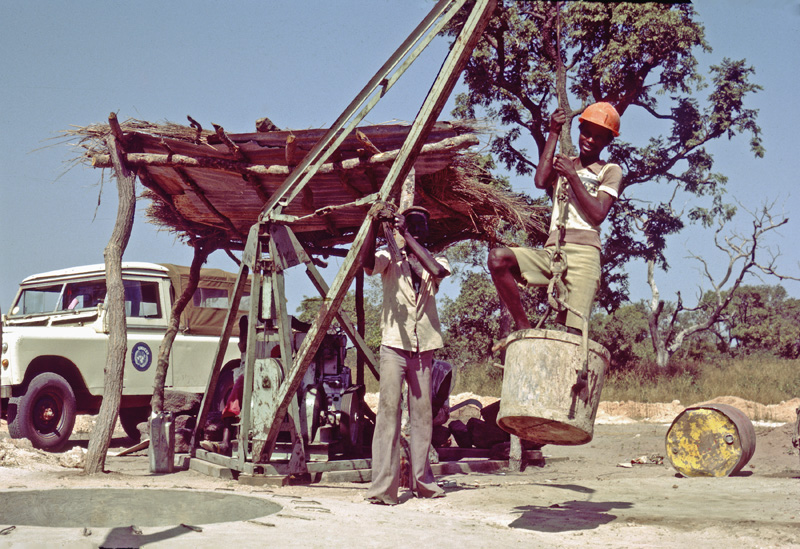
Worker preparing to be lowered into a well site.

From Tubob: Two Years in Africa with the Peace Corps

My husband Bruce’s job with the UN well-digging unit continued to be one frustration after another. He described it as “running a business on promises.” Getting supplies in a timely fashion was challenging. Many trips downriver could have been avoided if the upriver crew could have depended on routine supplies, such as motor oil, fuel and spark plugs. As it happened, they had been unable to change oil in the vehicles for some time because they couldn’t get enough oil to perform this task. They could only top up the oil when it was desperately needed. The disregard for vehicle maintenance grated on Bruce.

Sometimes equipment would go into the bush, only to break down and have to be rescued. Bruce knew many of these breakdowns could have been avoided with consistent maintenance. It was expensive for yet another vehicle to go into the bush to rescue the first, change a tire because there was no spare, take fuel which should have been filled before they left. The wasted time and resources slowed down the operation and raised expenses.

To help alleviate needless trips, Bruce made an itemized list of things that needed to be checked off before the Land Rovers and trucks left for the bush. Bruce instructed the lead mechanic to check off the items on the list as they were performed.

__ Tires checked
__ Spare tire checked
__ Radiator Level Checked
__ Oil changed, if needed (see schedule)
__ Check battery
__ Check brakes

A truck was about to depart and Karafa, the head mechanic, handed the to-do list to Bruce, with all items dutifully checked.

Bruce looked over the form. “Karafa, you’ve checked off ‘Oil Changed.’”

“Yes.”

“But we’re out of oil.”

“Yes.”

“How could you check this off then, if we don’t have oil?”

“We must check this off before truck can go to bush.”

“But you couldn’t change the oil.”

And on it went. Bruce then realized that Karafa, as well as most of the other men at the shop, couldn’t read nor write. Yet Karafa managed to maintain a fleet of trucks under very difficult conditions. Until you’re faced with situations like this, it’s hard to realize the advantages of education that we take for granted.

Book Review: Hauchuca Woman

Arletta Dawdy manages to pass on an amazing amount of southwest history in Hauchuca Woman. The story ranges from 1886, toggling to 1952, and ends with a satisfying 1961 epilog. The historical fiction is the first of the Huachuca (pronounced Wha-chew-ca) Trilogy, followed by novels By Grace and Rose of Sharon.

Josephine, the story teller, born in 1877, was about nine years old when she first met the famed Chiricahua Apache, Geronimo. Josephine’s family befriended the small starving band and in turn were considered the infamous chief’s friends.

Although the episode with Geronimo is a short scene, it sets the pace of a historical novel about the life of a white woman who lived through the taming of the Southwest, particularly in Arizona, in the late 1800’s. Josephine, 75, tells her story to her two young-adult grandchildren who are cousins, and offspring of Josephine’s twin sons. The young people are eager to tape record their grandmother’s fascinating history, bits and pieces of which they’ve heard all their lives. Toggling from 1952 and the telling of the story back to the events of 1880’s, makes for an interesting contrast. The three travel to the nearer story settings, allowing the reader to “see” through more modern eyes various historical events.

Through Josephine, the grandchildren are able to piece together their grandmother’s complex and enlightening story. Josephine’s Lazy L ranch, is her family’s homestead and a place the grandchildren cherish. They hope to encourage their families to help make it a place where family, friends and guests could gather and relish in an atmosphere of history carved from decades of dedicated labor.

Josephine’s colorful life takes surprising and often unconventional turns and twists. Her story demonstrates the highs and lows of a life well lived.

I found the segment about Fort Huachuca particularly fascinating. The Fort, still in active use, headquartered the famed 10th Calvary, the “Buffalo Soldiers,” one of the Army’s elite black cavalry corps.

Arletta Dawdy does a good job captivating the spirit of yesteryear. The details of time and setting, dialect, clothing and transportation, add immeasurably to the work.

Huachuca Woman is available in print and e-book formats. To learn more about the author, visit www.ArlettaDawdy.com

Dodging Longhorns in The Gambia

From: TUBOB: Two Years in West Africa with the Peace Corps

After work one day I walked to the farmers’ market with a long list of items we needed. Heading home, I tried not to think about the heat and the heavy pack on my back. Instead I planned our Easter dinner. Absorbed in my thoughts, I trudged along the winding path. Suddenly I stopped in my tracks. A large herd, maybe fifty head or so of longhorn cattle, grazed on the scrub grass, completely blocking the path.

To turn around and go back to take the road home would add at least a mile to my walk, not appealing in that heat. I looked around for a Fula herdsman, but didn’t see him, though I was sure a herd this size wouldn’t be here on its own. Most cattle, especially this many, were owned by the Serahule tribe, but herded by a Fula tribesman. Well, I’d just take my chances. I walked down the dusty path, talking softly so I wouldn’t startle them.

“Hi, guys,” I murmured. “I’m just going to slide right by you here.” I kept watching out for those long horns, hoping one wouldn’t stick me. Almost as worrisome was being swished by a shitty tail.

“Okay, here I am, just step aside.” I kept my voice low key, almost a whisper. A few of the cows mooed at me, some sort of grunted. None were alarmed, though they rolled their huge eyes at me. A few stepped out of my way; others let me step around them. Flies from the cattle landed on me, but I concentrated on not waving them off, trying not to make sudden moves. Churned-up dust settled on my shoulders and hair. I walked perhaps a quarter of a mile through the scattered herd before reaching the other side of them.

At one point along the path, a small hill rose on one side. From the hill I heard, “Abete ata bake, Mariama!” Well done, Mariama!

I looked up and saw the herdsman sitting in the shade. He waved. I waved back. The poor guy probably had held his breath the whole time I wove my way through the cattle, expecting to have to pry me off one of those long horns.

For weeks afterward, I heard about that incident. Word spread like locusts in a maize field. Woman couldn’t imagine why I would do such a thing. Men thought I was probably just ignorant of what could have happened to me. I kept telling everyone who questioned me that it was just too hot to turn around and go home the long way.

Book Review: Coins in the Fountain

Judith Works gives readers a fascinating Italian experience in Coins in the Fountain: The Story of an Italian Intermezzo. The book is a memoir of the author’s ten-plus years in Italy.

Equipped with her newly acquired law degree, Judith Works accepted a position with the United Nations Food and Agricultural Organization (FAO) headquartered in Rome. Together with her husband Glenn, they set up housekeeping, a task fraught with obstacles and lack of conveniences.

Rome, is called the Eternal City–even the ancient people thought it would go on forever. The author claims it would take an eternity to see it all. When time permits they explore it, piece by piece, street by street. Once settled at work and in what eventually would be “home,” Judith and Glenn were able to travel on weekends, holidays and vacations. The author and her husband know how to travel, to observe, and to experience a way to life. Often putting up with nightmare traffic, they attend concerts, visit churches, museums, galleries, flea markets, quaint shops, countrysides, big cities, small villages. Sometimes they travel with friends, other expatriates, sometimes on their own. The author is obviously knowledgeable in art and readers have the wonderful advantage of seeing church frescos, sculptures, paintings, ceramic tiles, fountains, etc. though her experienced and critical eye.

Food is an obsession in Italy and takes a prominent role in this memoir, as does wine. The book describes in detail cuisine in Rome and in other parts of Italy. Glenn became adept in Italian cooking, which further enriched (pun intended) their food experience.

The Works returned to the States after finishing her four-year contract with FAO, but were delighted to return to Rome a short time later, this time to work with United Nations World Food Program (WFP) on a six-year contract. Works’ job necessitated travel to other countries as well and she briefly describes these ventures.

The name of the book, Coins in the Fountain refers to the Trevi Fountain, the most famous and beautiful fountain in Rome. It is thought that if visitors throw three coins in the fountain, they will return to Rome. At least it worked for the author, to the delight of all who read this book.

Coins in the Fountain: The Story of an Italian Intermezzo could be a guidebook for tourists visiting Italy, as well as for armchair travelers who may never step on Roman soil, but have the advantage of traveling vicariously through this exceptionally well-written book. Coins in the Fountain is available in ebook format. For more information about the book and author, visit www.coinsinthefountain.com

The Gambia: The Art of Carrying Water on Your Head

From: TUBOB: Two Years in West Africa with the Peace Corps

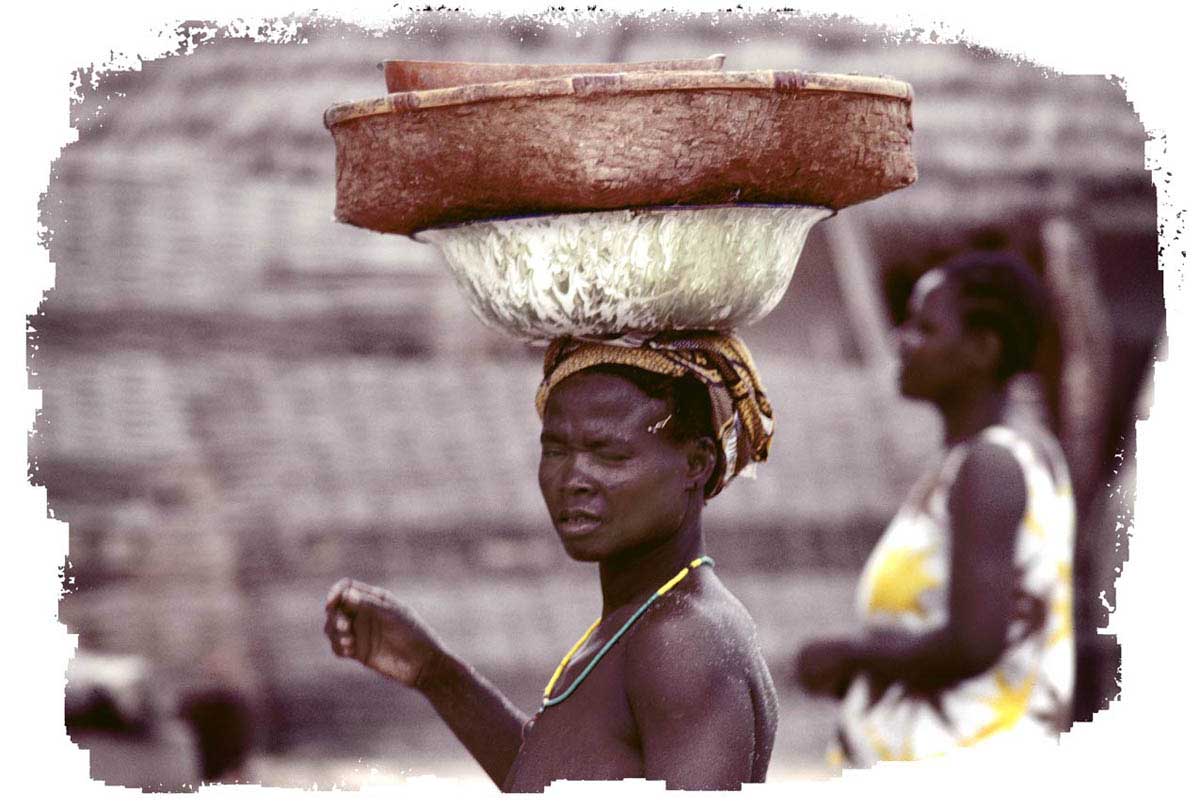
I marveled that people in The Gambia always looked so clean. Although they might get dirty digging wells or working in the rice fields, or performing any number of physical chores, they bathed and changed clothes frequently. Men often wore spotless, long white kaftans when they went to mosque or on business. Impressive, since all washing was done by hand.

Traditionally, women and girls hauled the water. To pump water at our UN well, one climbed steps to a platform above the well that stood perhaps three feet from the ground. When I arrived at the pump with my two buckets, they often urged me to go ahead of them. I usually refused, saying I would wait my turn. One day I watched two girls, perhaps sisters, chatting while they filled their containers with water. The older girl, probably about twelve, filled a laundry tub; the other, maybe eight years old, a large bucket. After the older girl filled her tub, she slid it aside to the edge of the platform while the younger girl filled her bucket.

With both containers full, the girls returned to the ground and together lifted the large tub onto the older girl’s head which had a circle of cloth on it to cushion the load. Then, with that heavy load on her head, the older one helped the younger girl heft the pail of water onto her head, never spilling a drop. Throughout the whole procedure they carried on a normal conversation, pausing only briefly to heft the containers, then walked back to their compound, still chatting, the heavy containers balanced on their heads, with perhaps one arm raised to steady it.

When Gambian girls are quite young, their mothers train them to carry basins of water. We watched the young girl in our compound, Jariettu, carry water in a shallow basin from the well to their hut. At first, she spilled much of the water, but after a few months, she was able to carry her load with confidence and without spilling a drop.

No wonder Gambians have such wonderful posture.

Book Review: Where Danger Danced

Irene Bennett Brown again captures her readers with Where Danger Danced, the second of the Celia Landrey Mystery series. This second cozy mystery is as delightful as the first.

As Celia Landrey guides her last tour group of the season through town, they are distracted by screaming and confusion at a service station where an old fuel tank is in the process of being removed to make way for a new one. To the horror of onlookers, human bones are discovered buried near the old tank.

Celia works hard to preserve her town’s reputation. Pass Creek is not only where her home and livelihood, Landrey’s Inn, is located, it is where she and her late husband of twenty years lived. Active in the small community, Celia is devoted to keeping the town a safe haven, a place where people want to live and visit.

The grim discovery of the skeleton sets the town to humming speculation. The Police Chief, knowing Celia’s penchant for fiercely protecting her town and her determined drive to get to the bottom of a mystery, warns her to let the police do their job. In others words, stay out of it.

Even her fiance, Jake Flagg, discourages her from getting involved. It’s time they set a wedding date and he strongly prefers her to concentrate on that.

But, how did those bones get into that deep hole? She couldn’t let it rest. Cold cases are apt to be less important to the police than current problems. She inquires around town but the townspeople, especially the old-timers, clam up when she asks questions about whose remains have been unearthed. In many different ways, she’s told to mind her own business. Many of her friends are clearly exasperated with her. What’s going on?

Where Danger Danced is an entertaining, captivating read. It’s a perfect sequel to Where Gable Slept. I can’t wait for the next one. The novel is available in both e-book and print formats. For more information about the author, visit www.IreneBennettBrown.com
.

What Did That Drum Just Say?

From: Tubob: Two Years in West Africa with the Peace Corps
Woman at traditional well

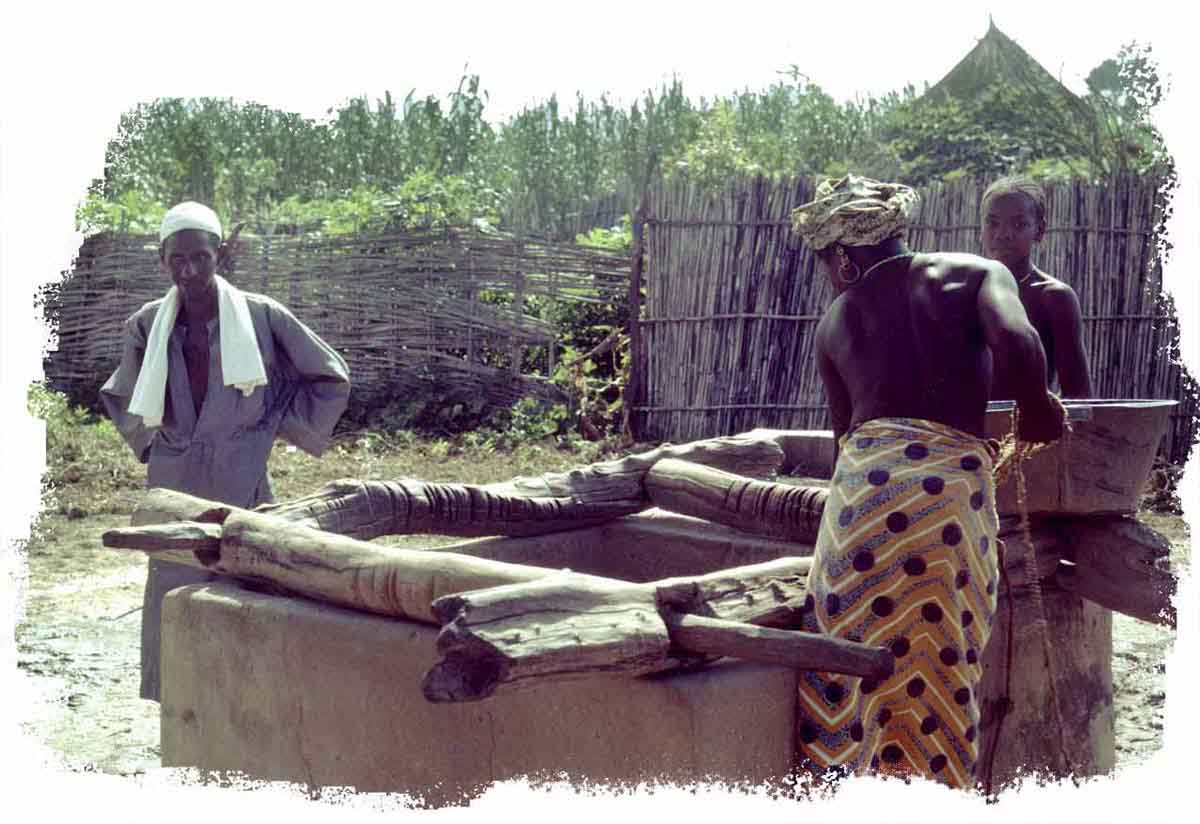
The UN well in front of our compound was a popular watering hole for all of Mansajang. Although the village proper did have a water spigot, it often didn’t work and when it did, people complained of the water’s taste. All day long, women and girls came to the UN well to fill their tubs and pails of water, carrying the heavy loads on their heads as they returned to their compounds.

Because washing clothes has such a high demand for water, many women washed clothes right there at the well, then carried their clean wet clothes home to hang on their compound fencing. They used the local soap, OMA, made from peanut by-products. My husband Bruce became concerned about soap residue filtering through the soil into the well water.

He made a circle of rocks around the well a safe distance away and asked the women to wash clothes outside the circle and explained that this would keep the well water clean. It made more work for them, having to haul their heavy tubs farther from the water source, but they obliged him when he was there, and promptly went back to their former habits when he wasn’t. Bruce patiently reminded them with good natured banter. The problem, of course, was that the women didn’t understand they were jeopardizing their own water supply.

One evening a man from Mansajang called on us and asked Bruce to talk to the village about safe water. Probably, this particular man was sent because he could speak English. Apparently the village elders had gotten wind of a problem with the well and wanted everyone to understand. Delighted, Bruce accepted his invitation.

“What time should we be there?” I asked.

Surprised with the question, the fellow answered, “After evening prayers. You’ll hear the drum.” Gambians had a different sense of time than we did. Watches or even clocks were rare. Activities centered around Muslim call of prayers five times a day. When it was time, people, mostly men, stopped what they were doing, brought out their prayer mats, faced Mecca to the east, and prayed.

A word about the drums. Three basic types of drums are common in The Gambia: the rhythm drum, used for dancing; the ceremonial drum, used for more serious things such as funerals or other somber events; and the talking drum. The talking drum has a sort of “boink, boink” sound to it with varying pitches. People understand the talking drum, as they understand their language, whether it be Mandinka, Wolof, or any of the tribal languages. The talking drums provide tremendously efficient communication, especially in areas where there are no telephones

Knowing that we would hear the drum, we agreed to be at the village meeting place.
Sure enough, we heard the drum soon after we’d finished our dinner. We walked to the center of Mansajang, perhaps a half mile away. The meeting place, a raised platform under a giant baobob tree, was devoid of people. One lone person walked by. In Mandinka, I greeted the man, then said, “Where are the people?”

“The people aren’t here.” Such a typical response. I never got used to it. The man resumed his walk.

“But we heard the drum. We are here for the meeting,” I called after him.

He turned to look at me, shook his head and tsked. “The drum said there was no meeting.”

Apparently one of the village’s important people couldn’t attend so the meeting had been postponed.

Gambians found it hard to believe that we could understand, or “hear,” Mandinka, but we couldn’t “hear” the drums. I’m sure in their eyes we were so hopeless.