
The Art of Getting a Driver’s License

Ch-1-RGB 2From: Tubob: Two Years in West Africa with the Peace Corps

Peace Corps volunteers in The Gambia were urged to get a drivers license. Most of us would never drive while in The Gambia, but you never knew. My husband Bruce and I were in Banjul, the capitol city, taking care of the many details before we went to our assigned village. We had opened a joint checking account and now I needed to get my drivers license. Early on, when we stayed in Banjul, Bruce was issued his license so he could drive project vehicles. He now had to catch a bus to the Yundum shop to take care of business, so he walked with me to the police department building where I would get my driver’s license. At the police station, we walked down dark dingy stairs and along dirt-streaked hallways.

He squeezed my arm affectionately. “Brace yourself. This is going to take awhile.” He left to catch his bus.

As it happened, no one was in front of me in line, but still I waited for a long time for someone to help me. Many people milled around behind the counter, but it was hard to tell if anything was actually getting done. One woman slept, draped over her typewriter. Finally, I was given a form to complete and I showed the man my Washington State driver’s license. He left for several minutes, then handed me my paperwork and told me to go to another room where they would attach the picture I’d brought. I did as instructed and waited again.

Back and forth I went to four different counters. At the last one, which was also the first, I stood at the window and watched the fellow “process” my paperwork. He shuffled the papers around, then looked at something else on his desk. He went over to another desk and talked with that fellow, glanced at me watching him, returned to his desk, pushed papers around some more. His desk was piled with papers and I could imagine mine getting lost. Like the shell game, I kept watching to keep track of the pea, my application. Seething at this senseless delay, I said nothing but never took my eyes off my paperwork. Finally, he stood, shuffled over to the counter and, without a word, he slid my license toward me.

Three of the five items on the license were incorrect: my date of birth, my middle initial, and the spelling of my last name. I let it go, not willing to make this an even longer exercise.
In the Immigrants’ Footsteps

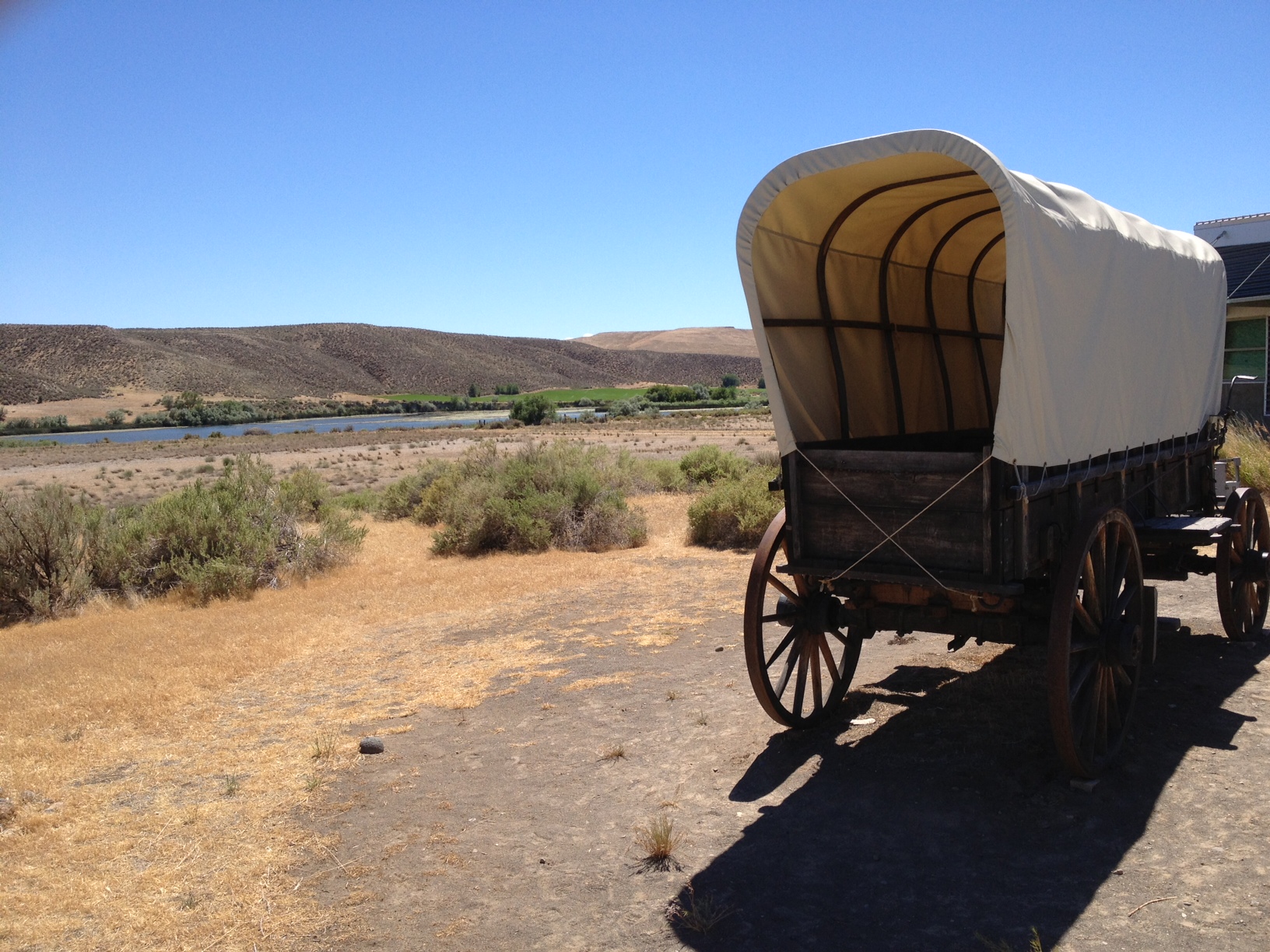
ID Covered Wagon 4


As early immigrants struggled along the Oregon Trail, they had a tough decision to make as they made their way through Idaho. Should they risk the danger of crossing the Snake River or endure the dry, rocky route along the river’s south bank?

The original course of the Oregon Trail was from Independence, Missouri to Oregon City in the Willamette Valley. Although fur trappers and explorers used the travel corridor since 1811, most pioneers traveled the trail by wagon train from 1841 through 1848. By the 1860’s the trail was used very little as an emigration route.

The Oregon Trail entered Idaho in the southeast corner of the state. At Fort Hall, it joined the Snake River, following the south bank until a crossing was reached near what is now known as Glenn’s Ferry. The route left Idaho near Fort Boise after winding through 500 miles of the state.

Crossing the Snake was always dangerous, but when the water was low enough to negotiate, everyone who could took advantage of the more favorable northern route to Fort Boise. Those who crossed the river found more potable water and better feed for their stock. But during high water, most immigrants were forced to travel along the South Alternate route into Oregon, a difficult dusty trail that took its toll on man and beast.

About half of the immigrants chose to attempt the crossing by using the gravel bars that extended across the river. Not all were successful and many casualties were recorded in pioneer diaries. Many diaries also recounted how the Shoshone and Piutte Indians helped the immigrants cross the river, claiming they would have never made it without their help.

The Three Island Ford was used by pioneer travelers until 1869, when Gus Glenn constructed a ferry about two miles upstream.

Three Island Crossing State Park is located on the Snake River, just four miles off I-84, 72 miles east of Boise. As weary travelers, we drove into the park in the late afternoon on a scorching hot day. Although we didn’t have a reservation, we lucked out with a lovely, shaded campsite. We breathed a sigh of relief as we settled into our green oasis. Once rested, we enjoyed hiking the trails throughout the park. One of our hikes took us to the site where Gus Glenn’s ferry entered the water. Cables and equipment are still visible and informative signs helped us to imagine immigrants, covered wagons, stock, and freight crossing the river.

A special attraction here is the Oregon Trail History and Education Center where emphasis is placed on the Euro-Americans and Native Americans working together at the Snake River crossing. Many exhibits demonstrate the hardships of the trail. Of particular interest was a packing list for the Oregon Trail and a life-sized covered wagon. The Center also features Native American life, together with a tipi and native craft work. A small theater shows an orientation film about the Three Island Crossing.

Three Island Crossing State Park was a memorable experience with comfortable surroundings and an opportunity to learn of the area’s place in Oregon Trail history.

Book Review: Where Lilacs Still Bloom

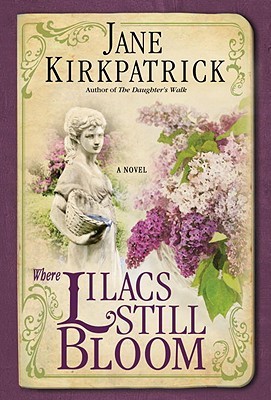
Where Lilacs


Award winning author Jane Kirkpatrick’s historical novel, Where Lilacs Still Bloom, filled my heart. It’s a compelling story of enduring love of family and God’s earthly bounties.

The story begins in 1889 in Woodland, Washington, when German immigrant and farm wife Hulda Klager seizes an idea to improve the pie apples growing in their small orchard. She’s weary of the scrawny fruit that’s hard to peel. Her experiments with apple hybridization result in a crisp, juicy apple that’s easy to peel. Her consuming interest is questioned by those who feel she’s overstepping boundaries of a simple housewife and mother. Some even assert that she’s tampering with God’s plan.

Hulda’s father encourages her to follow her God-given talents. Even though her husband Frank teases her about her “hobby,” he encourages her to pursue her growing interest, providing there’s “bread on the table and pies in the oven.” She begins to experiment with flowers, concentrating on lilacs, with a dream of growing a creamy white lilac with twelve petals. By 1905 Hulda had created 14 new varieties of lilac, using a turkey feather to cross-pollinate, always seeking to produce “bigger blooms, hardier stalks, richer color, and finer fragrance.”

Interest in Hulda’s garden grows and she begins to hold open houses, sometimes drawing hundreds of people, even from distant communities. She resists selling cuttings, preferring instead to share God’s bounty. Her four children help in the garden, and as they leave home to begin their own families, Hulda opens her home to two young girls who need a loving home and who can help in the garden. These girls’ lives, thread throughout the book, show how tender care for plants mirrors life.

Throughout Hulda’s long life she sees tragedy in the loss of loved ones, but she endures and finds comfort in her horticultural interests. Her gardens, along with their farm and their neighbors’ property, are threatened with seasonal floods and when the Columbia and Lewis Rivers overflow in 1948, the entire community is flooded. We learn the true character of this legendary woman as she deals with this calamity.

Where Lilacs Still Bloom is filled with the richness and grace found in Jane Kirkpatrick’s work. This novel is her twenty-second book and nineteenth novel. A master storyteller, Kirkpatrick researches her subjects, then brings their story to readers in a compelling, refreshingly creative way, yet always keeping true the subject’s spirit. I highly recommend this book. It would be of special interest to garden enthusiasts, but also to anyone drawn to an inspirational story of loyalty, faith, family values and God’s bounty. For more information about the author, visit www.jkbooks.com

Reviewers Note: I was especially fascinated with this book since I also live in Washington. Next spring I hope to drive to Woodland in the southwest part of the state to visit Hulda Klager Lilac Gardens. For more information, visit www.lilacgardens.com

An Object of Superstition

AlbinoFrom: Tubob: Two Years in West Africa with the Peace Corps

Each week, the Basse Health Centre where I worked in The Gambia conducted an antenatal (prenatal) clinic and a separate well baby clinic for children five years and younger. Sister Roberts suggested that I attend these clinics where record keeping was vital. I agreed, not knowing that I would be involved in a local superstition.

The next day, Tuesday, I helped in the antenatal clinic. The clinic, a separate building in the hospital compound, had rows of perhaps fifty chairs on one side and a couple of tables at the other. Outside, the overflow waited in a covered area. Many of these pregnant women had come from miles away, most walking, some arriving in bush taxis. or donkey-pulled carts. Many carried babies on their backs.

Women and their children stood in line, which, at first, was a phenomenon to me. My African experience so far had been crowds of pushing people, at banks, the post office, the ferries and bus stops. But here the woman formed a queue, as instructed, and stayed in line with their well-behaved children in tow.

At one table, the auxiliary nurses reviewed the woman’s personal health record, took blood pressure, and pulled down the lower eyelid to look for pale coloration, a sign of anemia. Many Gambian women were anemic due to frequent childbearing. The woman then progressed to the next table to see the nurse mid-wife while I recorded the woman’s name and entered information in a ledger. All during this procedure, I noticed women shielding their eyes from me. Some actually cupped their hands around their eyes to avoid looking at me.

I asked the nurse mid-wife why the pregnant women wouldn’t look at me. “Oh, Mariama, it’s a stupid superstition that if they see a white person they’ll have an albino baby.”

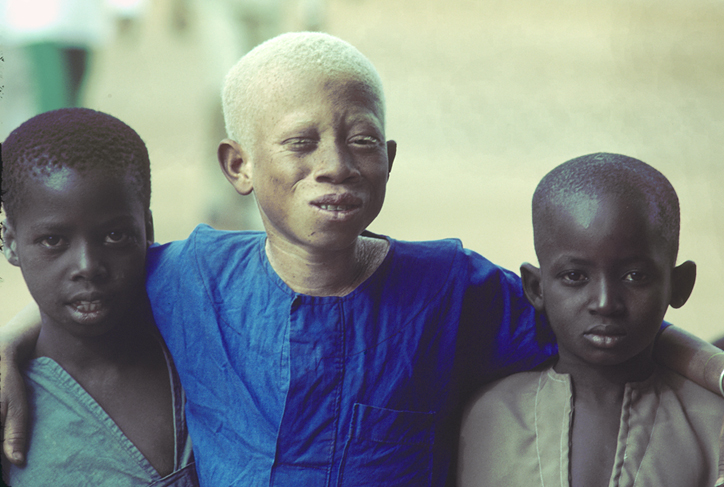
I had seen African albinos and it is an unfortunate condition. Their skin is white and very sensitive to the sun. An albino’s eyes are affected with extreme light sensitivity. Having an albino baby would be something to fear. It bothered me that the women felt threatened by my presence.

After clinic that first day, I told Sister Roberts about my concern. She also scoffed at the superstition.

“But still,” I countered, “I don’t want to give them that worry.”

We agreed that I wouldn’t attend the antenatal clinics, but she definitely wanted me to attend the well baby clinic on Fridays. It was a good compromise. I felt odd enough without having to bear the burden of having women think I would be the cause of their having an albino baby.

Book Review: The Longest Trail

The Longest Trail

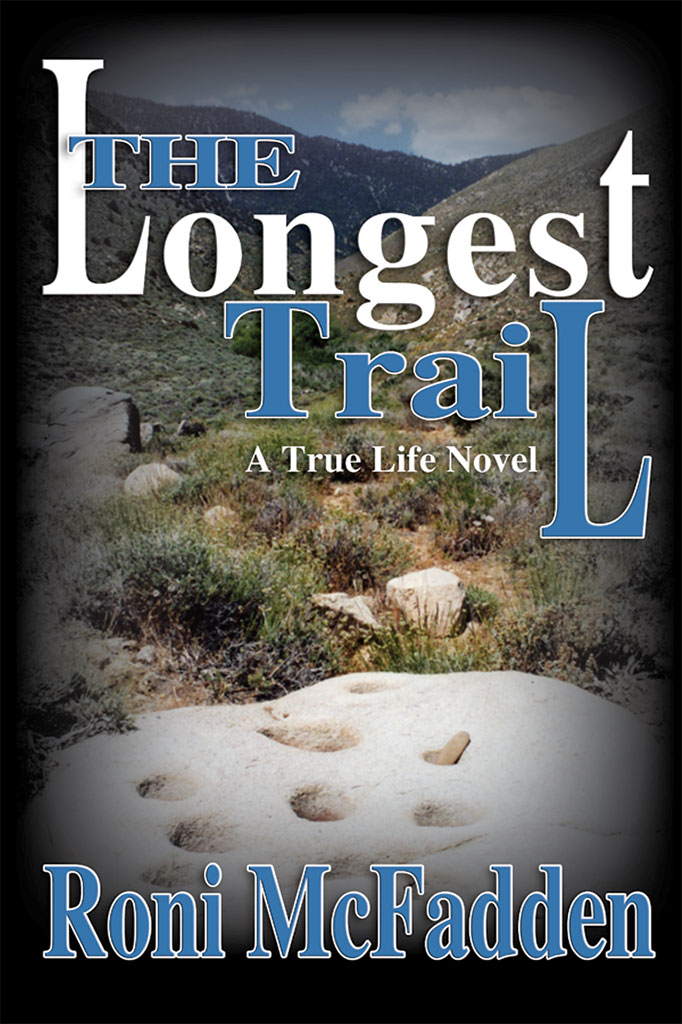
Roni McFadden has written a memorable book,The Longest Trail, a true-life novel that begins in 1963 in northern California when Roni is twelve years old. After saving her baby-sitting money for two years, she buys her first horse, Sparol, for $125,

While on horseback, Roni can forget the sexual abuse from her step-father, forget that she isn’t accepted at school, and, later, that the crowd she’s running with could get her into serious trouble with sex, drugs and free love. When astride a horse, she feels whole and at peace with herself.

Through a friend, Roni meets John Slaughter, then in his forties and married with his own children, a throw-back cowboy with a kind nature and a magical way with horses. In addition to his regular job, John takes hunters on pack trips in the High Sierra Mountains. He offers her an opportunity to help with the horses, to exercise, feed and groom them, and clean corrals. While at school, she lives for the time when she’ll be with the horses, when she’ll be at peace.

Roni proves her value and is soon a part of John’s pack operation and joins him at a pack-station, a place where they stage high-country trips. Through the years, Roni is given more responsibility. With the responsibility comes dealing with city folks who bring the noise and rush of city life to their country outings. She learns patience, self-reliance and how to deal with hardship and discomfort. She learns to appreciate the high country’s beauty and simple pleasures. Roni finds a kinship with horses that few achieve.

An important part of this intriguing story is Roni’s involvement with the by-gone spirits of native peoples. As she learns more about herself, she absorbs ancient spiritual values, wisdom that enriches the rest of her life.

The Longest Trail is the story of an angry, confused girl becoming a woman of strength and character. It’s a fascinating journey, sometimes rough, sometimes awesomely beautiful, always entertaining. I highly recommend this coming-of-age book–it’s an unforgettable story. To learn more about the author, visit www.thebiscuitpress.com


Egg: The Perfect Protein

Chicken CookingFrom: Tubob: Two Years in West Africa with the Peace Corps

We needed chickens to supplement our protein. I had seen live chickens for sale at the market, but when I talked to Binta, the woman in our compound, I learned these chickens were past laying eggs and sold for meat. She apparently told her husband Mosalif that we wanted chickens.

The next morning when Mosalif came to our door to greet us, he asked if we wanted him to buy chickens. Work that day would take him into the bush and he could buy young hens for us. I asked how much money he needed and gave him money enough to buy four.

Unfortunately, Bruce needed to meet with the UN project lead in Yundum and would be gone for two days. But knowing that we would be getting chickens, he had fixed up the other outside passageway of our hut as a chicken coop. Africans didn’t coop up their chickens since they didn’t eat eggs and had no need to gather them. Besides, they reasoned, why eat an egg when, left alone, it would grow into a whole chicken. Binta’s chickens roosted wherever they found a safe place, often in one of the empty compound huts or on a tree branch. Since we didn’t care to have an egg hunt every day, we needed to confine our chickens for at least the night and part of the day.

Bruce cobbled together a gate to keep them in. We found straw for them to make their nests. To begin with, we could feed them rice that had already turned buggy. While downriver Bruce planned to buy real chicken food, a by-product from peanuts. We began grinding up egg shells to mix with their food so that the extra calcium would ensure stronger shells.

At the end of the day, Mosalif stopped by with four young chickens, two of which he said would give us eggs right away, the other two would produce soon. I was thrilled.
Only having had dogs and cats, I worried that the chickens would run off, maybe join Binta’s brood. To make sure they knew where they lived, I tied strings to one leg of each of the four chickens, long enough for them to get to a nest, drink water and eat rice. My intention was to only do this for one day, until they were used to their surroundings.

On that first day Mosalif came over in the early evening to see how I was doing with the chickens. When he saw the strings, he knelt down to get a closer look. Mosalif was Fula and since I didn’t know that language, he and I conversed only in Mandinka. “A mong beteata.” This is not good, he said, watching the chickens trying to walk around, lifting the tied leg high, giving them a strange gate.

“I am afraid they’ll run away.”

He looked somber, but in thinking about it afterwards, I’m sure it was all he could do to keep a straight face. “You have fed them, Mariama. They won’t run away.” He carefully removed the strings. “When it is dark, they will come back to this place. Then you close the gate.”

Well, I wasn’t at all sure about that, but I’d give it a try. Sure enough, at dusk they all filed into the chicken coop as though they’d done it all their lives. I closed the gate behind them.

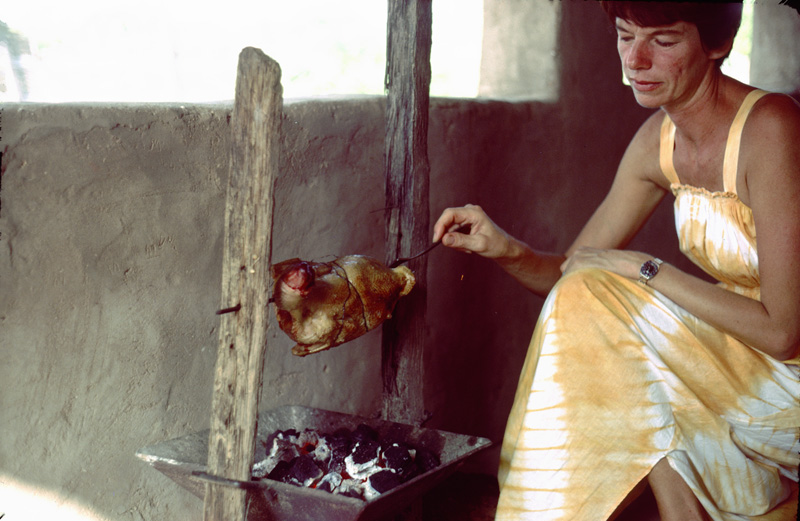
During our stay in The Gambia, we derived great pleasure, entertainment and nourishment from our chickens. We were the only volunteers in-country with chickens and I marveled at that. Once a week we enjoyed an egg dinner, usually an omelette, and eggs for breakfast once or twice a week, plus I used eggs in puddings and other desserts. I found I could make a double boiler by inserting my covered enamel bowl into my large pot filled with water and prepare a very good cheese souffle or a delicious bread pudding, both dishes using four eggs.

Even though there were plenty of nests, two or three chickens often crammed into one nest, African style, like people on bus seats. Our flock grew, some we bought, many were given to us. At the most we had seventeen chickens.

We named our chickens, names that seemed to fit their little personalities: Ruth Schultz, Blue, Kunta Kinte, Myrtle and Penny, who was the color of a copper penny, and two that we called Sisters because we got them at the same time and couldn’t tell them apart.

Book Review: The Whistling Season

whistling

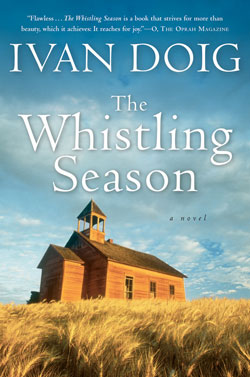
Every once in awhile a book of pure excellence comes along and, for me, Ivan Doig’s The Whistling Season has reached that level.

In 1909 change was in store for the Milliron family. The story is told in the voice of a reminiscing Montana school supervisor when he was 13 years old, The oldest of three sons, Paul is a precocious child who takes his responsibilities seriously. His father counts on him, especially since the boys’ mother died the year before.

The family manages, but the house is usually in disarray. Besides keeping up his farm at Marias Coulee, Montana, the father works as a drayman for a diversion canal under construction, and is president of the local school board. Housework and cooking naturally aren’t at the top of chores that manage to get done. When the father sees a housekeeper’s work wanted ad in the newspaper, the family’s interest is piqued. It is puzzling though when they learn through the ad that the housekeeper, though well qualified, does not cook. Can’t all women cook?

When the new housekeeper Rose and her brother Morrie crash into the Millirons’ lives, immediate change transforms the household. Through a death, serious accident, a vengeful family and a puzzling mystery, every member of the family responds for the good of the whole. These are tough folks, people who must take life as it’s served to them. How they measure up to the challenges shows the caliber of grit it takes to survive the dryland Montana prairie.

The entire book takes place primarily between the Milliron’s modest farmhouse and the one-room schoolhouse that serves grades one through eight.

The Whistling Season unfolds with the flawless assurance of an acclaimed storyteller. The landscape and characters are vivid, as is the emotional depth of the novel. It’s a story guaranteed to pop into readers’ minds with gentle reminders of the book’s every-day situations. The Whistling Season is a masterpiece.

A Precious Gift

Women Dressed up

From: Tubob: Two Years in West Africa with the Peace Corps

One late afternoon, I sat in my hut reading and heard my name sung out. I stepped outside and opened the gate. A woman I had counseled about good nutrition for her baby smiled at me. She reminded me that her name was Sibo and that I had visited her at her compound. Sibo carried a basin on her head containing a parcel wrapped in cloth.

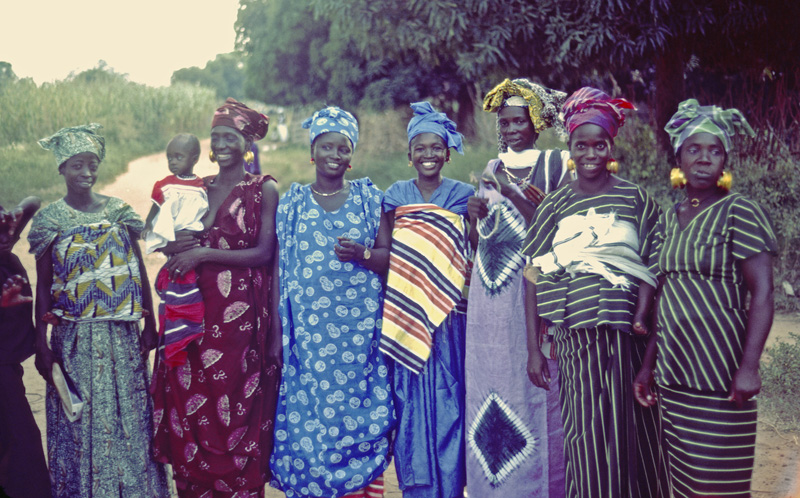
When women went to market, or made a formal visit to one another, they dressed up for the occasion. In this case, Sibo wore a nice top with a matching wrap-around skirt, and matching head scarf. I found their clothes attractive. Most tubobs I knew couldn’t manage a wrap-around skirt, we just couldn’t keep it secure without buttons, zippers or pins.

I invited Sibo into our house. As she lowered her load to the table, I offered her water, which she accepted. She had walked a distance. Her village was well beyond the Health Centre.

After taking a swallow of water, she opened the cloth to reveal perhaps five pounds of rice. Her family had grown and harvested the rice, she said, and it was a gift to me for caring. I was stunned. This was a gift of sacrifice, representing back-breaking work. Not only was the gift wonderful, but she’d walked miles in the hot sun to deliver it. I barely had the Mandinka vocabulary to express my appreciation. “Abaraka,” I said, with my hand over my heart. Thank you from the bottom of my heart. Repeated several times, it was about the best I could manage. I brought out my enamel bowl and she poured the rice from her cloth into the bowl, not spilling a kernel.

We chatted for awhile, she looked at our wall hangings, snapshots of our family, a U.S. map and a world map. I showed her our home state, then showed her where she lived. She obviously had never seen a map before. I invited her to see my kitchen and she marveled. By American standards it would be primitive, but to her it was luxury. She surprised me by saying my kitchen was good because I didn’t have time to prepare food the way they do, over an open fire.

I heard a motorcycle putter up to our compound, idle while the driver opened the gate, then a quiet rumble as he rode the motorcycle to our door. Many volunteers who lived in outlying areas were issued small motorcycles, some more like motor scooters. The rule was they were to use them only within a fifty mile radius. Dave lived in Fatoto at the eastern tip of the country and often stopped by when in our area. After I introduced them, he launched comfortably into Mandinka with Sibo.

After a short while, Sibo said she must return to her home to prepare dinner for her family. Dave offered to give her a ride on his motorcycle, but she declined, laughing. When I said, “Sibo, why don’t you? It would be so much faster,” she hesitated. Dave turned his motorcycle around and said, “Na.” Come. Much to our amazement, she hiked up her skirt to climb on, covering her legs as best she could. Dave indicated that she had to hang onto him. She stood her basin on end between them, then hung on and they took off at a sedate speed. She grinned back at me. What a sight.

Gambian rice has a rich, nutty flavor and takes a bit longer to cook than our processed rice. We ate it soon because it had limited shelf life. I didn’t want this precious gift to become chicken feed.

**Note: To leave a comment, please click on “Reply” below

Book Review: Home Fires

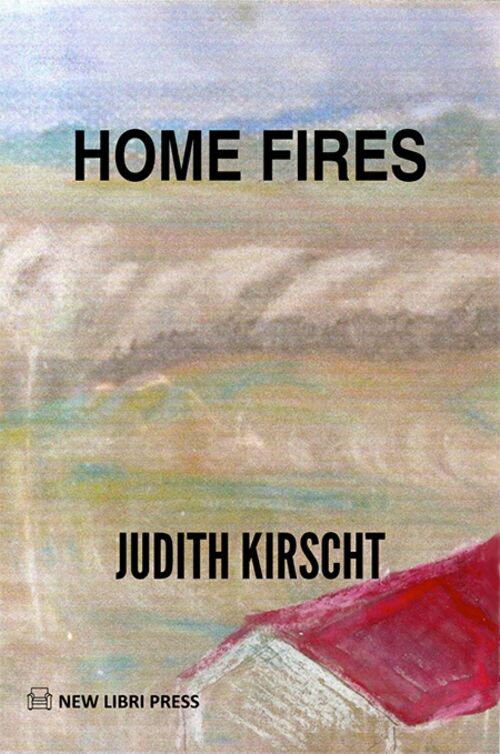
Home FiresJudith Kirscht’s Home Fires is a noteworthy and timely novel dealing with a family gone awry.

Myra and Derek Benning and their teenage children, Peter and Susan, appear to live a privileged life. Susan has a few social issues, but there’s love and strong bonds between the parents and children, and they’re a happy family. Myra feels blessed to have a handsome, successful husband and thankful for their enduring love. A phone call shatters her serenity and plunges the marriage into chaos.

Guilt, anger, and surmounting worry consume Myra. But then, an even more serious situation surfaces with daughter Susan and immediate action must be taken. Myra does what she must do, but at a price that affects every member of the family.

The story takes place on the Santa Barbara, CA coast and the author beautifully sets the various scenes, making the reader feel as though she breathes the salty air while walking along the beach, strolls quaint streets of the water-front town, or skims along waves while sailing the Santa Barbara Channel.

Although the subject matter is serious, Home Fires is an enjoyable read. Kirscht handles the subject of a complicated dysfunctional family with finesse. The various facets of the story are believable with realistic dialog and situations. Home Fires is an excellent novel, one I enjoyed immensely. Even when I wasn’t reading it, the story was on my mind, trying to second-guess the outcome.

Home Fires is currently available in ebook format, but soon also will be available in paperback. For more information about Judith Kirscht, visit www.JudithKirscht.com

**Note: To leave a comment, please click on “Leave a Reply” below.

Book Review: Think Like Your Dog

ThinkLikeYourDogDogs are not our whole life, but they make our lives whole.
Roger Caras, as quoted in Think Like Your         Dog: and Enjoy the Rewards

Dianna M. Young (with Robert H. Mottram) has shown with undeniable expertise the value of communicating with your dog in a language canines understand. In Think Like Your Dog: and Enjoy the Rewards, Young gives readers the step by step process necessary to have a canine companion to bond with in a rewarding relationship.

The most important lesson to be learned is that in every human and dog team, there is one leader and one follower. In a dog’s eyes, there is no in-between. Young clearly reiterates this principle throughout the book and gives understandable examples of how it can be achieved.

Think Like Your Dog discusses the important steps to take when your pup is first brought home, which ideally is not before eight weeks of age. Those first eight weeks with the pup’s mother assure that the puppy will get a strong foundation in tems of behavioral characteristics it will possess for the rest of its life. The next eight weeks with the new owner are critical in providing socialization skills, exposing him to people, kids, trains, buses, other dogs, noisy places, crowded places. Further, the pup should go through these experiences on his own four feet, not to be scooped up in the protective arms of his owner.

Each chapter in this valuable book discusses how a dog views the various elements of his life. The reader learns how a dog thinks through our verbal and body language, the senses and how all that relates to his comprehension. She discusses the various breeds and how they may differ when it comes to choosing a family pet. She talks about getting a dog as a puppy, or a mature dog and, in either case, how to proceed with meaningful training.

It’s important to have the proper dog equipment and in the book various types are illustrated and explained. Methods of training are outlined, with emphasis on positive reinforcement. The importance of a structured environment, patience and compassion are directly related to a successful dog and handler relationship.

Our chocolate lab Toby is 10 years old, yet I learned techniques in this book that we can use to enhance our family’s relationship with him. Not only that, I’ve learned the mistakes we’ve made, primarily relating to getting him too young, at five weeks, before he had that essential time with his mother.

Think Like Your Dog: and Enjoy the Rewards makes an ideal all-in-one reference book. It’s an enjoyable read with interesting stories and photos emphasizing the various principles Young teaches. For more information about the author and her training and boarding facility on Camano Island, visit: www.HowtoThinkLikeYourDog.com