Book Review: Free Spirit

Free SpiritJoshua Safran’s Free Spirit: Growing up on the Road and off the Grid is a haunting, beautifully written memoir about his appalling childhood. Although the subject matter is grim, the book is never-the-less poignant and often wryly funny.

Joshua’s early memories take place in the l970s San Francisco. His mother Claudia, steeped in hippie/revolutionary activism, searches for what she believes to be utopia. She leaves San Francisco in search of the perfect “intentional community,” a promised land free of nuclear war.

Joshua and his mother embark on a series of wild on-the-road adventures. There is no doubt Claudia loves her son, but many of her actions show a gross lack of common sense. In one instance, mother and son travel for days–mostly hitchhiking–to a Rainbow Gathering. She doesn’t think to bring a tent, or even food. Joshua is left on his own for days while his mother takes up with a just-met lover. Rain-soaked and miserable, the six-year-old pilfers a blanket and, on his own, finds food and shelter. Drugs and alcohol are plentiful; real food scarce.

Through the years Claudia travels with different men, but Joshua, even as a young child, can see no idealistic future with any of them. Claudia is unbelievably naive, always making excuses for her current lover’s failings. Through all their travels, she teaches her son a love of books and he learns to read at an early age.

They try a variety of living situations–communes, make-shift homes, a teepee, buses, a trailer, an abandoned ice-cream truck, and on Camano Island, Washington, a lean-to built on a stump. In the meantime Claudia has married an abusive Salvadorian guerrilla. Joshua struggles with his step-father’s alcohol-fueled abuse to both his mother and to him, or alternatively listens to their noisy love-making in their tiny water-logged shack. Joshua is eager to go to school, but he has huge obstacles to overcome to even get ready. They have no running water, no electricity, not even a decent outhouse. Joshua doesn’t own a comb, toothbrush, or a mirror. His clothes are patched and dirty. Kids bully him and tease him about his unkempt appearance. Still, he loves school, loves to learn and especially loves being warm. Eventually they move to Stanwood, just across the bridge from Camano Island, and he takes solace in the Stanwood library, relishing in the many books, being able to use the bathroom to wash himself with warm running water, and as a refuge from his abusive step-father.

Free Spirit is, in the end, a story of triumph. The language is rough and the situations harrowing, but it is an honest, stark but eloquently-told coming-of-age story. At the end of the book the author sums up his adult life. What he has accomplished is impressive.

To learn more about the author, visit http://www.jsafran.com/
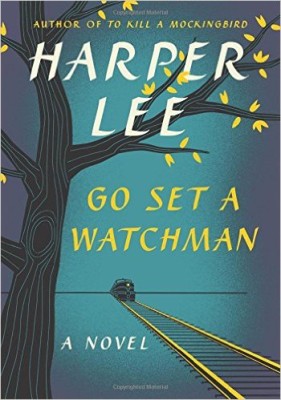
 

Book Review: Go Set a Watchman

go-set-a-watchman-281x400Go Set a Watchman, the book itself, has an interesting history. When Harper Lee presented her first novel to a literary agent in the 1960’s, the author was persuaded to rewrite it from the main character, the child Jean Louise Finch’s, point of view. To Kill a Mockingbird was the result, a book that became one of the most widely read books dealing with race in America. Now, 55 years later, the “original” book has been released.

Go Set a Watchman begins with Jean Louise Finch, now 26, returning home to the small town of Maycomb, Alabama, from New York City, where she has lived and worked for the past few years. She plans to spend three weeks visiting her father, 72 year-old Atticus Finch a beloved attorney who, despite suffering the crippling effects of rheumatoid arthritis, still practices law. Although the novel doesn’t specify the date, it is presumably in the mid-to-late 1950’s, because the Supreme Court has passed the school desegregation law, a 1954 law that has incensed most Southerners.

Having lived in New York, Jean Louise is seeing Maycomb County in a different light. In New York she has worked and lived near people of color, but in Maycomb she’s taken aback by what she sees as gross inequality. Worse, she sees her father, whom she has always worshiped, in a different, unfavorable light.

Go Set a Watchman is an important book for our times. Harper Lee doesn’t gloss over racial attitudes. She looks at the whole person, strengths and flaws together. While To Kill a Mockingbird is considered a coming-of-age novel, Go Set a Watchman is a coming-of-age novel for an adult, a work of wisdom, humanity and passion, a book evocative of another time, but relevant today. It isn’t necessarily a fun or easy read, but it’s a book that made me think. I highly recommend Go Set a Watchman.

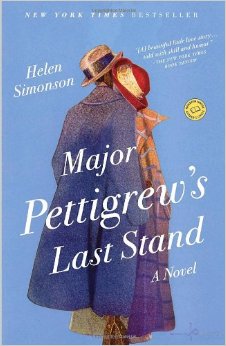
Book Review: Major Pettigrew’s Last Stand

Major Pettigrew

Helen Simonson’s debut novel, Major Pettigrew’s Last Stand, is a delightful, charming story centered around Major Ernest Pettigrew (retired).

In the small English countryside village of Edgecombe St. Mary, Major Pettigrew, a widower, is attracted to a lovely widow, Pakistani shopkeeper, Mrs. Jasmina Ali. Although Mrs. Ali was born in Great Britain and, in fact, has never been to Pakistan, she follows many of the traditions of her culture.

The Major and Mrs. Ali are drawn together by their love of literature and loneliness resulting from the loss of their spouses, but soon find themselves caught up in stronger feelings than mere friendship and a good pot of tea.

When they attend a country club program that spirals out of control, they find their relationship threatened. The village considers the Major a pillar of their community, while regarding Mrs. Ali as a foreigner.

The author, Helen Simonson, was born in England and raised in a small village. The English humor and way of expression is part of the enchantment of this novel. At one point the Major finds himself in a stressful situation. “He calmed his voice to a tone suitable for placating large dogs or small, angry children.” Great emphasis is placed on tradition, the importance of one’s family, and appearances. The threat of change can be one’s undoing, or can it be a good thing?

Major Pettigrew’s Last Stand is a fun read, but it also has its moments of truth, issues most of us face in our modern world. I loved spending time in the English mindset, particularly of an older man happily set in his ways. And I particularly appreciated Major Pettigrew’s wit. To learn more about the author, visit http://www.helensimonson.com/

Book Review: Arctic Dreams

Arctic DreamsArctic Dreams by Barry Lopez is a compelling masterpiece about the Arctic, the mysterious land of stunted forests, frozen seas, and animals perfectly suited to the harsh far north.

The book offers exquisite descriptions of the biology, anthropology, and history of a land few of us will ever see. The arctic’s harshness has carved a way of life unknown to all but a few. Through the centuries, various countries have sent men to explore this mysterious land, and more often than not, the explorers did not live to tell about it.

Arctic Dreams is not a book you rush through. Nor does the author hurry through his descriptions of the animals, plants, sea life, or the frozen sea itself that is both the giver and taker of life.

Lopez’s keen observation of life is amazing in its scope. He is an uncompromising defender of the wild country and its native inhabitants, and shares minute details of the far north. He lingers with his description of the polar bear, its habits, its ability to not only survive but thrive in this cold country. He shares his fascination of the narwhal with its ivory tusk spiraling out of its forehead. This “unicorn of the sea” lives year round in the Arctic waters of Greenland, Canada and Russia. Many animals, birds and sea life are discussed in great detail: how they survive, how they relate to each other as sources of food, and how they serve the native people.

The author speaks highly of the Eskimos and normally uses that broader term for the native Arctic people throughout the book. Eskimos today more often speak of themselves in terms or their origin, such as “Inuit” that refers specifically to Eskimos of the eastern Canadian Arctic. Lopez has high regard for the Eskimos’ skill of survival, of observation, and adaptation to the harsh environment.

Memorable moments in the book stay with me. In describing a particular scene at Melville Bay, Lopez states, “It was so beautiful it made you cry,” but in the next breath, while looking at an iceberg, he says, “It was so beautiful it made you afraid.”

Lopez’ Arctic is a land of contradictions and mystery, of rare, raw beauty. Through Barry Lopez’s precise and thorough descriptions, I experienced a sense of this frozen landscape and could see, through his observant eyes, the beauty of this wild place.

If you’re a lover of nature and value detailed descriptions, you will appreciate Arctic Dreams. It’s a scholarly and engaging Arctic experience. To learn more about the author, visit http://www.barrylopez.com/

Book Review: Sacred Hearts

Sacred HeaartsI was riveted to this book. Having read Sarah Dunant’s The Birth of Venus, I hoped this last novel of the trilogy would be as good. I wasn’t disappointed. Sacred Hearts is a powerful account of convent life in the northern Italian city of Ferrara.

In the late sixteenth century, the price of wedding doweries was so exorbitant that most noble families could afford to marry off only one daughter. The remaining women were dispatched to convents, with doweries to be sure, but much less than for a wedding. Many of these women went against their will. Some adjusted to the rigors of convent life, others chafed at the idea of spending their lives cloistered in a strict environment, following rigid rules, sometimes at the whims and dictates of the outside world.

When sixteen-year-old Serefina is forced into the Santa Caterina convent, ripped from her family and the man she loves, she is consumed with rage. She’s a talented young woman, bright and gifted with a thrilling singing voice, but she is determined to never surrender to what she believes to be a place of horrors.

Sister Zuana, the convent’s dispensary mistress and the daughter of a doctor, is sent to sedate the ranting young newcomer. Remembering her early years at Santa Caterina, the older nun becomes a mentor. What follows–the intricate relationship of trust and betrayal–is the story of Sacred Hearts. The Abbess, Madonna Chiara, who commands the convent’s total and unquestioning obedience, plays an important role in the intrigue and complications of life in a shuttered world.

Durant describes convent life in such realistic detail that the reader can feel the chilly dampness of the stone walls and floors, the bone-weariness of 2:00 a.m .prayers, the discipline of imposed fasting, silence, and humiliation. But one also feels the pure acceptance of Christ, the joys of serving, and of being able to exercise one’s talents to benefit sisters of the convent to the glory of God.

Sacred Hearts is an absorbing, meticulously researched novel of historical fiction. Durant gives life to the Renaissance period, particularly of its brutal affect on women.

I highly recommend this book and plan to read the second of the trilogy, In the Company of the Courtesan.

Harmattan!


Image © 1968 Sydney Oats, used under CC by 2.0 license

Image © 1968 Sydney Oats, used under CC by 2.0 license


From:  Tubob: Two Years in West Africa with the Peace Corps


One day while living and working in the west African country of The Gambia with the Peace Corps, my husband Bruce and I looked to the east and saw a solid wall of sand coming our way. Fierce winds carried sand and dust with amazing force. The wind was so great, Bruce hung onto a corner of our roof, afraid that it would blow off. I hung on to Bruce. We closed our eyes to the stinging wind and bowed our heads to shield our eyes. When it was over we found sand everywhere, in every crevice, nook and corner.

A harmattan? We’d heard of the harmattan, a strong wind that blows from the Sahara Desert during the dry season. This must have been it.

A couple of weeks later we received a note from George Scharffenburger, The Gambia’s Peace Corps Director. He was bringing his guest, Terry, who was in charge of The Gambia desk at Peace Corps headquarters in Washington, D.C. to visit us. Terry was interested in seeing how Peace Corps volunteers lived and worked in their host country.

We lived in what was known as the “U.N. compound.” Our living conditions were quite adequate, considering some Peace Corps accommodations. And compared to our African neighbors, our kitchen was luxurious. In The Gambia, most villagers where we lived “up river” in the village of Mansajang, cooked on an open fire, with a large pot balanced on three rocks.

We considered our living situation very special with a 3-room mud-brick 30 x 10-foot house, and a round thatched-roof one-room mud-brick hut, about 20 feet in diameter, that we used for a bedroom. The 3-room house contained a kitchen, a small sitting room where we ate, and a small bedroom. The bedroom was for the convenience of U.N. visiting guests, such as the Frenchman responsible for keeping the many fresh-water well foot-pumps in repair. Bruce worked as a Peace Corps volunteer for the United Nations well-digging unit, while I was a health worker based at the Basse Health Centre.

By American standards, our 3-room house was very crude. There was no glass in the windows, nor screens. There was a large gap between the corrugated roof and walls, and all that openness meant flying insects had easy entry. The kitchen didn’t have running water; in fact, it didn’t have a sink. We did have a small refrigerator, which was a blessing, and a small propane 3-burner stove, much like a camp stove. There were no enclosed built-in cupboards, but we fashioned a set of shelves for our food supplies. Our pots and pans, dishes and silverware were arranged on a table, which also served as my work space to prepare meals.

Our shared latrine, merely a hole in the ground, was in a corner of the compound with a thatched fence around it for privacy.

An African family also lived in the compound, plus there were two empty huts, placed there for the convenience of traveling U.N. drivers transporting supplies back and forth 250 miles to the capital city, Banjul. The African family of 4 lived in a round hut exactly like the one we used as our bedroom.

George and Terry arrived bearing mail for us from our family. There was no individual mail service where we lived, but it was the custom for people coming from the capital city to bring mail with them. We showed them around; Terry was obviously impressed and mentioned that we had a nice arrangement. Up-river where we lived in “the bush” was noticeably hotter than down-river where they had the benefit of ocean breezes.

Terry soon wanted to take a shower. She was a bit taken aback, when I showed her our “shower,” which amounted to a wooden platform with two full buckets of water. Terry had never taken a bucket bath, but she was game. Actually, I think she thought it quaint. When finished, I noticed she didn’t go to the well to refill the buckets for the next person, as she had found them. The well we used served the entire village of Mansajang.

I served dinner, we had a nice visit, then turned in for the night. The “guest” bedroom had two single cots. During the night we had another harmattan. There’s really nothing we could do to protect ourselves or our guests. With all the openings in the small house and nothing but screens in the hut, we just hunkered down to wait it out. This was Terry’s first experience with a harmattan. The next morning she woke up covered with fine sand in her hair, her ears, her bedding, even in her opened suitcase. With resignation, I began washing all the pots, pans, dishes and silverware which lay exposed on the table so that I could begin to prepare our breakfast. But first, I had to dump water out of the kitchen pail, since it was filthy with sand and dirt, and fetch fresh water from the well. Things move slowly in Africa.

Terry obviously no longer felt our living situation quaint. I don’t know that she saw the humor in my statement, “Now you know how a sugar cookie feels.” George and Terry’s enthusiasm for our living conditions vanished. They couldn’t leave fast enough. For us it was business as usual.


Book Review: Life in a Whirlwind of Numbers: 26 Years of OCD

Life in a WhirlwindIn Life in a Whirlwind of Numbers: 26 Years of OCD, David William Dahlberg shares his painful and often overwhelming life with OCD (Obsessive-Compulsive Disorder).. What made David’s condition even more tragic is that his condition went undiagnosed until well into his adulthood.

Triggered by a distressing event in his early teens, Dahlberg is tormented by consuming images and frightening scenes that won’t go away. He develops ritual behavior that he repeats over and over again to expel the tormenting images. Math was an easy subject for Dahlberg, but numbers both triggered his phobias and played into temporarily abating them by numerically ritualizing common actions. With a complicated system of calculations, he determined which numbers, or combination of numbers, were “good” and which were “bad.” Even going to bed would sometimes take a half hour or more, taking his feet off the floor a prescribed number of times, coinciding with the clock.

His condition began affecting his school work. He was a bright, musically talented boy, but, left on his own it would take an uncommonly long time to complete his lessons, obsessing over a phrase and repeatedly writing it. Often socially withdrawn, he would infuriate teachers and other students with inappropriate comments. Studying by himself seemed impossible; he couldn’t stay focused on the task at hand. Although he could concentrate on music while in band or orchestra, when alone he found himself repeating the same passage over and over again, obsessed with doing it the “correct” number of times.

It became clear, especially in later years looking back, that when he was in a classroom or otherwise around people he could hide his irrational fears, or at least he wouldn’t act on them when he could be observed. But when alone his time and energy were spent trying to dispel the persistent images.

Throughout his school and college years, Dahlberg struggled with OCD, while all this time his condition went undiagnosed. He had never even heard the term Obsessive-Compulsive Disorder. In addition to having to make his rituals in certain numeric order, for years he suffered from sleep deprivation. He was married a number of years before a crisis occurred in which he sought professional help. It was then that he learned his condition had a name: OCD.

Life in a Whirlwind of Numbers is a well-told story about the all-consuming, debilitating affects of OCD. I admire the author’s honesty and courage in discussing his often painful and tormented life. He leaves the reader with hope that diagnosis and treatment are available, as are medications to bring relief. I recommend this enlightening book to anyone interested in learning more about obsessions, and especially to those who suffer from the affects of this condition.

Book Review: The Interestings

Meg Wolitzer’s engrossing novel, The Interestings, brings the reader into the lives of six The Interestingsteenagers who meet at a summer camp for the arts, form a strong bond, and call themselves “The Interestings.” Some of the teens come from wealthy families, some are there on scholarship. To them it makes no difference: they form life-long friendships that will endure through decades. That is, most of them. Some will follow different, even dangerous paths.

Most of the novel is seen through the eyes of Jules Jacobson, who comes to the summer camp with aspirations to become a comic actress. Beautiful and gracious Ash, Jules’ best friend and hopeful playwright, and Ethan, a gifted animator, eventually marry and become extraordinarily wealthy. We follow the six teens into adulthood as they pursue their diversified lives.

The book takes place almost exclusively in New York beginning in 1974, the year President Nixon resigns, and sweeps through to the characters’ fifties. Wolitzer’s skill in following these six characters—male and female, young and old, gay and straight, rich and of ordinary means, depressed and vital—is never confusing, and is always thoughtful and perceptive. Even though there are flashbacks, I always knew where in the story I was. The author articulates the thoughts of the various characters with feeling and humor, consistent with their age. She also brings us along with the times: the early days of diagnosed HIV-positive, cordless phones, the Moonies, Women’s Lib, the Internet.

The Interestings is an ambitious human study and is immensely entertaining. The paperback version I read has 538 highly absorbing pages. I found myself fully engrossed with the characters, place, and time.

Meg Wolitzer is an accomplish writer and teacher. To learn more about her work, visit http://www.megwolitzer.com/

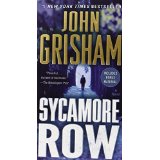
Book Review: Sycamore Row by John Grisham

Sycamore RowOn a Sunday morning after church, Seth Hubbard, a wealthy man dying of cancer, hangs himself from a sycamore tree. Just before his final act, he hand-writes a new will, one that replaces his previously filed will that named his adult children his primary beneficiaries..

On Monday, when Clanton, Mississippi attorney Jake Brigance receives a letter from Seth Hubbard and the hand-written will, he’s astonished. The will reads that Seth Hubbard has left 90 percent of his vast holdings to his black maid, Lettie. The attorney doesn’t know Mr. Hubbard nor Lettie, but he feels obligated to handle this case judiciously.

The estate is estimated to be $24 million, mostly in cash assets. When Hubbard’s daughter and her husband and Hubbard’s divorced son learn of their father’s death, they come running, unlike their behavior when their father was alive. Of course, they’re already mentally spending their inheritance.

When the facts of the hand-written will become known, the chaos begins. Attorneys gather to contest the more recent will, salivating at the money to be earned in defense of the family.

The case goes to trial and surprising, even shocking, events are revealed. Author John Grisham, a southerner, doesn’t soft-peddle race relations in the late 1980s, when this story takes place.

Readers of Grisham’s first legal thriller, A Time to Kill, will recognize the attorney Jake Briggance and some of the characters from his world. I especially enjoyed the banter between the lawyers.

A former attorney, John Grisham practiced Mississippi law before he turned to writing. His popularity is well deserved. In reading his books, you learn about the law, but his stories aren’t steeped in legalese. Coming from the Northwest, I cringed at some of the racial insinuations. I realize they are true in the south, or were in the 1980’s, and especially further back when some of the story takes place.

Sycamore Row is a fast-paced and engrossing legal thriller, one I heartily recommend.

How Can I Help?

George MacKay IMG_1687We often ask “How can I help?” when someone we’re close to—a relative, friend or neighbor—loses someone to a death, or is burdened with caring for a convalescent or terminally ill loved one. How can we help?

We ask this with sincerity, but people burdened with caring for a loved one are often so overwhelmed they cannot concentrate on what other people could do for them. On the other hand, some of us find it difficult to ask for help. We don’t want to impose, or can’t even imagine what someone else might do to ease our burden.

Instead of asking what you can do, think about what you can do, then do it. Right now.
Here are a few ideas:

Fix a meal. This is a huge time and expense saver for the person responsible for feeding a family.

Prepare a goody bag for those waiting at the hospital. Those in all-night or all-day vigils hesitate to leave to go to a hospital cafeteria (if there is one). A selection of sandwiches, crackers and cheese, cut up vegetables, nuts, apples, bottled juices, and even a thermos of coffee is a welcome and healthful treat, and beats eating junk from a dispensing machine.

Consider a gift card. It’s expensive to have a family member in the hospital. Consider giving the caregiver a prepaid gas or parking card. It’s not only the money, but the thought that means so much to a stressed family member.

Find a helpful job. Look around and see what you can do to make a grieving family’s life easier. I once read of a neighbor wanting to help a family who had just lost a beloved relative and were preparing for a cross-country flight to attend the funeral. The neighbor took his shoe-shine kit to their house and said, “Bring me all the shoes that you’ll be taking.” He shined five pairs of shoes, filling a real need while at the same time showing his love and concern.

Maybe mowing a lawn would help, cleaning a house, or making a needed repair. Washing windows could be a blessing for someone short on time or energy.

Fill an urgent need.  A friend of mine took on the care of an adult son who was suddenly a quadriplegic after a diving accident. Her brothers stepped in to build a wheelchair ramp, redesign the bathroom and adjust doorways to accommodate a large wheelchair. This resulted in huge savings, but even more important, gave emotional support when it meant the most.

Offer to babysit or adult-sit. People can only be in one place at a time and it’s stressful to be concerned about children or an elderly parent at home while being needed at a hospital. If it’s too much for one person, organize a team who will take turns taking care of the child or person in need of attention at home.

Give a caregiver a break. Offer to stay with the patient for a few hours or overnight while the caregiver attends to her own needs, or just takes some time off. Everyone needs time to themself and this break can go a long way toward giving needed relief.

Offer transportation. Getting to a hospital or health center can be daunting to someone who doesn’t drive. Offer to drive, perhaps setting up a schedule so you can be counted on. If the frequency is too much for you, organize a team to provide transportation on a regular basis.

Give them a reason to laugh. Laughter is healing and relieves stress. Reminisce with a grieving or burdened person, recalling the good times, the funny times. Laughter also helps to bring life into perspective.

Express appreciation. Let the family know how much the patient has been admired and what good things he or she accomplished. It’s comforting to a family losing a beloved member to know how much that person meant to others. After my father’s sudden death, I delivered a promised set of tellers’ floor mats to a bank, a long-standing customer of my father’s. After the workmen unloaded the items from my car, they gathered around and told me how much they had admired my father, his steady good work, and his wonderful sense of humor, even telling me some of the funny things he had said. Of course, it brought fresh tears to my eyes, but I’ve always been grateful and touched that they shared those feelings with me.

Keep the family in your prayers and thoughts. No matter what the family’s or your religious affiliation, offer your prayers, or concerns and thoughts if that’s more appropriate. Letting someone know you’re praying for them, or thinking about them, offers moral support. Illness can be a lonely battle and it’s comforting to know others are rooting for you.

Whatever you do, be assured that you’ll be giving a grieving or anxious family a lift that will touch their hearts. Knowing that other people care helps lighten a difficult burden.