Christmas in Samoa

Pago ChristmasExcerpt from Sailing with Impunity: Adventure in the South Pacific

Christmas away from home is always a little sad. Some of our fellow yachties chose to fly home for Christmas, but we planned to remain in American Samoa where we were securely anchored for the hurricane season.

American Samoa is strongly Christian, so as Christmas approached, the Samoans definitely got into the spirit of the season with decorations and Christmas music on the radio. Apparently, separation of church and state wasn’t a high priority. Local business people, government employees and bankers were expected to take time off from work to rehearse for scheduled Christmas programs. On several occasions we went to a particular store, or even the bank, and found it closed for a few hours during this season because the workers were attending choir practice.

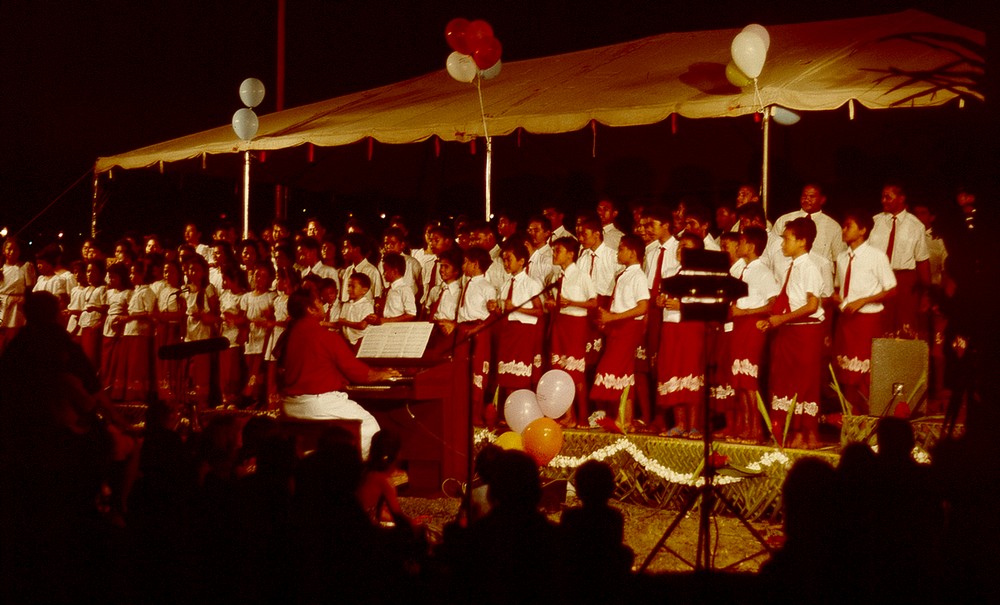
For two weeks before Christmas, wonderful outdoor concerts were held every night at a park near Pogo Pogo Harbor, with various church, school, business and government choirs. We attended a program one night and were so impressed. Four different groups sang traditional Christmas carols plus other pieces we didn’t recognize. Between choral performances, scripture was read, mostly the Christmas story from the four gospels. And the drumming! We could have listened to the drumming all night. The concert ended with Handel’s “Hallelujah Chorus” from the “Messiah.” The music resonated with me for hours afterward as we swung at anchor aboard Impunity.

Although we both felt pangs of homesickness during the Christmas season, we were glad to experience Samoa at Christmas. This experience enriched our journey and gave new meaning to community spirit.

Arrive Curious, Leave Inspired: The Bill and Melinda Gates Foundation Visitor Center

Photo by Michael Hansen

Photo by Michael Hanson


The late football coach Vince Lombardi said, “The measure of who we are is what we do with what we have.” A highly inspirational example of this is right here in Seattle, the Bill & Melinda Gates Foundation. Launched in 2000 by the Gates family, the foundation is co-chaired by Bill and Melinda Gates and Bill’s father, Bill Gates, Sr. As of November, 2014 the Gates endowment in U.S. dollars was $42.3 billion.

The Foundation is said to be the largest private foundation in the world and is driven by the interests and passions of the Gates family. Throughout the facility are thought-provoking quotes such as this from Melinda Gates: “If you can really believe that all 7 billion people on the planet are equal to you in spirit, then you will take action to make the world more equal for everyone.”

When you step into the large facility on Fifth Avenue North, you are greeted by a staff member. Visitors are free to wander at will, but we opted to be accompanied by a staff member for more detailed explanations of this complex philanthropic organization.

Each of the large rooms has unique displays that graphically describe the foundation’s goals and accomplishments. Beyond the reception area, the “Voices” room allows visitors to hear voices from around the world and to see portraits of the foundation family—employees, grantees, partners, beneficiaries, and co-chairs.

Moving on to the “Family & Foundation” section, we learned why and how the Gates family started the organization. Examples display methods used to work around the world.

In the “Partnerships” section, displays show how their partners are making progress on tough problems globally and locally. A note about the Gates Foundation’s “partners”: The Foundation doesn’t itself give money to causes, but rather donates funds to various partner organizations through grants, thus allowing far greater dimension to its recipients. On that same note, since the Foundation doesn’t solicit donations, visitors are encouraged to donate to causes that interest them.

The “Theater” features continuing short films about the large variety of projects, ranging from clips of Bill and Melinda to African scenes to agriculture projects in India to school children in the United States. Visitors come and go as they please, viewing as many clips as they desire.

Visitors are invited to solve real-world problems in the”Innovation & Inspiration” room. Computers and other tools are provided to give food for thought and promote ideas.

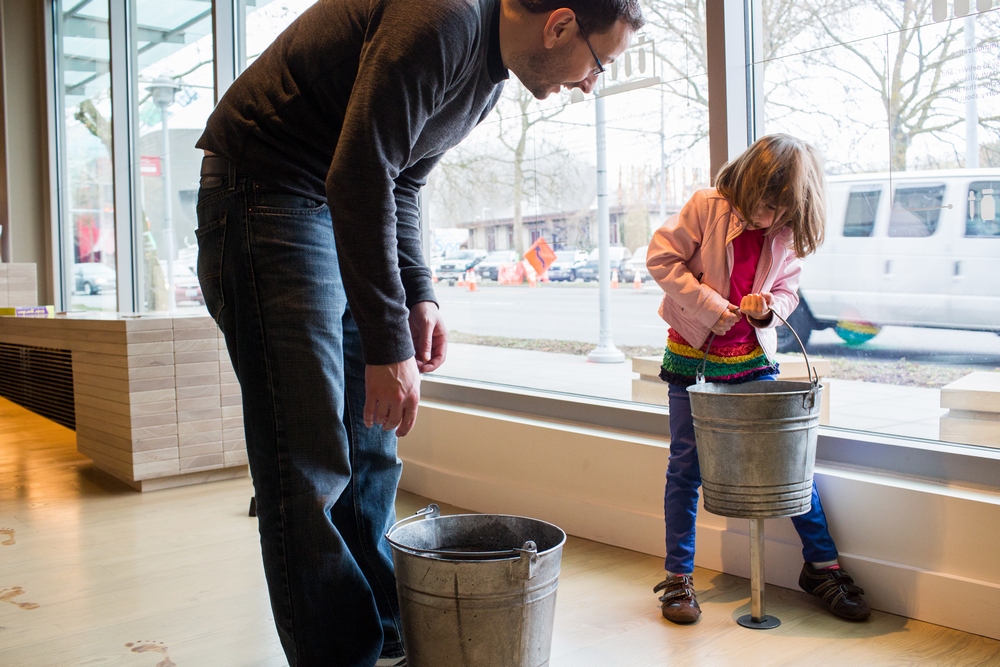
Connecting these various rooms is a long hallway with a child’s footprints imprinted on the floor. Those footprints demonstrate the distance people, most often women and children, have to carry water from the water’s source to their home, which could be a distance of three miles. Pails are loaded with the approximate weight of water. Visuals such as this drive home the desperate need many countries have for basics that we so often take for granted, such as clean water, sanitation, vaccines, and education.

The Gates Foundation works with partner organizations worldwide to tackle four program areas:

— Global Development Division works to help alleviate the poor from hunger and poverty. The partner organizations help identify and support innovative approaches to reach people’s basic needs for food, healthcare and education.

— Global Health Division helps to advance science and technology by delivering tools for basic health programs, such as vaccines, drugs and diagnostics, plus discover new solutions for on-going health needs such as clean water and sanitation.

— U.S. Program Division’s primary focus is that all students graduate from high school prepared for college. They also address issues of social inequity and poverty in Washington State, where the foundation makes its permanent home.

— Global Policy & Advocacy Division is dedicated to advancing the goals the foundation works to achieve through policy analysis, accountability, and strengthening government relations. Besides the Seattle headquarters, the foundation has a European and Middle East office in London, and offices in China, India, Ethiopia, Nigeria. and South Africa.

Every person deserves the chance to live a healthy, productive life. The Bill & Melinda Gates Foundation is actively doing something about that. If you’re in the Seattle area, take time to visit this impressive visitor center. There is no admission fee. The center is open Tuesday through Sunday, 10:00 a.m. – 6:00 p.m.. For more information visit their website: www.gatesfoundation.org or call (206) 709-3100,

Book Review: Incommunicado by Randall Platt

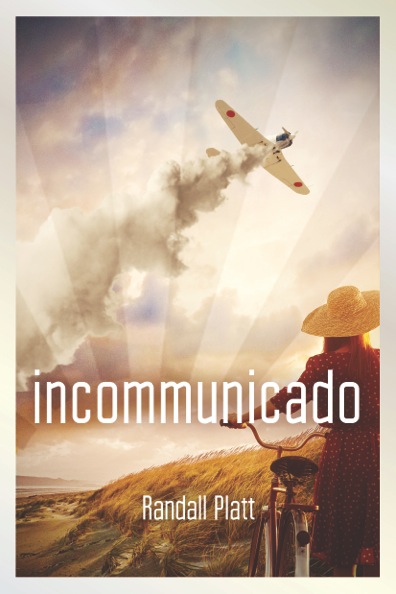
Incommunicado (1)

Twelve-year-old Jewels Stokes doesn’t have an easy life, but her spunk and determination at least make it interesting. Her brother Rex, a senior in high school and a nerd at that, takes life pretty seriously and mostly thinks his sister is a pest. Their mother hasn’t the best reputation in the small coastal town of Sea Park, Oregon, and the two kids are left pretty much on their own. Jewels has one true and faithful friend, Tommy Kaye, a respected resort owner who has contributed generously to the town.

When Pearl Harbor is bombed on December 7, 1941, people are shocked, but uncertain just what it means. Where is Pearl Harbor, anyway? But when the facts are uncovered and the townspeople realize the Japanese are suddenly their enemy, their rage is directed at Jewels’ friend Tommy Kaye, who is of Japanese ancestry.

The town erupts into paranoia and it’s obvious that Tommy Kaye is in danger. When the FBI gets into the picture, it’s clear that Jewels has to do something to save her friend from what they’re calling “internment” or even prison.

Incommunicado is a fun read, but more than that, it offers a glimpse of what life was like in 1941, and how people reacted to the Japanese surprise attack on Pearl Harbor. The author does a good job of describing mob mentality, of how people get caught up in rumors, and their fear of the unknown. Platt goes into some detail about the precautions people had to take during the war, such as maintaining blackout conditions in coastal towns. She describes gas, food and specific product rationing, and collecting goods needed during the war, such as scrap metal.

Although this book might be considered a coming-of-age story, I found it enlightening and enjoyed this spunky girl’s attempt to make things right during the turmoil of World War II.

To learn more about Incommunicado and author Randall Platt, visit http://www.plattbooks.com/

A Thing of Beauty: Chihuly Garden and Glass

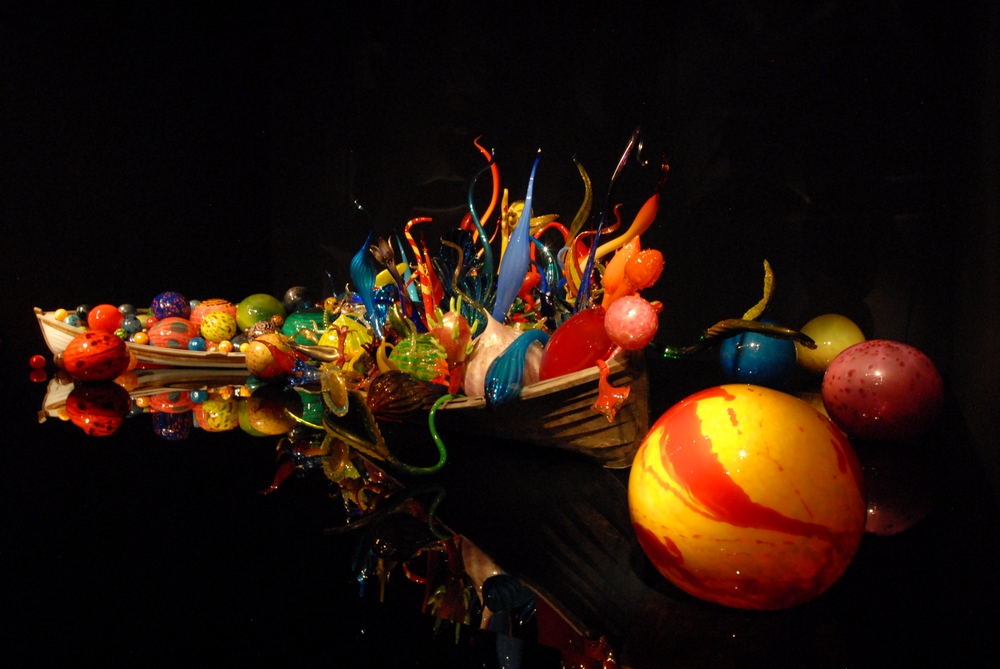
Chihuli Glass!One of Seattle’s finest destinations, Chihuly Glass and Gardens, is located at the base of the Space Needle at the Seattle Center. This magnificent exhibit includes three primary components: the Garden, the Glasshouse, and the Interior Exhibits.

A northwest native, Dale Chihuly has led the avant-garde in the development of glass blowing as a fine art. Chihuly was introduced to glass while enrolled at the University of Washington. Upon graduation, he enrolled in the first glass program in the country, at the University of Wisconsin. He continued his studies at Rhode Island School of Design where he later established the glass program and taught for more than a decade. In 1968 he worked in Venice where he observed and later adopted the team approach to glass blowing.

In 1971 Chihuly co-founded Pilchuck Glass School, an international glass art school near Stanwood, WA. He has received wide acclaim, both nationally and internationally, for his innovative and ambitious exhibitions.

At Seattle’s Chihuly Garden and Glass, we walked first into the exhibition entrance, then wandered from room to room, each featuring its own impressive theme: Glass Forest, Northwest Room, Sealife Room, Persian Ceiling, Mille Fiori, Ikebana, and Float Boat, Chandeliers and Macchia Forest. Each room bears a theme in spectacular color and texture that flows on floors, ceilings and walls. The walkway leading to the garden is resplendent with chandeliers.

The magic continues in the Garden with dramatic glass artfully interspersed with live plants, flowers and trees. The Glass House, a 40-foot tall structure inspired by Chihuly’s appreciation for conservatories, includes a 100-foot long suspended sculpture.

The Bookstore features books and materials relating to Dale Chihuly’s artworks. The gift shop has partnered with Northwest companies and many talented artisans to reflect the creative spirit of the region.

The Collections Café features many of Chihuly’s private artwork and projects. The menu shows a selection of fresh local food, and serves lunch, dinner, and a weekend brunch. Admission to the exhibition is not required for dining at Collections Café.

A quote from Dale Chihuly: “I want people to be overwhelmed with light and color in a way they have never experienced.” At Chihuly Garden and Glass, he meets that challenge. From one breathtaking display to another, we were pleasantly overwhelmed with light and color, and gained a deep appreciation for Dale Chihuly and his great contribution to Seattle culture.

For hours, admission fees and driving directions, visit chihulygardenandglass.com
or call 206-905-2180.

Dearest Darling by Andrea Downing

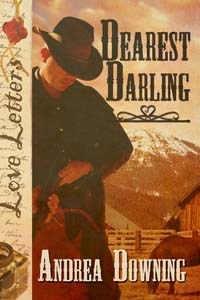
dearestdarlingWhen Emily Darling intentionally reads a letter left on her doorstep, but addressed to Ethel Darton, it becomes more than a mistake in postal service. It becomes a chance of escape from her over-bearing brother. The letter, starting with the greeting “Dearest Darling” captivates her heart and hopes. What kind of man would write such an endearing and tender letter? He is obviously in need of companionship, living in the wilds of Wyoming, and is making travel arrangements for his mail-order bride. But wait, there’s more: a train ticket to Cheyenne with instructions to take a stagecoach to Jackson Hole where he will meet her.

From the letter she learns these two have never met, but that Ethel Darton has sent a picture of herself in an earlier letter.

When Daniel Saunders meets the stagecoach on the appointed day, he meets an imposter, someone who has taken advantage of a free train ticket. He’s outraged. But what is he going to do? He can’t leave her in town, alone, with no means of supporting herself. He needs time to sort this out.

A novella, Dearest Darling is a delightful read, cleverly paced with seemingly insurmountable complications, and realistic, convincing dialog. Details of Wyoming ranch land enhance the story, giving the reader an exciting view of yesteryear’s west.

To learn more about the author, visit http://andreadowning.com/

High Desert Museum: An Extraordinary Museum

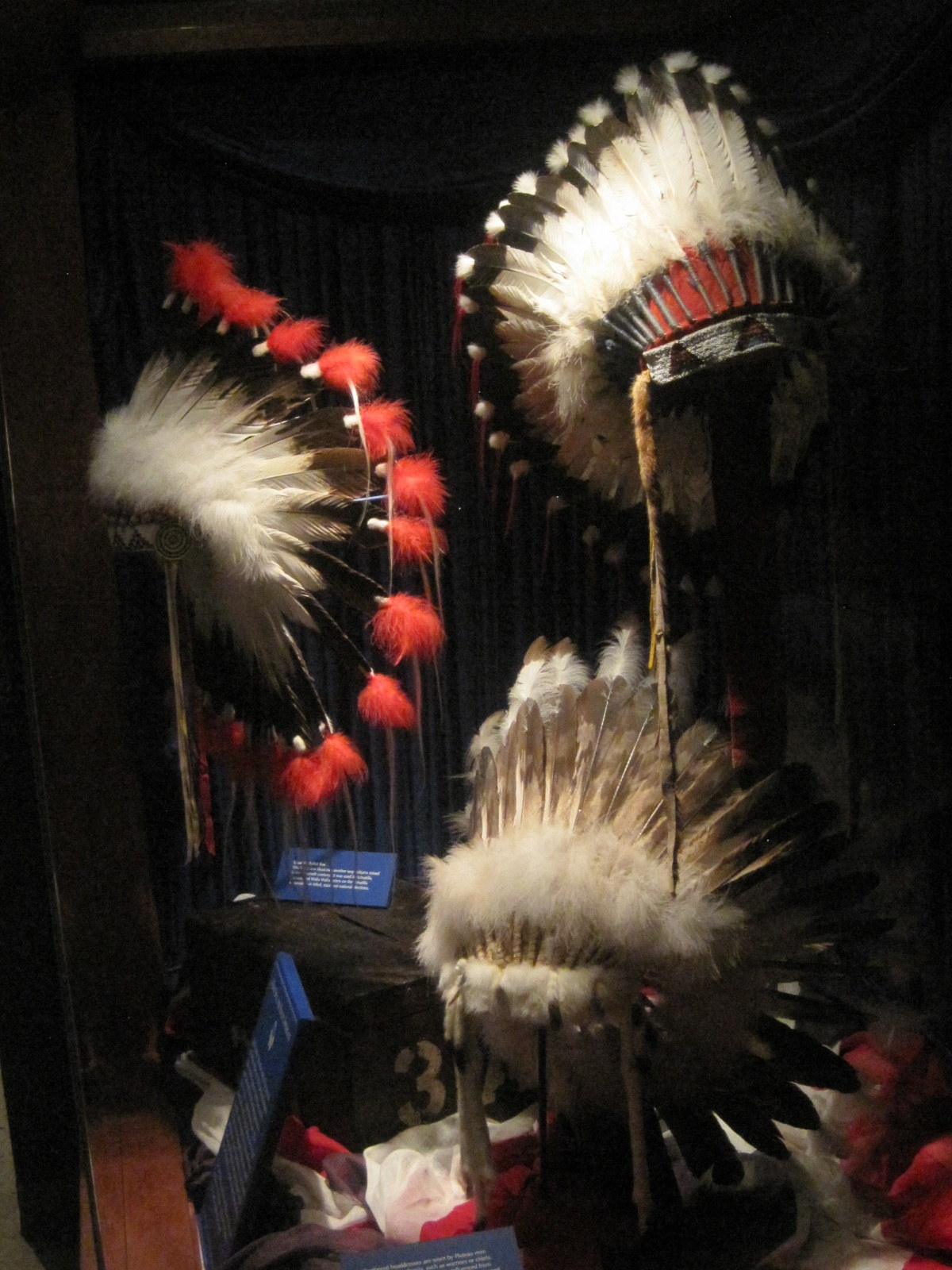
Indian Head Dresses Photo by Roni McFadden

Indian Head Dresses
Photo by Roni McFadden

While attending the Women Writing the West Conference this past October, I had the great pleasure of visiting the High Desert Museum in Bend, Oregon, an excellent all-encompassing museum with many outstanding exhibits.

A temporary exhibit while we were there was “Tough by Nature: Portraits of Cowgirls and Ranch Women of the American West” which showcased Artist Lynda Lanker. Lanker’s heart-felt exhibit features charcoal and graphite drawings as well as stone and plate lithographs, acrylics, oil pastels, and egg tempera. These pictures honor the spirit and stories of ranch women and cowgirls who earn their sustenance and livelihood from the land.

Another temporary exhibit features the work of Edward S. Curtis who spent 30 years beginning in the late 1800s creating a photo-ethnographic study of the North American Indian. Curtis’ collection is widely considered the finest limited edition books ever made in the U.S. The High Desert Museum holds the complete set of the 20 bound volumes of The North American Indian.

The museum has several permanent exhibits. “Spirit of the West” is ever popular and starts with a stroll past a Northern Paiute shelter and a French trapper’s camp. The details depicted are in incredible detail with the sights and sounds of an Indian camp, a settler’s cabin, a hard rock mine, and into Idaho’s old Silver City.

“By Hand Through Memory,” another permanent exhibit, takes visitors through the Plateau Indian Nations’ journey as they traveled from reservation confinement to the 21st Century. Their struggle to retain cultural identity is both poignant and moving.

The High Desert Museum gives visitors a chance to see close-up in both indoor and outdoor displays of live owls, hawks, eagles, falcons, a Canadian lynx and bobcat. None of the animals cared for at the Museum can be released to the wild, either because of injuries or because, separated from their mothers, they never learned to hunt or avoid predators.

Another enlightening permanent exhibit is the Miller Family Ranch where visitors can meet the characters and watch as they do chores (be careful, or you’ll get roped into lending a hand).

As visitors walk around inside the different sections of the building, the outside is brought in by spacious windows looking out on meandering streams in woodsy settings.

The famous Henry James Monk stagecoach, a sawmill, ranger station, a nature walk–it’s all there. If you’re in the Bend, Oregon area, don’t miss this very special museum.

To learn more about the high Desert Museum and read about current and future exhibits, visit http://www.highdesertmuseum.org/

My Guest Today: Shanna Hatfield

the-christmas-cowboy-cover

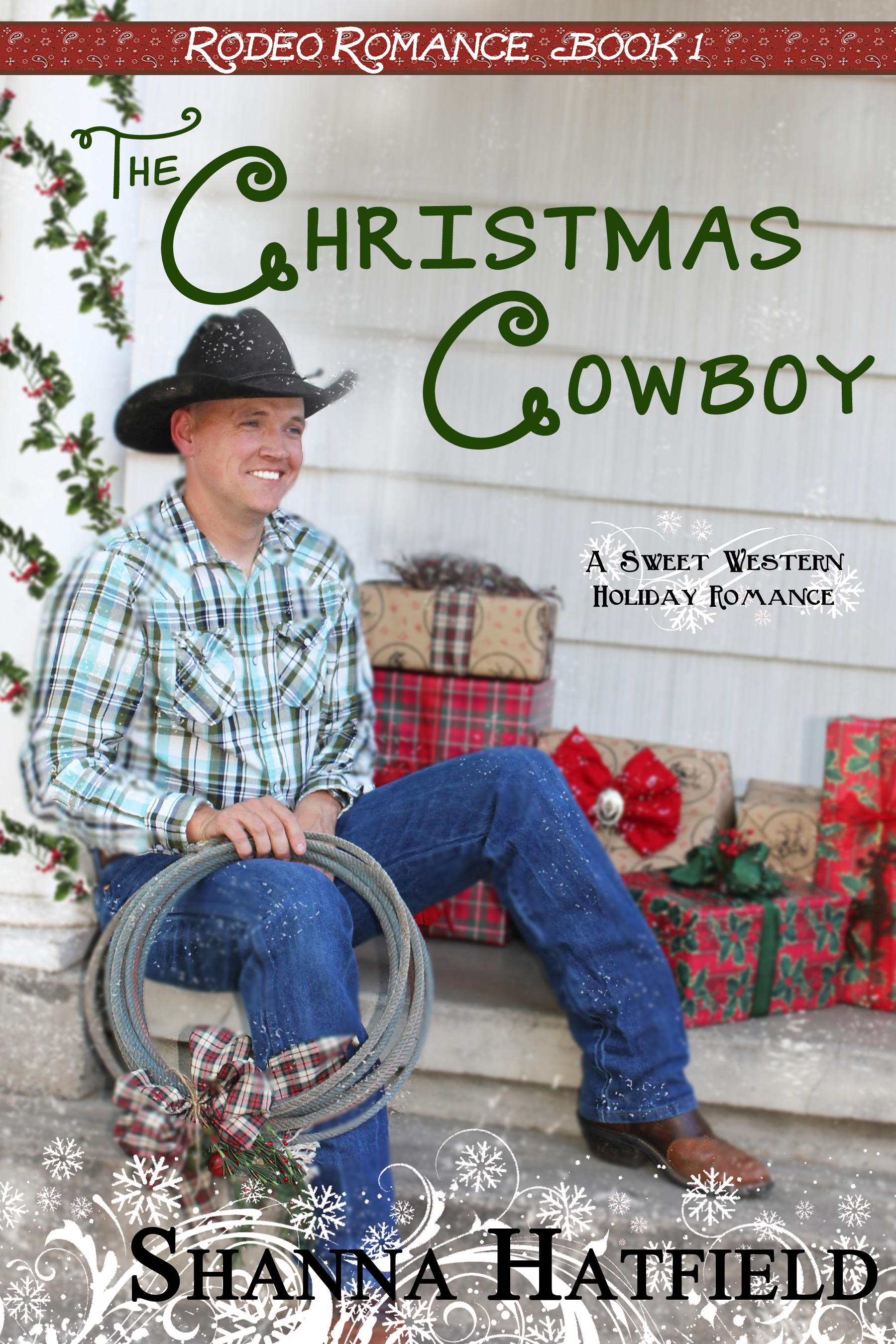
My blog guest today is USA Today bestselling author, Shanna Hatfield. Let’s start our celebration with a book review of her novel The Christmas Cowboy.

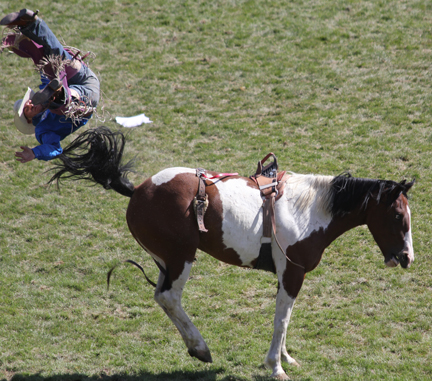
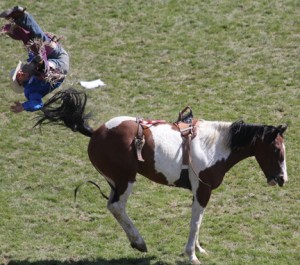
When Kenzie Becket meets a fellow traveler at the airport, she’s naturally attracted to him. Who wouldn’t be? Tate Morgan is the epitome of a cowboy—attractive, impeccable manners, and a champion rodeo saddle bronc rider to boot. But she knows better than to do anything but admire him from a distance. She been burned from this type before, and she will never let it happen again.

Tate Morgan recognizes a class act when he sees one, looking so attractive, yet professional in her business suit. Tate learns Kenzie Becket is a corporate trainer for one of the most successful direct sales companies in the country. But she resists every attempt he makes to become friends.

Both coming from the Tri-City area in eastern Washington, they happen to meet several times in their various travels, he to rodeo events, she to meetings and workshops. Their attraction grows, and slowly Kenzie’s reluctance begins to melt. She finds herself looking forward to running into Tate and disappointed when it doesn’t happen.

But when she sees Tate in another woman’s arms, she rebukes herself for thinking anything could come of a relationship with a cowboy. No matter what her friends say, no matter Tate’s attempts at explanation, she’s done. She should have known better in the first place.

Tate’s hurt and confused with Kenzie’s hostile attitude toward him. When an incident occurs that sends their lives spinning like a lariat, their world changes.

The Christmas Cowboy by Shanna Hatfield is a fun, lively way to kick off the Christmas season. The author writes with authority about rodeos, the corporate scene, and especially matters of the heart. The Christmas Cowboy is the first of Hatfield’s Rodeo Romance series, followed by Wrestlin’ Christmas, Capturing Christmas, and The Christmas Vow.

In the back of The Christmas Cowboy is information about one of the author’s charitable interests: Justin Cowboy Crisis Fund (JCCF), an organization that provides need-based financial assistance to athletes injured through their participation in professional rodeo.

The following is from my blog guest, Shanna Hatfield, who will explain JCCF in greater detail.

Ring in the Holidays with a Helping Hand

Shanna JCCF logo

The idea for my sweet Rodeo Romance series started with The Christmas Cowboy, a story that invaded my thoughts while CC and I sat in the Las Vegas airport after the Wrangler National Finals Rodeo, waiting for our flight home.

Once I started writing the story, I did some research about what would happen if a cowboy sustained a serious injury at a rodeo. My research led me to the Justin Sportsmedicine Team® where one of the team members kindly answered my many questions. The team provides medical support services to professional rodeo athletes at rodeos across the country.

Beyond treatment at the arena, professional rodeo athletes can find help from the financial hardships that arise when they’re unable to compete due to serious injuries. Many don’t have a guaranteed salary or provisions for income upon injury. While injuries are part of the business of rodeo, financial worries don’t necessarily have to be par for the course.

The Justin Boot Company formed a partnership with the Professional Rodeo Cowboys Association (PRCA) and the Women’s Professional Rodeo Association (WPRA) in 1989 to establish the Justin Cowboy Crisis Fund (JCCF). The idea behind the JCCF is to assist professional rodeo athletes and their families in the event of catastrophic injuries resulting from professional rodeo activities.

Since my first encounter with the folks at JCCF, I’ve been impressed by all they do and how much they care about others, and decided to give something back to them.

November 1 through December 24, ten percent of the net proceeds from all my book sales will be donated to the Justin Cowboy Crisis Fund. Every book purchased during this promotional period adds to the donation total. Don’t forget to add books to your Christmas shopping lists!

To kick off the promotion, I’m releasing two new books and celebrating with a party.

November 12, Capturing Christmas, the third installment in the sweet holiday western Rodeo Romance series, releases. Pre-orders are available today! http://amzn.to/1FC8ZQj

In addition, The Christmas Vow   , the fourth book in the Hardman Holidays sweet Victorian romance series releases that day. Pre-order your copy for only $2.99! http://amzn.to/1KQHhvI

Also, a party to celebrate the release and raise awareness for JCCF will take place from 10 a.m. to 2 p.m. (Pacific Time) November 12 on Facebook. Join in the fun with guest authors, games, and oodles of cool prizes. Here’s the link to the party: http://tinyurl.com/cowboychristmasparty2

~*~

Convinced everyone deserves a happy ending, hopeless romantic Shanna Hatfield is out to make it happen, one story at a time through her sweet historical and contemporary romances. When she isn’t writing or indulging in chocolate (dark and decadent, please), Shanna hangs out with her husband, lovingly known as Captain Cavedweller. This USA Today bestselling author is a member of Western Writers of America, Women Writing the West,  Romance Writers of America,  Sweet Romance Reads, and Pioneer Hearts.
Shanna alleyoop


Riding the Rails to Yesteryear

MRSR 4 227In high anticipation, we gathered at the Mt. Rainier Scenic Railroad depot (MRSR) in Elbe, Washington. With a mournful whistle, the train, consisting of a steam engine pulling four cars, click-clacked its way toward us.

The longest continuously operating steam train in the Northwest, the Mt. Rainier Scenic Railroad is a big attraction to this tiny town. Elbe, established by German immigrants in the late 1800’s, was named after the Elbe River Valley near Hamburg, Germany. The town is also known for its famous historical Lutheran church, Evangelische Lutherische Kirche.

We had our choice of seating and our family of six adults chose the last of four cars which happened to have windows with no glass, the better choice to hang out to take pictures. Some cars had glass windows. We sat on bench seats; the car before us had tables, much like a dining car.

Bill, our conductor, made his career on trains for 41 years and in his retirement volunteers with MRSR. He coached us to signal the engineer that it was safe to move the train forward, a signal known as “High Ball” followed by the train’s engine number. Together we yelled “High Ball 17!” and the train’s whistle immediately responded. With a blast of steam, we were on our way.

A train’s whistle, originally referred to as a steam trumpet, is an efficient means of non-verbal communication and each cadence has its own meaning. One whistle indicates the train is ready to go. When we passed a crossing, we heard two long, one short, one long cadence, other times it blew in greeting as we passed various landmarks. The gentle swaying of our bench seats and the nostalgic whistle made me think of what traveling one hundred years ago must have been like. Sitting by the window, I often felt the spray of steam condensation.

The train’s maximum speed is about 10 miles per hour giving us plenty of time to view a few back yards, then wide open space with grazing cattle and horses, meadows, a spectacular beaver dam, and mountain streams cloudy with glacier runoff. At one point we were on a trestle, high in the air.

As we climbed a grade, our sturdy little train chugged what sounded to me like, “I think I can, I think I can.” As we traveled Mount Rainier’s forests and foothills in October, we viewed fall’s colorful changing leaves, mixed with brilliant green conifers. At one point, as we crossed the Upper Nisqually River, we got a peek of the great mountain, its top capped with clouds.

We pulled into the small unincorporated community of Mineral for a scheduled museum visit. Mineral originally began as a mining town, then turned into a logging camp and sawmill, neither of which are currently in operation. Today Mineral claims to have the most comprehensive collection of steam logging locomotives in the world. The excursion schedule allows 45 minutes to visit the various exhibits which include individual buildings: Railroad Logging Camp, House of Gears, Rod House and Restoration Shop. A gift shop has railroad memorabilia, and a small concession has light snacks and beverages. Some people brought lunches and sat at picnic tables situated throughout the railroad camp.

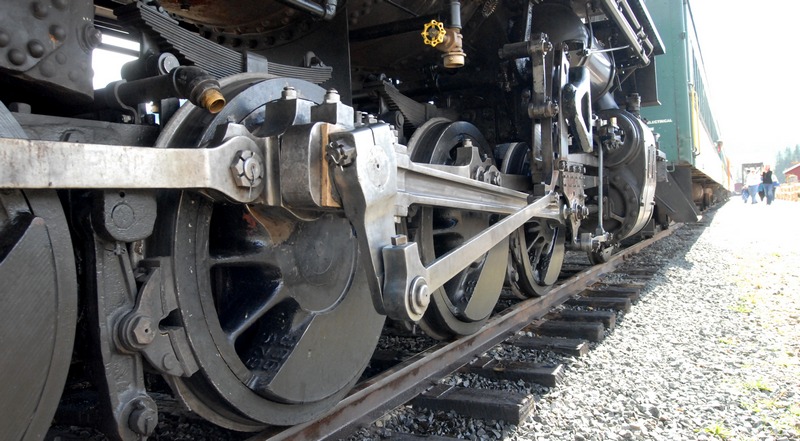
When our conductor Bill learned I was a writer, he invited my husband Bruce and me to visit Engine 17’s cab. It was a high step up, plus three more steps to a space filled with boilers and the machinery needed to pull the train. A blast of heat–about 110 degrees–made me appreciate the work of an engineer. We were told that on a hot day the engine cab can climb to 140 degrees. No wonder we often see an engineer leaning out a window! A two-foot wide walkway the width of the train gave access to two pressure gauges and about 30 valve handles. Rather than wood or coal used in the old days, this steam engine is fueled by diesel and a large fuel tank is also in the engine cab. There are no ready-made parts for this American Locomotive Company Engine 17, originally built in 1929. In its renovation, all parts had to be machined from scratch out of blocks of steel. The rebuilt engine has been in use for about 1500 hours.

The MRSR excursion takes about two hours. We rounded out our day with a late lunch at the Mount Rainier Railroad Dining Company, an old train which has been turned into an Elbe restaurant. We enjoyed our meal and our group of six had a dining room to ourselves.

For more information about the Mt. Rainier Scenic Railroad and Museum, visit www.MRSR.com or call (360) 569-7959.

The Layered Look: The Painted Hills of Oregon

Painted Hills 750

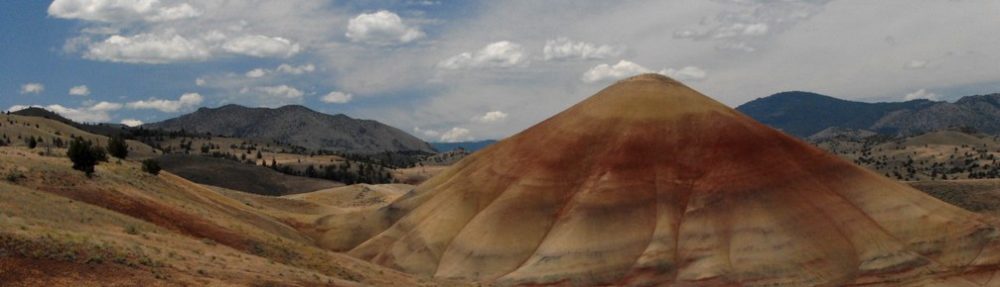
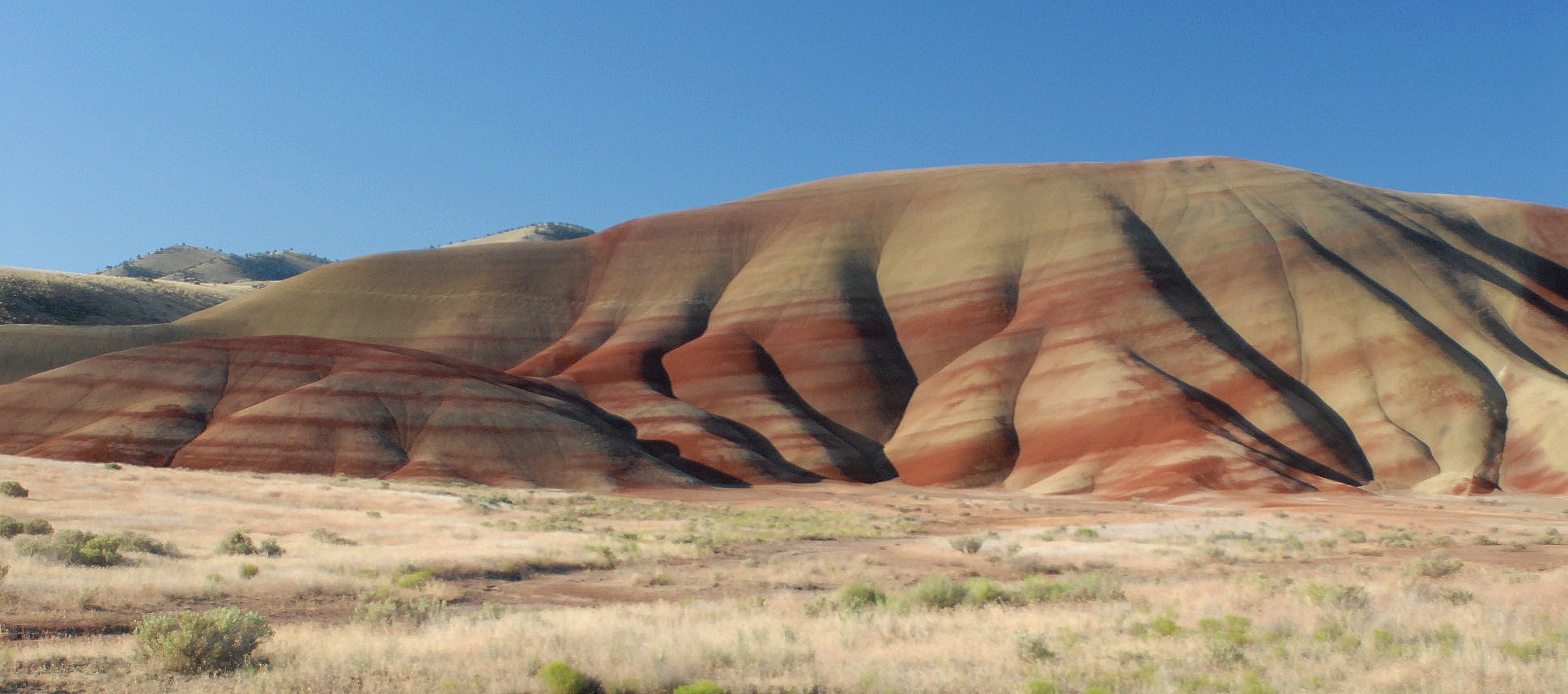
You have to keep reminding yourself that what you are seeing is real. The rolling, rounded hills striped with colors of rich rust, deep green, and yellow appear surreal, like an artist’s conception of outer space. You want to capture them on camera quickly before the illusion disappears, just to prove to the folks at home this marvelous pallet of pastels really exists.

Believe it. The Painted Hills in north central Oregon are authentic, and very old. About 30 million years ago, volcanoes from the Cascade Mountains 100 miles to the west deposited layer upon layer of cooled ash over the region. In time, plants and animals churned the surface, water flowed, eroding and redistributing the minerals, and air oxidized the ash. Many different minerals combine to produce the colorful display we see today: aluminum, silicon, iron, magnesium, manganese, sodium, and many more.

Very few plants are able to grow on the Painted Hills. The soils bind water so intensely plants are unable to draw nourishment. So, except in crevasses and gullies where some plants survive, the hills are bare.

From a distance the striped hill surfaces look hard as though they are painted on canvas, but close-up, you can see they have a popcorn appearance and, particularly after a rain, they are soft and spongy. For this reason, visitors are asked to keep on trails and to avoid walking on the hills. Noticeable trails, however, are created by deer and antelope.

Several good walking trails traverse Painted Hills with excellent interpretive signs and brochures. The moderately strenuous, 1.5-mile Carroll Rim Trail rewards the hiker with an outstanding view of the Painted Hills and Sutton Mountain. For a close-up view of a crimson hill and to see the claystone popcorn structure, take the short Painted Cove Trail which winds around the hill on a wooden walkway.

Another interesting hike is the quarter-mile Leaf Hill Trail that takes walkers past the area where large quantities of plant fossils have been removed for study. Except for this trail, fossils are rarely found in the Painted Hills.

The Painted Hills, located 10 miles west of Mitchell, off U.S. 26, is one of three units of the John Day Fossil Beds National Monument. In 1975 Congress established the monument which is composed of 14,000 acres and contains rocks preserving millions of years of plant and animal life. The other two units are the Sheep Rock Unit, near the town of Dayville, Oregon, and the Clarno Unit, 18 miles west of Fossil, Oregon. The Sheep Rock Unit, located at the intersection of State Route 19 and U.S. 26, has several trails and overlooks.

The Clarno Unit, 18 miles west of Fossil, OR, known for its Clarno Nut Beds, is one of the world’s finest fossil plant sources where more than 300 plant species have been found. Several trails allow visitors to see the actual fossils embedded in rock.

Be sure to visit the Thomas Condon Palenotology Center, a National Park Service research facility dedicated to the John Day Fossil Beds. It also serves as the park visitor center and fossil museum. We were fascinated as we watched through a picture window a scientist at work in a laboratory and collections room which contains more than 45,000 specimens.

Another interesting side visit is the James Cant Ranch, located on both sides of the John Day River in the John Day Fossil Beds National Monument. The Cant Ranch complex is preserved as an interpretive site showing visitors an early 20th-century livestock ranch. The James Cant Ranch is listed on the National Register of Historic Places. In addition, there are several short trails with exhibits showing a ranch of yesteryear with original wagons and farming equipment.

There are several camping facilities near Prineville, a small town (population 5,000) about 50 miles southwest of the Painted Hills. Prineville Reservoir State Park, located 17 miles south of Prineville, is a large 70-site facility. In addition, several U.S. Forest Service campgrounds are in the area.

Take your time at the John Day Fossil Beds National Monument. The area, particularly the Painted Hills, is a unique, fascinating place to visit and a photographer’s delight.


Book Review: Moonshadows

Moonshadows


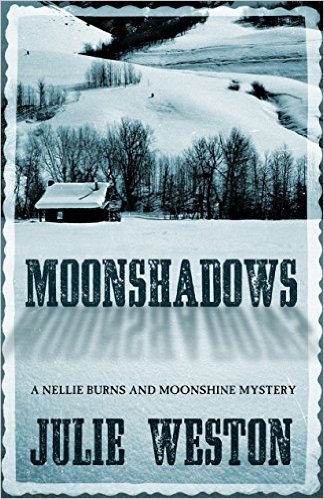
Settle in for an engaging period mystery with Moonshadows by Julie Weston.

Nellie Burns steps into a man’s world of photography in the small mining town of Ketchum, Idaho in the early 1920s. In Chicago she’d worked in a photography studio, but only with portraits. Now she plans to follow her heart’s desire with nature photography.

Nellie hires crusty retired miner Rosy Kipling to take her out to capture a winter night scene where “the moon will shine full on and create shadows on snow.” Although he’s never far from his bottle of whiskey, he and Nellie form a sort of bond.

While on her cold night-time trek, she makes a startling discovery at a nearby cabin. She discovers a hideous crime, then another. Nellie uses her talents as a photographer to capture on film what she discovers, but then finds herself embroiled in the mystery. Nellie’s fierce desire to be independent may cause her to be a victim as well. As the story spins into a tight mystery, Nellie emerges as a reluctant heroine, sometimes doubtful of her course, but determined that right will prevail.

The reader sees, through Nellie’s observant eyes, the flavor of Idaho’s rugged landscape in the early 20th Century. Moonshadows is packed with Idaho history, rich characters and information about the early days of photography and its cumbersome equipment. Weston does a worthy job of capturing the spirit of small town living and the attitudes of the day.

Moonshadows is the first of the series, ”A Nellie Burns and Moonshine Mystery.” For more information about the author, visit julieweston.com