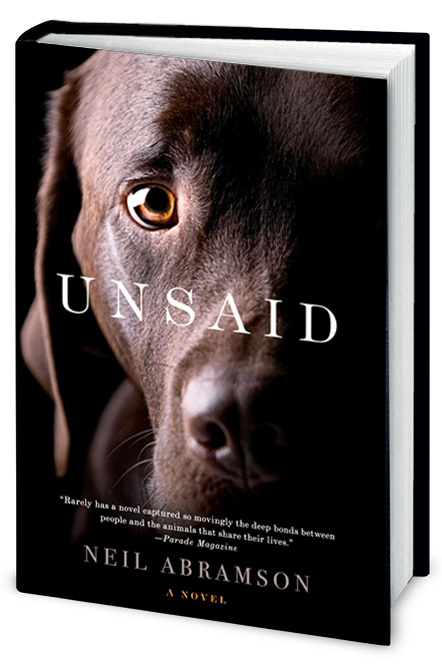
Book Review: Unsaid

Neil Abramson’s poignant novel, Unsaid, is told by Helena Colden, 37, a veterinarian who recently died of cancer. Her lawyer husband, David, is left with the care of his wife’s animals: three dogs, six cats, two horses and a pig. The animals were her passion, but David feels an obligation to carry on with their care.

Jaycee, a friend and colleague of Helena’s, asks David to defend her and Cindy, a chimpanzee, against the Center for Advanced Primate Studies. Jaycee has taught the chimp how to communicate through sign language and other aids. The Center feels the study has failed and plans to return Cindy to the primate population for other experimental work, likely to test human diseases.

Still grieving, David is overwhelmed with obligations to his law practice, running the household, and now being asked to take on a questionable case of animal rights. Out of respect for Helena, he consents to defend Jaycee and the chimp, Cindy.

This story is told from an interesting point of view, that of a deceased person who can be everywhere at once, one who sees and hears all.

This novel touched my heart with the many animal scenes, particularly those with a little autistic boy, the son of David’s newly acquired housekeeper. If you are an animal lover, this is a book for you. I have had and loved animals all my life and this book was balm for my soul. I thoroughly enjoyed Unsaid and highly recommend it.

Zipline Adventure: Zipping Among Treetops

Recently, our extended family—eleven of us—zipped along the treetops at Canopy Tours Northwest on Camano Island. The unique adventure takes place on the historic 134-acre Kristoferson Farm, which has served the community in various capacities for more than one-hundred years. Today, half of the farm is devoted to growing organic hay and lavender, with the other half devoted to the well-designed zipline tour.

Upon first arriving we were assisted in “suiting” up. The harness has lots of straps and adjustments and our outfits were topped off with a hard hat. Each step of the way we were shown how to work with the equipment, what to expect, and how to land on the various platforms.

The zipline tour consists of six separate lines, each landing on a different platform. Between the zipline sections, our guides led us on lush, green trails. I’ll admit to being a little apprehensive with the first zipline “ride.” Stepping off into a void was a little daunting, even with all the clip-ins and safety gear and in the hands of efficient, certified guides. But I soon relaxed into the adventure as I zipped along old-growth forest, reveling in the rush and the zinging ring of the line, with the assurance that I’d land safely on the platform with a guide’s help.

Once I felt safe, which was actually right away, I found it easy to let go of control and trust the guides and the equipment. We were in good, knowledgeable hands. I simply enjoyed the ride.

Along the way our guides explained some of what we were experiencing such as the various species of trees, the diversity of shrubs and ferns, and what wildlife we might see. The views are fantastic and we enjoyed observing our island from aloft. The zipline tour lasted about two hours.

For a fun adventure, I recommend Canopy Tours Northwest. For more information, visit https://canopytoursnw.com or call 360-387-5807.


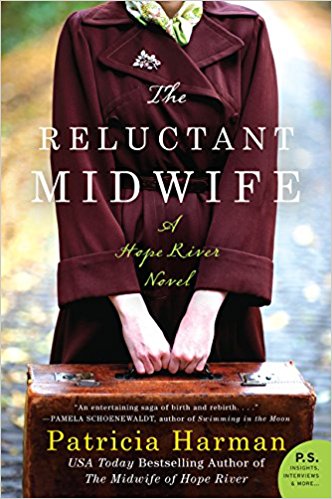
Book Review: The Reluctant Midwife: A Hope River Novel

Patricia Harman’s wit and wisdom shine through with this Great Depression era novel that takes place in hard-hit West Virginia.

Nurse Becky Myers finds herself the caretaker of Dr. Isaac Blum, a doctor she’s worked with for seven years. When the doctor’s wife dies a tragic death, he goes into a catatonic state, unable to speak or take care of himself. His family will not take responsibility for him and Becky sees no alternative but to care for him herself. Now unemployed, she soon runs out of money and decides they should go to his home in Liberty where at least they’d have a house to live in. When she finds his home has been sold for back taxes, they’re stranded with very little money and no place to stay.

Fortunately, an old friend, Patience Hester, the midwife for Hope River, and her husband Daniel, a veterinarian, let Becky and Isaac stay in their old abandoned house. Although Becky is a trained nurse, she is not comfortable assisting at childbirth, but when Patience becomes ill, Becky must take over her friend’s midwife’s duties. Because he can’t be left alone, she takes Dr. Blum with her. It’s not ideal, but at least they’re not starving.

Money is scarce and more often than not midwifery is paid with a chicken or something from the garden. For awhile Becky delivers groceries for a bit of income, but when that position dries up, she applies and is given a job at a nearby CCC (Civilian Conservation Corps) camp.

The Reluctant Midwife is an engaging, well-told story. The author, herself a midwife, writes of childbirth with expertise. She paints a bleak picture of the Depression era, but also praises the way people pulled together. The relationship between Becky and Isaac develops in a surprising way. I found the CCC details fascinating and admire the significant contribution they made at a time when living conditions were so desperate for so many.

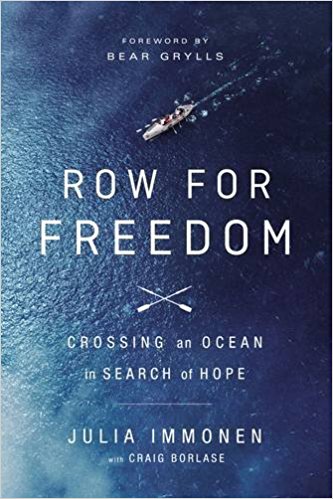
Book Review: Row for Freedom: Crossing an Ocean in Search of Hope

Julia Immonen’s memoir (written with Craig Borlase), Row for Freedom: Crossing an Ocean in Search of Hope, is a prime example of grit, determination and spirit offered for a worthy cause. When the author learns of the horror of human trafficking, she is determined to raise awareness of modern-day slavery.

Julia and four other women pooled their energy and resources to row across the Atlantic Ocean from the Canary Islands to Barbados. After extensive preparation, they set out to row 45 days to cross 3,000 miles of the Atlantic Ocean.

For six and a half weeks this group of women lived in a 29-foot boat, an amazingly small boat to carry 5 people. Below decks were 2 small cabins–each about the size and shape of a coffin. Their sparse belongings were stowed in tiny cubby holes. The crew rowed around the clock in two-hour shifts. It was exhausting, demanding work, and at one time or another all the women suffered from debilitating seasickness, chafing made worse by stinging salt water, sore wrists, painful ankles from the foot slides, and aching hamstrings. Julia handled the pain and discomfort by thinking of the estimated 27-million people trapped in modern day slavery. She rowed for them.

On the boat, one system after another failed, beginning on the second day when the battery tester failed, followed by almost daily failures of other systems including the desalinator used to convert salt water to fresh. Even the boat itself developed tiny holes that had to be repaired at sea.

They completed what they set out to do: spread the word about the horror of human trafficking, establish a new Guinness World Record for the first female crew of five to row an ocean. One of the crew was the first Irish woman ever to have rowed the Atlantic, and Immonen was the first Finn ever to have rowed an ocean. Although she realizes that their actions were infinitesimal in the face of the world-wide problem of trafficking, the author is comforted by a quote from Mother Teresa: “do small things with great love.”

Before their epic journey, Julia worked in the television industry putting together television programs. She had the know-how and skills for effective media. Now that knowledge would be put to work with live interviews to call attention to their feat and the reason behind it–making the world aware of human trafficking.

Row for Freedom is an exciting, worthwhile read. The author’s determination
and the team’s endurance is impressive. The physical hardships, the separation from families, the endless challenges of the boat’s integrity–all make this a worthy and memorial book.

To learn more about the author and her cause, visit www.sportforfreedom.org/

Textile Recycling: It Just Makes Sense

We all know the benefits of donating “gently used” articles to Goodwill or other thrift-type stores. Almost all communities have a way to make donating easy and convenient.

There’s a new type of recycling that I’m excited about: textile recycling, which is the processes by which old clothing and other textiles are recovered for reuse in different forms than originally intended. For instance, old jeans can be recycled into insulation.

The importance of recycling textiles is increasingly being recognized. Once in landfills, natural fibers can take hundreds of years to decompose. During the decomposing process, they may release methane and CO2 gas into the atmosphere, plus may release toxic substances into groundwater and surrounding soil. Additionally, synthetic materials may never decompose.

Which textiles are accepted for recycling? Torn, badly worn or even stained items such as:
Clothes
Shoes
back packs
purses
bedding
curtains
table cloths
area rugs
stuffed animals

How textile recycling works:
● When you donate clothing or any fabric item to a center for recycling, it is sorted into immediately usable items or recyclable items. You don’t have to worry about which is which–the sorters will determine the items’ destination.
● Wearable or usable material is sorted and made available for immediate use.
● Unwearable material is sorted by type of material and color. Color sorting results in fabric that does not need to be re-died, saving energy and pollutants.
● Textiles are then pulled into fibers or shredded, sometimes converting the fabric into yarn.
● Polyester-based textiles are shredded, then granulated and processed into chips. These are subsequently melted and used to create new fibers.

Giving second life to textiles results in many useful products, such as:
wiping rags
sound-proofing
athletic equipment
pet bedding
area rugs
Insulation for home, automobile, appliance
We all know it makes sense to recycle. Now we can recycle old clothes or fabrics that may be beyond reusing in their original form. Any item is acceptable for reuse or recycling as long as it is not wet, mildewed, or soiled with hazardous material.

To find the closest textile recycling center near you, visit http://www.weardonaterecycle.org/locator/index.php If a Goodwill Industries center is near you, they are usually a good destination for textile recycling.

What’s in your closet?

Book Review: The Portable Veblen


I can say, unequivocally, that The Portable Veblen is the strangest book I’ve ever read. But fun. Oh, so much fun! Author Elizabeth McKenzie’s mind is something to behold; her pen magical. Yet, there is substance to this romantic comedy and messages on many levels.

Veblen Amundsen-Howda is a strange, but lovable young woman who tries to do the right thing. She goes out of her way to please her mother, an over-the-top hypochondriac whose husband is the glue that holds their family together. Her biological father is institutionalized with a mental disorder and, true to Veblen’s nature, she makes every effort to bring joy to his life.

Veblen, who was named after Thorstein Veblen (1857-1929), a Norwegian-American economist, draws many of her attitudes and passions from the writer and has a framed picture of him displayed prominently in her home.

Veblen’s financé Paul Vreeland, a brilliant neurologist, has been awarded an important military contract to test brain-damaged patients. When Paul takes Veblen to meet his aging hippie parents, the visit is as bad as he dreads. Trying to keep all these elements—her family, his family and his research project—on an even keel while putting together their wedding is a challenge.

In the meantime, one of the main characters of the book, a squirrel who resides in Veblen’s attic, is her joy, but Paul’s nemesis. It’s hard to imagine, but the squirrel has a surprisingly important role is this story.

For a refreshing change, read this book. As Jeff VanderMeer of the Los Angeles Times says, “It’s wise, deep, and complicated.”

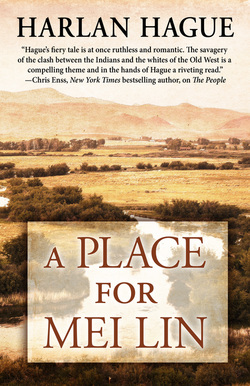
Book Review: A Place for Mei Lin

Harlan Hague has written an intriguing historical fiction, A Place for Mei Lin, set in America’s Northwest in the early 20th century.

At one time Caleb Willis was blissfully happy with his wife and two children, but when his family all tragically died, he was without purpose, not caring what happened to him. He drifts from Virginia and settles in Idaho’s Sawtooth Mountains area and sets up a gold dredging operation near Stanley. On a trip to town, he encounters a young Chinese woman, Mei Lin, who had been sold and pressed into service in a brothel. He witnesses abuse to the woman and comes to her rescue.

Not knowing what else to do, he takes her to his cabin. Their relationship grows, but all the while Caleb, still mourning his family, resists acknowledging his feelings toward his young house guest. Mei Lin, on the other hand, feels a gratitude that turns into love toward Caleb. She’s a strong, capable woman who strives to prove her worth.

A Place for Mei Lin is an interesting book on many levels. I have spent quite a bit of time in the Stanley, Idaho area and have seen the old gold-mining dredges and technology described in the book. The author vividly describes the rugged Sawtooth area, giving the novel a strong sense of place. The tragic plight of Chinese during this time is a reminder of our country’s bigotry toward a race of people once their services are no longer needed. And lastly, the novel is a tender love story that at first is one-sided, but soon develops, only to be threatened by forces beyond their control.

This is a novel worth your time, written by a skilled story-teller. A Place for Mei Lin is available in print, ebook and audio formats. To learn more about Harlan Hague, visit http://harlanhague.us/

A Special Getaway: Sol Duc Hot Springs

Twenty-one of us—extended family and friends—gathered together for a glorious mid-May three-day weekend at Sol Duc Hot Springs in the Olympic National Park and Forest on the Olympic Peninsula, Washington. We’ve experienced an unusually wet spring here in the Northwest, but we lucked out on the weather with bright, sunny days, allowing us to spend treasured time outdoors.

Most of the group occupied accommodations at the Sol Duc Hot Springs Resort, either at the large “River Cabin” or in smaller cabins. Bruce and I opted to camp with our truck and camper at the lush campground, about a quarter-mile down the road. We felt we had the best of two worlds—visiting with family and friends during the day and spending the night in a quiet unique Hoh Rain Forest campground.

The Hoh is one of the finest remaining examples of temperate rainforest in the United States and is one of the park’s most popular destinations. The Hoh Rain Forest is aptly named. During the winter, rain falls frequently in the Hoh, contributing to the yearly total of 140 to 170 inches (that’s 12 to 14 feet!) of precipitation each year. The result is a lush, green canopy of conifer and deciduous trees. Mosses and ferns blanket the surfaces, adding another dimension to the enchantment of the rainforest. We had the best of both worlds—camping in a rain forest, but with no rain.

The resort itself offers a multitude of activities including hot mineral-spring pools, massage therapists, poolside deli, restaurant, gift shop, and convenience store.
A pleasant walk through old-growth forest to the Sol Duc Falls overlook is just a mile from the resort.

There are no modern distractions like cell or wifi coverage, telephones, televisions, or radios at Sol Duc, allowing a refreshing change of pace and a feeling of getting back to nature.

The Olympic National Park is a great destination, and Sol Duc Hot Springs Resort and Campgrounds make a perfect place to call base camp.

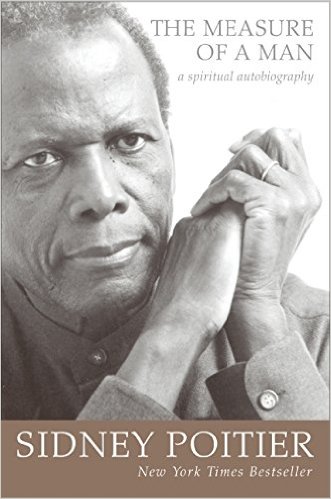
Book Review: The Measure of a Man: A Spiritual Autobiography

Sidney Poitier is a long-time favorite of mine. I’ve seen all his well-known movies and have admired his achievements. His book, The Measure of a Man: A Spiritual Autobiography is an engrossing read.

Born on Cat Island, a primitive island in the Bahamas, Poitier had a childhood of freedom and love, blissfully unaware of how poor in material things his parents were. When the family’s livelihood of growing tomatoes was no longer an option, they moved to Nassau and he was suddenly plunked down in a world of cars, movies, running water, electricity, white people and the resulting race distinction. He got into trouble and was sent to his older brother’s home in Miami, Florida. It was in those years he realized how ignorant he was, how slim were his chances of succeeding. He could barely read; was lucky to get dish washing jobs.

Poitier moved to Harlem, New York when he was 16. His acting career in live theater happened almost accidently, but he realized this was where he belonged. The old adage “when the student is ready, the teacher appears,” is an apt description of his break-through. But in the 1950’s, acting opportunities for blacks were stereotyped. He moved to Hollywood and managed to get roles, supplementing his income with restaurant work. After several minor roles, he and Tony Curtis starred in The Defiant Ones, a box-office hit. In 1964 he was awarded an Oscar for Lilies of the Field, Hollywood’s first Best Actor award to a black man, followed by To Sir with Love, Guess Who’s Coming to Dinner, and In the Heat of the Night. Although these movies were met with success, they were thought to be atypical of black people. The three movies were made in the height of race riots and bigotry. Blacks resented that the movies didn’t portray the average black man, that the roles he played were non-threatening to white audiences, and even smacked of “Uncle Tom.”

After fifty years in Hollywood trying to portray life, Poitier learned about life. Seventy-two years old when he wrote this book, his reflections encompass a part of our country’s greatly changing history.

Poitier concludes his autobiography with an awareness of his perception of self, of others and of the world. Although the book’s title suggests spirituality, I found it
engrossing and thought provoking, but not necessarily spiritual. I enjoyed the book, even more so since I have seen most of the movies he discusses.

For an in-depth look at Sidney Poitier, read The Measure of a Man: A Spiritual Autobiography. Even if you aren’t necessarily a fan (really?) it’s an interesting study of the times.

Navigating at Sea: Rules of the Road

At sea, this is how another boat looks at night.

Note: The following is taken in part from my memoir, Sailing with Impunity: Adventure in the South Pacific.

Operating a boat safely isn’t as easy as it might look. Before we embarked on our 13,000- mile journey aboard our Bristol 40, Impunity, Bruce insisted I take Coast Guard Auxiliary boating safety courses. I took several series of classes on boating safety, sailing skills, seamanship, and shoreline navigation. In addition, we had reference guides and nearly 200 charts on board.

Many books have been written on navigation rules of the road, and the reason for it all is safety. On the water, there are no visible traffic signals or lanes to use as guides. When you come upon another vessel, who has the right of way? How can you tell?

Like any specialty, the boating world has its own terminology. Such common words as right, left, front of a boat, back of a boat have nautical terminology (starboard, port, bow, stern). Even something as common as rope has another name: line. I could go on and on: a ceiling is overhead; wall is bulkhead, closet is locker, windows are port lights. There’s no sense arguing about it, it just is. Ocean travel is another world and if you’re going to be a part of it, you need to know the language.

Navigation rules to be observed:

●The first rule is to always have a proper lookout, someone on watch. We maintained a 24-hour watch system of 4-hours on, 4-hours off. That meant that at sea we never got more than 4 hours sleep. It also meant that our boat was in safe hands at all times.

● Boaters must have the ability to determine risk of collision. Use everything you’ve got: eyes, ears, radar, radio.

● Know how to read ships lights for night time visibility.
– Different types of ships— tugboat, fishing boat, cargo vessels, sailboats— have different light configurations. Aboard Impunity we had a handy chart we used for quick reference when we didn’t recognize another boat’s light configuration. Lights determine the type of vessel.

● International rules dictate that when underway all vessels must display prescribed lights.
– All boats must have sidelights: a green light on the starboard side; a red light on the port side.
– All boats must have a sternlight.
– All power boats and sailboats over 65-feet must have a masthead light, or lights, depending on the type of boat, placed over the center of the vessel.

● Know how to determine which direction a ship is sailing
– If you see a green light, the ship is passing from port to starboard (left to right).
– If you see a red light, the ship is passing from starboard to port (right to left).
– If you see both green and red lights, the ship is coming toward you and you are likely on a collision course.
– If you see only a white sternlight, the ship is sailing away from you.

There are many more “light” rules for various types of boats, but these are the basics that every boater should know.

● Know responsibilities between vessels and which vessel must give-way in an approach situation
– Learn the duties of the “burdened” (or give-way) vessel
– Learn the duties of the “privileged” (or stand-on) vessel

● Learn what to do when approaching buoys and markers

If you don’t know the rules of the road, you’re putting yourself and other vessels in danger. Knowing and following the Rules of the Road is not difficult. It is smart, courteous, and safe. And it’s the law.