

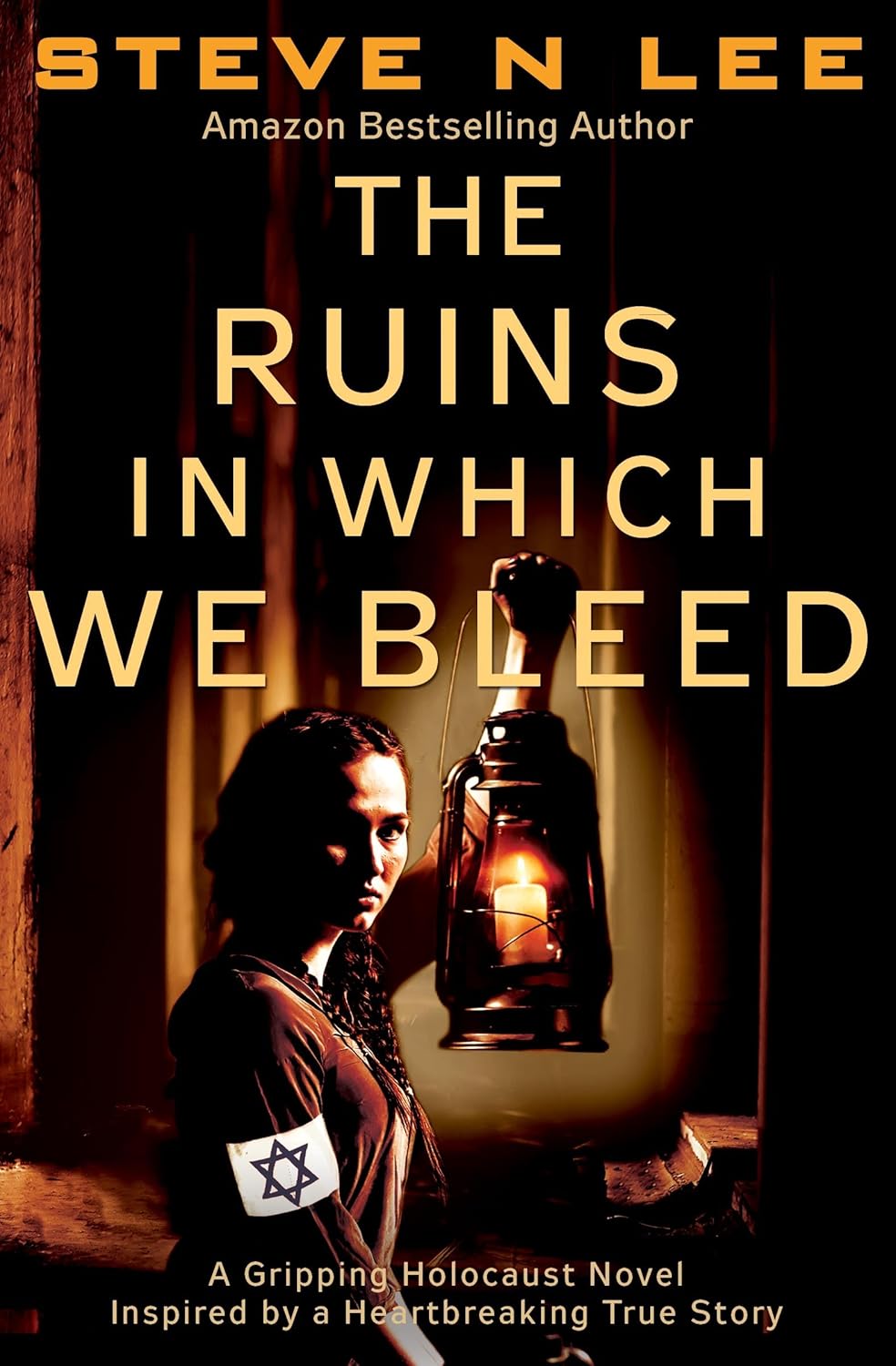
The Ruins in Which We Bleed by Steve N. Lee, is the third book of the “World War II Historical Fiction” series. This particular account of struggle for survival was inspired by a previously untold true story.
The narrative begins in 1943 when Helena Silwicka turns sixteen. She lives with her parents and two brothers, one older, one younger. Following the 1939 Nazi invasion of Poland, Jewish families were forced to abandon their homes and were imprisoned in Warsaw ghettos. The Silwickas live in a crowded apartment with an aunt. The family witnesses horror after horror, must scavenge for food, and live in constant fear of Nazi cruelty. They do whatever is necessary to keep their family together.
Mere survival is a daily challenge. People are randomly killed in the streets, food is not only scarce but outrageously expensive. Many stores are off-limits to Jews. Schools are closed to Jews. Nazis consistently set homes and apartment buildings on fire, then round up the homeless, pack them into cattle cars and stuff them into trains. To where? There are so many unknowns. The family lives in constant fear— fear of separation, fear for their lives.
Helena makes a little money sewing armbands that all Jews are required to wear: a white armband affixed with a blue six-sided star, worn over the right upper sleeve of one’s outer garments.
When the unthinkable happens, Helena is thrown into an unimaginable situation. She fights on despite horror after horror threatening her mere survival. She tries to maintain a positive attitude, to show gratitude for seemingly inconsequential “gifts.”
The story toggles between 1940-1941 to 1943. This family’s struggle was typical for Jews under Nazi rule in Poland and Germany.
The Ruins in Which We Bleed is a well written story of the atrocities of war. There have been numerous accounts of this grim history, and the author does a good job of bringing this story of horror to light. This was a typical family, which he clearly shows. Lee’s descriptions of life during that time period is believable, as is his grasp of life under Nazi rule. It’s an enlightening story based on what we know to be true.
When reading accounts such as this, I wonder how Jews could have let this happen? How could their leaders let the Nazis take over, round up their country’s citizens, put them in prisons, kill men, women and children? Did the people have blind faith in their leaders? Did it start small, then grow into the atrocity it became? Then, I wonder, could such evil happen here?