Book Review: H is for Hawk

H is for Hawk by Helen Macdonald is both a memoir and an extraordinary experience with one of nature’s most vicious predators, a goshawk.

As a child in England, Macdonald was fascinated by nature and spent hours observing wildlife, particularly birds. She fulfills a life-long dream of becoming a falconer when she acquires a goshawk whom she names Mabel. She begins to train the goshawk, taking tiny steps toward the day she can let the bird fly free to hunt, yet trust it to return to her.

The goshawk, a medium-large raptor, is bigger, fiercer and wilder than most hawks and is often considered the “true” hawk. Historically, goshawks have had relationships with humans, often as hunting partners.

Like any special-interest subject, falconry has its own vocabulary: wings are sails, claws are pounces, tail a train, when they wipe their beaks, they feak, when they frantically flap their wings, they bate, to mention only a few of the many terms of precision used by falconers.

When Macdonald’s father, a press photographer, suddenly dies, she is thrown into despair. In her writing she recalls the profound lessons she has learned from this patient man as she struggles with the pain of loss and the challenges of working with her hawk.

In parallel, the author frequently refers to the unpublished journal of T. H. White, a well-known English writer who was also a falconer, albeit an unsuccessful one.

H is for Hawk is a beautiful book on so many levels. Helen Macdonald fearlessly exposes her emotionally raw grief as she immerses herself in the complexities and challenges of falconry. I highly recommend H is for Hawk.

Book Review — Life in a Jar: The Irena Sendler Project

Author Jack Mayer has written a gripping true story about courage, hope and determination that shines light on a dark period of history.

When three girls from a rural Kansas high school researched a project for 1999’s National History Day, they started something bigger than anyone would have imagined. Under the guidance of their teacher, Norman Conrad, students Liz Chambers, Megan Stewart, and Sabrina Coons began what would be life-changing for all involved. From a tiny reference in a news magazine, they researched the story of Irena Sendler, a Polish Catholic who organized a network of social workers to save hundreds of Jewish children during World War II. This remarkable feat was suppressed by communist Poland and remained virtually unknown for 60 years.

As the students delved into their Holocaust history project, they fashioned their research into a 15-minute play they called “Life in a Jar.” The play was first seen in Kansas, then the Midwest, then New York, Los Angeles, Montreal and finally Poland where they elevated Irena Sendler to a national hero.

Under German occupation, all Polish Jews in Warsaw were rounded up and forced to live in a ghetto. They could only take what they could carry. Conditions worsened by the day as Jews were deprived of even everyday necessities. The 400,000 Jews sealed behind brick walls lived in unbelievably crowded conditions–sometimes more than 20 people in a two-bedroom apartment. People were starving and dying from untreated sickness, starvation and absolute poverty.

When it became apparent that Jews were systematically being taken away and murdered, Irena Sendler approached the condemned parents to convince them to give up their children so that they could be placed with non-Jewish families, or in Catholic orphanages. Sendler felt it important to keep some sort of record of the rescued children’s names, their new Christian name, and where they were taken. Lists were made and hidden in milk jars, then buried under an old apple tree. In all, 2,500 children were saved. Most were never reunited with their families.

Life in a Jar is an extraordinary story of exceptional people. The students’ individual stories are an integral part of the strength of the project. Irena Sendler’s story of tolerance and respect of all people is inspirational. I highly recommend this story of Kansas teens who “rescued the rescuer.”

Book Review: Where’d You Go, Bernadette

I loved this hilarious and touching novel by Maria Semple. Where’d You Go, Bernadette is filled with charm, intelligence and rare wisdom.

Fifteen year old Bee lives in Seattle with her parents in their 12,000 square-foot home, a former Catholic school for wayward girls. The building is in deplorable condition with blackberry vines growing through the floorboards, a roof that leaks, and an overpowering musty odor.

However, the family’s obnoxious living style has nothing to do with their intelligence.
The entire family is brilliant. Bee, with a straight-A average, has been accepted at a prestigious boarding school. Her mother, Bernadette, is an award-winning architect, and Bee’s father, Elgin, is a high-level executive at Microsoft. The family moved to Seattle when Microsoft bought Elgin’s facial-recognition program and offered him a job.

As a reward for Bee’s perfect grades, the family plans to celebrate by taking a cruise to Antarctica. Bee’s highly intelligent but agoraphobic mother, throws herself into preparations for the trip, ordering equipment on-line at terrifying speed. All the while Bernadette is nearing a meltdown trying to cope with living in Seattle, a place she never wanted to be.

The book rapidly moves forward through Bee’s first-person accounts, emails between Bernadette and her personal secretary who supposedly lives in India, and gossipy emails between two mothers whose children also go to Bee’s school.

Situations occur that build on one another, complicating their lives. And then Bernadette disappears.

Wit and imagination make this novel special. Irreverent, keen observations about Seattle traffic, Canadians, family relationships, human nature, and Antarctica are hilarious. At times I laughed right out loud. For a refreshing look at our world, read Where’d You Go, Bernadette.

Book Review: Where the Crawdads Sing


Where the Crawdads Sing by Delia Owens is a memorable book on many levels: complicated family dynamics, a little girl’s struggle to survive, wildlife, and the nature of people. The story takes place almost entirely in North Carolina marshland and toggles between the 1950s and 1960s.

Catherine Danielle Clark, called Kya, watches as one at a time her family members leave home because of her abusive father. First her older siblings, then her mother, and finally her beloved older brother closest to her in age. It’s not unusual for her father to leave her alone for days. When he’s home and sober, life isn’t too bad. At least she feels some protection and they sometimes fish together. But then one day he doesn’t come home at all. She’s seven years old and alone in the world with no one to protect, guide, or provide for her.

Toggling into the 1960s, a young man’s body is found. It looks as though he’s fallen, or perhaps pushed from an old fire tower. Clues are scarce, but people have their suspicions.

Kya remembers seeing her mother prepare some food, but she soon runs out of money to even buy grits. She gathers mussels and trades them for cash to a kind black man who sells gasoline to boaters from a pier in the closest town, Barkley Cove.

As the story develops, we see how Kya views a world that ignores her. Very few people even take notice of “the Marsh Girl.” Her heart and soul develop in the marsh. For her, the marsh is family.

I found this a remarkable story, emotional and moving. I couldn’t put the book down. And I learned a lot, too, about life “way out yonder, where the crawdads sing.”

♬ Where the Deer and Antelope Play ♬

To experience unique wildlife, Hart Mountain National Antelope Refuge fills the bill. In this remote wilderness you may experience wildlife in a dramatic setting so stark it will take your breath away. Located in the high desert country of south central Oregon, and maintained by U.S. Fish and Wildlife Service, the refuge is open to the public year round.

Hart Mountain is a rugged, massive fault block ridge rising 8,065 feet above sea level. The craggy west side ascends abruptly from the floor of Warner Valley to dramatic, colorful cliffs and ridges. Several deep gorges slash the ridges. The east side of Hart Mountain is less rugged and forms a series of more gentle hills and low ridges. Its lower regions grow sagebrush and grass ranges typical of south central Oregon.

Because of its many springs, Hart Mountain has been called an oasis in the desert. The refuge at Hart Mountain is remote with no grocery or gasoline facilities available. May through October is the best season to visit the refuge. Even then, road conditions may limit access to parts of the area. RVers, especially those with large rigs, may want to consider driving to the refuge in a smaller vehicle.

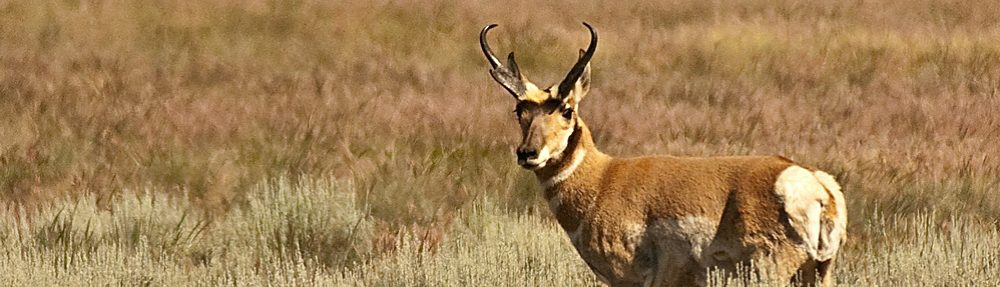
We were on a sharp lookout for antelope, sometimes called pronghorn. Antelope are shy animals and will bolt at the slightest fear of danger. Antelope, North America’s swiftest mammal, can reach speeds of more than 40 miles an hour and can cover 20 feet in one leap. These deerlike animals are characterized by their curved, hollow horns with a single forward-projecting prong on each horn. The antelope’s tan body has a white belly and two white stripes on the neck and chest.

At one time, before the settlers came to America, Hart Mountain was the home of bighorn sheep. Indigenous writing on rock walls shows figures of wild sheep, indicating they were an important source of food. The first settlers also hunted the sheep. Large herds of domestic livestock were eventually brought into the area causing competition for forage. Diseases introduced to the bighorn sheep also contributed to their disappearance by the early 1900s. In November 1954, 20 bighorn sheep were donated by British Columbia, reestablishing the bighorn at Hart Mountain.

Visitors normally have to work to see bighorn sheep although herds are occasionally seen from the road. Usually, they are easier to spot along cliff areas if you are above them, which means taking a steep hike. Bighorns have the capacity for climbing and jumping due to the structure of their hoofs. The halves of each hoof separate allowing the feet to cling firmly to rocky terrain.

Mule deer are routinely spotted anytime of year, though spring and summer are the best times. The mule deer, named for their large, mule-like ears, avoid human activity but can be seen along forest edges or on brushy slopes in the foothills.

About 200 resident migratory bird species use the refuge, often seen along riparian areas along the edge of a stream or river. The air is alive with their songs. Sage grouse are often spotted around meadows and their kuk, kuk, kuk can be heard as they search for food among the sagebrush.

Wild flowers abound throughout the refuge. In June, fields of iris danced in colorful display. We also found Indian paintbrush and brilliant yellow arrowleaf balsamroot. Photographers will find plenty of subjects to capture.

The thirty campsites on Hart Mountain’s Hot Spring Campground are primitive with no RV hookups, drinking water, firewood or fire rings. There are pit toilets, two of which are handicap accessible. Drinking water is available at headquarters. There are no reservations and no camping fees. A hot springs enclosure allows visitors to enjoy warm waters with an open view of the sky.

Visitors might consider making this refuge a day trip and camp in the Lakeview area where there are U.S. Forest Service camps or Goose Lake Oregon State Park. Goose Lake, off US 395, 14 miles south of Lakeview, has 48 sites with electricity and water. Showers are available and there is a dumping station. The park has boat facilities and excellent wildlife viewing. The lake spans two states, Oregon and California.

Be sure to visit the Refuge headquarters which has several interesting displays and pamphlets.

An interesting outside display identified many of the native plants found on the refuge: wild-rye, hawksbeard, Indian ricegrass, low sagebrush, rough fescue, Idaho fescue, balsamroot, bluebunch wheatgrass, bitterbrush, and big sagebrush. Each of these plants is vitally important to ensure adequate cover and nutrition for many resident species.

If you’re looking for a memorable wildlife experience, consider visiting Hart Mountain National Antelope Refuge. You’ll be awe-inspired with the spectacular views and fascinated with the abundant wildlife.

For more information, visit https://www.fws.gov/refuge/Hart_Mountain/visit/plan_your_visit.html

Book Review–Change of Leads: The Lost Shoe

I loved The Lost Shoe, A. K. Brauneis’ exciting novel that takes place in Wyoming Territory in the late 1800’s.

Lifelong friends, Napoleon Nash and his nephew Jackson Kiefer are trying to work themselves out of lives of crime. The Governor of Wyoming Territory has promised them a secret pardon if they can prove themselves worthy of freedom. In exchange, they are required to perform tasks known only by the Governor and a few select people. In the meantime, hefty “dead or alive” bounties still posted make life a challenge.

While stopping in a small town to have their horses shod, the two happen to run into an old friend who invites them to visit his ranch. Against their better judgement, they accept the offer. The heart-warming visit with the rancher and his family makes them realize how much they long for normal lives and they are even more impatient to finish their agreement with the Governor and become free men.

Their world takes a turn for the worse when they are discovered by an ambitious marshall who is unaware of the Governor’s promise of freedom. As their lives spin dangerously out of control, the two must muster up their courage, count on the few friends they have left, and struggle toward an ever-dwindling chance of freedom.

Brauneis writes with authority about conditions that took place in Wyoming in the mid-and late 1880s. The novel’s characters have great love and rapport with their horses, and the author’s own equine knowledge is obvious. The book is written with heart, a quality I greatly admire. Trial scenes in a court of law are particularly compelling.

The Lost Shoe is the first book of The Navarre Link Chronicles: Change of Leads. The author has also written a prequel to the series, Ice.

Book Review: News of the World

Paulette Jiles has written a truly exquisite novel, News of the World. The story begins in 1870, Texas. I rarely read a book twice, but I found myself rereading some of my favorite parts in this tender novel.

Captain Jefferson Kidd, a respected man in his seventies and a veteran of two wars, makes his living by traveling through Texas reading to audiences hungry for news. World news, local news, exotic news, he reads any news that takes people from the here and now and fires their imagination with the happenings of elsewhere. He slants his newspaper reading to the taste of his audience at a dime a person. On one of his trips he is approached by an acquaintance, a freighter, who has been commissioned by the Army to return a ten-year old girl, a Kiowa captive, to her family 400 miles away. The freighter cannot leave his business that long, and gives the Captain the $50 gold piece the Army has given him to have the girl returned to her relatives.

Captain Kidd agrees, but with some misgivings. The girl, Johanna, though white with blond hair and blue eyes, acts thoroughly Kiowan. She was six when her captors brutally killed her mother, father and sister. But, surprisingly, she longs for her Kiowa family. She doesn’t remember any English, nor does she have mannerisms of the “civilized.” Captain Kidd sympathizes with the girl who has been torn away from her birth family, and now from her adopted family.

With the $50 gold piece, he purchases a wagon and they begin their journey through unsettled and unforgiving territory, all the while watching for thieves, Indians, the often-corrupt federal army, and always on the lookout for those who would kidnap the girl to sell. He must also watch for her attempts to escape. The two face many dangers and physical hardships traveling across Texas.

As the miles pass, they draw closer to one another. Johanna senses Captain Kidd’s kindness and generous heart, and he worries that his little charge won’t be able to accept yet another drastic change in her life.

News of the World is an outstanding novel. I loved it; a sheer delight to read.


Book Review: The Patchwork Bride

The Patchwork Bride, a fun, engaging novel by Sandra Dallas, takes place in the late 1800’s Texas, Colorado, and Kansas.

Ellen and Ben are nearing the end of a loving and exciting life on their ranch. Their favorite granddaughter June arrives, a runaway bride seeking refuge. As Ellen pieces together a quilt made from squares of old fabric rich with memories, she tells June about Nell, a three-time runaway bride.

Nell travels to Texas to find a husband, hopefully a cowboy. She hires on as a cook on a large ranch and meets Buddy. There is an instant attraction, but a misunderstanding mars her happiness. Nell continues to search for a lasting relationship, but finds complications and disappointment.

In between stories Ellen and her granddaughter talk. June is distraught and feels guilty about abruptly leaving her planned wedding. As the grandmother selects pieces for her quilt, the material reminds her of how life is pieced together by memories, some heartbreaking, some fulfilling.

I enjoyed this entertaining and tender novel, and its stories within the story. The author’s references to places and products of the times are historically correct and interesting, as are the language and mannerisms of the period.

Book Review: The Girl Who Wrote in Silk

Kelli Estes has written a memorable novel, The Girl Who Wrote in Silk, a testament of the endurance of the human spirit.

The story is inspired by true events and the tragic aftermath of the Chinese Exclusion Act of 1882, an immigration law excluding people from the United States based on their Chinese race.

The story toggles between Washington Territory in 1886, and present day Orcas Island, largest of the San Juan Islands, located in northwestern Washington state.

Mei Lien, fifteen years old, together with her father and grandmother, are among the many Chinese living in Seattle who are forced to leave the United States. They’re herded onto a ship and told they are being deported to China. Mei Lien overhears a conversation between the ship’s owner and its captain that their “cargo” will not reach China. She tells her father what she heard and, before they reach the ocean, he makes her jump overboard in the hope that she can swim to land. Joseph, a kind, caring man living on Orcas Island rescues her.

In present day, Inara Erickson has just finished school with a degree in International Business and has recently inherited the family’s estate on Orcas Island. Inara’s dream is to renovate the estate into a boutique hotel. While staying at the house, she discovers a loosened stair tread and forces it open. She finds a silk sleeve, intricately embroidered with mysterious scenes and images.

Inara consults a University of Washington expert on China studies and together they unravel the mystery of the sleeve’s origin and the long-ago fate of the Chinese people aboard the ship.

I loved this elegant novel, not only because it takes place in my part of the country, but because of its historical interest. Kelli Estes has woven a spell-binding story about a brutal part of our history while recognizing the love and humanity that binds us all.

Whale Watching in the Northwest: A Unique Experience

Image by Bruce Trimble

If you’re in the Northwest, consider a whale watching cruise. We chose to sail with Island Adventure out of Anacortes, Washington.

On a brilliant sunny day, we sailed out through the San Jan Islands and into the Strait of Juan de Fuca.

The San Juan Islands are among the best places in the world to view orca and minke whales. The area is home to three pods of resident whales who are numbered and named. Orca whales have been returning to the area for hundreds of years and feed on Pacific Northwest salmon.

We cruised for a while before spotting our first whale, then we saw many as they cavorted in the water, expelling air through their blowholes as they fished for salmon. We saw many salmon jumping, probably trying to escape from their predators. The orca is a beautiful species with glossy black back and white belly, white eye patch, and grayish white saddle patch. The dorsal fin may be three to six feet long. The coloration of the orca’s dorsal fin and saddle patches are distinct, and these unique physical characteristics are used to identify individual whales. Adult orcas weigh 7,000 to 25,000 pounds, measure 17 to 32 feet, and can live 100 or more years.

During different times of the year, other whales—the minke, gray and humpback—also can be seen in these waters.

With each sighting, our on-board naturalist identified many of the orca by their pod names, J, K or L, and then their sub-groups consisting of mothers and offspring. We were able to observe a mother with her calf on several occasions as she showed off her baby to us. The boat kept a respectable, legal distance from the whales as required by law.

The orca is really not a whale at all, but is the largest member of the dolphin family. However, it is commonly called a whale because of its size and habits. The distinctive black and white orcas are probably the most studied group of marine mammals in the world. They are regarded by some scientists as the third most intelligent animal on the planet, after humans and chimpanzees.

Orca, sometimes called “killer whale” are an endangered species in Washington, Oregon and California. When viewing, observers should stay at least 200 yards away, using binoculars or cameras with zoom lenses for a closer view. If the wildlife approaches the boat, the engines should be placed in neutral, giving wildlife the right-of-way.

Whale watching tours are scheduled March through October. The orca population is decreasing at an alarming rate due to many factors. To learn more about whales and what can be done to protect this amazing mammal, visit whaleresearch.com