Book Review: The Tumor

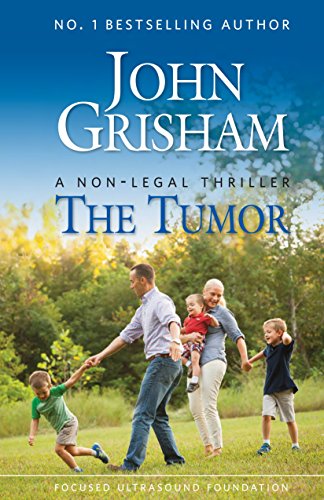
John Grisham, known for his legal thrillers, made a detour in The Tumor: A Non-legal Thriller. It’s very short—74 printed pages—though I read it on my Kindle.

The story begins with Paul, born in 1980 and now 35 years old, his wife, Karen, and their children. The family lives a normal, busy life. Paul is healthy, active, doesn’t smoke and takes no medication.

One day Paul suddenly experiences a grand-mal seizure and is rushed to the hospital. In looking back, Paul and Karen realize that he has been gradually showing unusual symptoms. He has headaches, has difficulty concentrating at work, becomes irritable, and at times experiences blurred vision.

Tests reveal that Paul has a brain tumor about the size of an egg, a type known as a glioma. Surgery is the only solution and the operation takes about three hours. Gliomas are graded one through four, with one and two benign; three and four malignant. Paul’s is a four and his chances of survival for more than five years are slim. Grisham goes into some detail about the actual surgery, the findings, the recovery, the recurring symptoms and the grim prognosis.

Had Paul been born in 1990 and diagnosed with the brain tumor at age 35, his story could be rewritten. With focused ultrasound technology, it is possible to have a non-invasive therapeutic treatment that will improve outcomes and decrease the cost of care. In addition to brain tumor treatment, focused ultrasound treatment is in development to treat many other diseases including Parkinson’s, Alzheimer’s and tumors of the liver, pancreas and lung.

John Grisham believes this book is the most important he’s ever written. He is an active member of the Focused Ultrasound Foundation (https://www.fusfoundation.org/). The Foundation’s mission is “To accelerate the development and adoption of focused ultrasound.” The book refers the reader to different aspects of the foundation’s functions to find treatment centers, learn about clinical trials, and how to become active in the support of the foundation and its goals.

I found The Tumor, published 2016, enlightening and well-written. I admire the author’s departure from writing best-selling legal thrillers to applying his impressive talent toward furthering a technology aimed at saving or improving lives.

Book Review: Death in the Time of Pancho Villa

Death in the Time of Pancho Villa, a novel by Sandra Marshall, blends the Mexican Revolution’s real-life people and facts together with compelling fictional characters and situations. The story takes place in the Texas/Mexico border town of El Paso, 1911.

Rose Westmoreland travels by train from Ohio in search of her missing husband, Leonard. His well-to-do parents are disapproving of a woman traveling alone, but Rose must know what has happened, good or bad. All Rose knows is that Leonard, an accountant, was sent to El Paso by his employer to audit the company books, and a short time later he disappeared.

Rose is fortunate to find a woman’s boarding house where she is befriended by the owner and another guest, a young Mexican expatriate. The three women plot together how Rose might find her husband. The further she delves into the mystery, the more complicated and dangerous the situation becomes. As it happens, Rose’s arrival coincides with a critical Mexican revolutionary battle that takes place in Juárez, directly across the Rio Grande River.

Rose’s investigation gets even more puzzling when it appears her husband’s reason for being there was far more complicated than auditing books. Drilling rights among competing international oil companies enter the fray and Rose’s situation becomes even more dire as she gets closer to the truth.

I very much enjoyed Death in the Time of Pancho Villa, the first in “A Rose in Old El Paso” series. The author weaves historical people and events into a realistic, captivating mystery. When I’m reading fiction, I always enjoy learning more about real- life characters and the author’s portrayal of Francisco “Pancho” Villa, a Mexican revolutionary general, made me want to learn more about him.

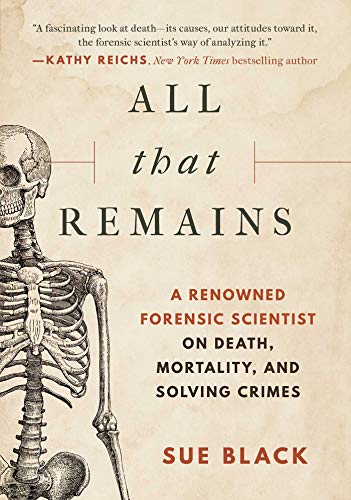
Book Review: All that Remains

Life is pleasant. Death is peaceful, It’s the transition that’s troublesome.
–Isaac Asimov

All that Remains, by Sue Black, is an absorbing memoir on death, mortality, and solving crimes, a renowned forensic scientist. Among her many accomplishments, she has served as Director of the Centre for Anatomy and Human Identification at the University of Dundee, Scotland.

Black’s experience working in a butcher shop as a school girl in Inverness, Scotland, piqued her interest in how bodies work. She shares her early college experiences and how she learned the priceless lesson that there is much the living can learn from the dead. The author is an enthusiastic proponent of people donating their bodies after death so that others may learn.

The author has used her forensic expertise in solving high-profile crimes as well as identifying bodies of missing people. She was the lead forensic anthropologist for the British team’s work in the 1999 war crimes investigations in Kosovo, helping to organize and identify bodies buried in mass graves. She goes into some detail about the terrible acts against humanity in this horrific conflict. The author also worked in Thailand after the 2004 Indian Ocean tsunami. She has appeared in court, giving testimony about the scientific facts surrounding crimes, and also speaks on radio and television about her experience as a forensic scientist. Black shares these experiences in honest detail, acknowledging that not everyone can tolerate this information, but insisting that knowledge allows people to come to grips with the deaths of their loved ones, especially those who have been missing for a period of time.

I strongly recommend All that Remains. It’s an informative account of life and death written not only by someone who has enormous experience, but one who has compassion and understanding. The author shows her gentle humor when working in the field, often being the only woman on a team, of dealing with extreme heat, or freezing cold. She is adept in making scientific data understandable to the layman. Not everyone is comfortable with this subject, but I appreciated Black’s unapologetic look at death and immortality, and how knowledge of death can help us accept the inevitable.

Book Review: All Too Human

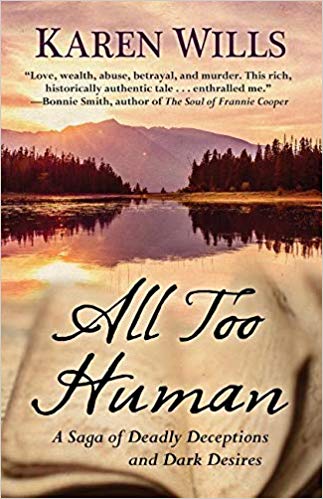
Karen Wills’ memorable novel, All Too Human: A Saga of Deadly Deceptions and Dark Desires, takes place in 1905, Montana.

Rebecca Bryan is a lawyer in partnership with her beloved Uncle Max. Uncle Max has asked Rebecca to go to the home of an old friend, Lucinda Cale, recently deceased, to locate the woman’s last will and testament and to help Lucinda’s family sort out her estate. Rebecca travels from their home in Kalispell, Montana to Cale’s home, a rustic wilderness hunting lodge near the Montana boomtown of Jennings.

After a harrowing trip in a blizzard, she finally arrives to find a family not necessarily mourning the matriarch as much as one who seems relieved to be without the old woman’s demands. Except for Amy. Lucinda’s thirteen year-old granddaughter was close to her grandmother, but is distant and disdainful to others, especially to Rebecca. Lucinda Cale’s oldest son Damon is friendly to Rebecca and grateful that she would try to help them find his mother’s will. Claudia, Damon’s gentle, pregnant wife, welcomes Rebecca, as does their little son, Teddy. Also with the family is Bretton, Lucinda’s mysterious, moody second son, who is there only for the funeral.

In searching for the will, Rebecca comes across Lucinda’s hidden diaries, journals that cover many years, starting in 1866. They tell of a young woman finding freedom from family scandals and poverty when she marries dashing, wealthy Garrett Cale. She describes their journey from St. Louis to the Northwest mining country in Montana. But the young woman’s life becomes one of physical and emotional abuse and dark deceptions. Lucinda becomes a schemer using her beauty to control those around her, actions that eventually affect her children and grandchildren.

Author Karen Wills captures Montana’s wilderness with breath-taking prose. Her characters are believable in their strengths, weaknesses, vulnerability and violent actions. I thoroughly enjoyed All Too Human.

Washington’s Treasure: Deception Pass State Park

Looking west from Deception Pass State Park

Among the many Washington treasures are its state parks. We recently camped using our truck and camper at Deception Pass State Park. The park spreads over 3,854 acres and includes both saltwater shoreline and three lakes. Located in northwest Washington, the park has three campgrounds: Cranberry Lake and Quarry Pond Campgrounds located on Whidbey Island to the south and Bowman Bay on Fidalgo Island to the north. The two islands are connected by a pair of bridges known collectively as Deception Pass Bridge.

Campsites offer ocean, mountain, forest, or lake views. Visitor facilities include utility sites with water and electricity, and tent sites. All camping spaces are equipped with a picnic table and fire ring.

In addition to superb camping, the park offers services for water activities which include two docks, boat launches and moorage. Boating, kayaking, freshwater and saltwater fishing, crabbing, swimming, and SCUBA diving are among the many water activities enjoyed at the park.

The park offers 38 miles of hiking trails through lush forest lands and along shorelines. In addition, there are 1.2 miles of ADA hiking trails, 3 miles of bike trails, and 6 miles of horse trails.

Besides soaking in nature’s bounty in our spacious site at Cranberry Lake Campground, we enjoyed a morning drive north to Anacortes, known for the Washington State Ferries dock and terminal serving San Juan Islands as well as Victoria, British Columbia. Another day we drove south to Coupeville, the county seat of Island County, and the second oldest community in Washington. Nearby Keystone is also the jumping off point via ferry to the Olympic Peninsula.

From many places in the park, visitors can see work done by the Civilian Conservation Corps (CCC) in the 1930s. At the Bowman Bay campground a CCC building was renovated in 1987 that exhibits the incredible story of the CCC’s work across the State of Washington during the Great Depression.

We recently purchased a Washington State Park off-season senior citizen pass for $75. This pass entitles pass holders to free camping and moorage between October 1 and March 31, as well as Sundays through Thursdays in April. Our three-day camping trip to Deception Pass State Park paid for this pass, so for the rest of the season our camping will be free.

Deception Pass State Park, open all year, is one of Washington’s most popular parks. Reservations are highly recommended (www.parks.state.wa.us or call (888) CAMPOUT to make reservations).

Book Review: The Reapers’ Song

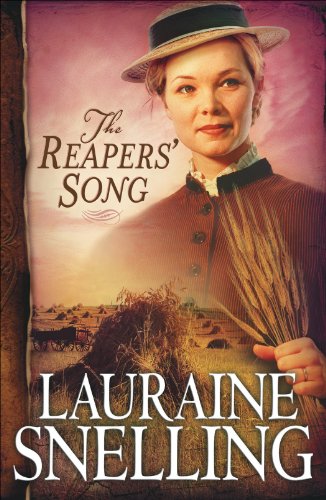
Lauraine Snelling’s novel, The Reapers’ Song, the fourth book of the “Red River of the North” series, takes place in Dakota Territory and covers the period 1885 – 1886.

Blessings, Dakota Territory, is beginning to prosper from the hard work of the Norwegian homesteaders. The railroad helps bring business to the little town, and the surrounding farms are producing crops and livestock.

Ingeborg and Haakan, their children and neighbors, many of whom are relatives, work long, hard hours. Some still live in sod houses; others are fortunate to have wood-framed homes. The stock and harvest must come first, and it is a steady grind to eke out their living.

Haakan and neighboring farmers have managed to acquire a steam engine with a separator to harvest wheat. A team of men take the separator on the road, threshing for other homesteaders in return for a portion of their grain. While the men are gone, their fields remain idle, and Ingeborg worries about all the work to be done before the harsh winter sets in. She decides to take over some of the field work in her husband’s absence. But her plan backfires and causes unimagined pain.

The Blessing community is grounded in deep faith. Without thinking of their own inconvenience, they help neighbors, welcome strangers into their homes, and do whatever is necessary for the good of all.

The author paints vivid pictures of the vast Dakota prairie, the dinginess of a house built of sod, the blessing of a church with a pastor, and the treasure of a school. She skillfully describes clothes, equipment, and attitudes of the period, and shows how faith and dedication help the immigrants thrive. I am enjoying the “Red River of the North” series and look forward to the two remaining books.

Book Review: Tinsmith 1865

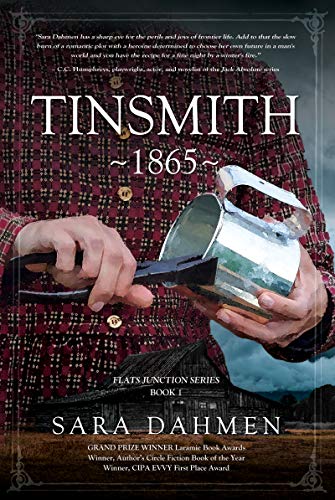
Sara Dahmen’s historical fiction, Tinsmith 1865, is a skillfully written account of tin and coppersmiths in the years following the Civil War. But more than that, it’s a story of a woman who doesn’t fit into the expected mold of that era.

Marie Kotiarczyk, 18, together with her recently widowed father and two brothers, travel by wagon train from Chicago to Flats Town, Dakota Territory. The Polish immigrant family are tinsmiths. Although Marie is fascinated by their occupation, her place is doing woman’s work. Unfortunately, she is not a good cook, nor does she have interest in any phase of womanly duties. What fascinates Marie is her family’s occupation.

They arrive in Flats Town to a shop her father has previously arranged to rent, a shop that will double as their home. Marie assumes her expected duties, but occasionally tinkers in the family profession. When her brothers join the Army to fight the Indian wars, Marie and her father are devastated. Marie steps in to help with the family business, fulfilling her deep-harbored dream, but also fearing not only failure, but breaking expectations of what a woman should do. When her father is stricken with illness, she must take over to fill the orders.

Marie has many worries. Will the townspeople take her occupation seriously? Her skills are in demand—will she be able to produce a worthy product? Will the cups she produces leak? Will the kitchen utensils she creates be things of beauty? When the Army places a large order, Marie is under pressure to show what she is capable of doing. She must succeed to pay their many debts.

I loved this book. The author portrays complex characters rich with desires and dedication to work. Her characters have scarred and calloused hands with grime under their fingernails; their clothes have holes due to sparks from creating their product. They’re not beautiful people, yet they’re appealing. I particularly appreciated learning about the tin and coppersmith profession. The author speaks with authority on that subject as she works as a metalsmith of vintage and modern cookware of tin, copper and iron.

Tinsmith 1865 is Book 1 of the “Flats Junction Series,” and is also currently in production to become a major motion picture. I’m looking forward to more of this series and to seeing it played out on screen.

Book Review: The Girl Who Loved Cayo Bradley

Nina Romano’s historical novel, The Girl Who Loved Cayo Bradley, takes place in the rugged ranchlands of New Mexico in the mid-1800s. Ever since her mother died, Darby McPhee, 16, has taken care of her father and four brothers. She dreams of doing what her mother wanted for her, to become educated. She has an invitation from her aunt, her mother’s sister, who will pay Darby’s way to St. Louis, Missouri, to live with her and get an education. It’s a dream come true.

Darby has been attracted to shy Cayo Bradley, a cowboy who works on a neighboring ranch. Cayo never says much to her, but his attraction is obvious and Darby yearns to hear the words she knows he wants to say.

Cayo’s real name is Connor Bradley. He was abducted as a child and raised by the Jicarilla Apache Tribe. The story covers his years with the Apaches, how he becomes one of them, learning their ways, using the name they give him, Coyote. He eventually leaves the tribe and finds work as a cowhand on a ranch.

As Darby and Cayo become acquainted, they fall in love. Still, Darby feels compelled to get the education she’s always wanted. Their parting is heart-wrenching, but both feel it’s temporary. In just a few years they can be together forever.

Darby loves school and does well, cramming as much education as she can into her busy schedule, yet always dreaming of returning to Cayo. Cayo, on the other hand, is having a tough time of it. He misses Darby; she’s in his every thought. He’s desperate to be with her. Then uncontrollable circumstances threaten to shatter their dreams.

By using flashbacks to Cayo’s previous life and alternating between the two main characters, the author delivers a fast-paced, heart-rending story with compelling and believable characters. I heartily recommend The Girl Who Loved Cayo Bradley, a story that kept me captivated to the end.

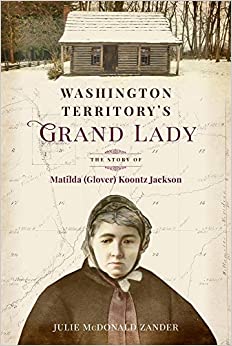
Book Review: Washington Territory’s Grand Lady

Washington Territory’s Grand Lady: Matilda (Glover) Koontz Jackson by Julie McDonald Zander is a scholarly non-fiction, well-researched and meticulously documented story of a hard-working early Northwest settler who could be called the “first lady” of Washington State.

Matilda was thirty-seven years old, the mother of four sons and pregnant with her fifth child, when she, her husband Nicholas, and their family journeyed west across the Oregon Trail in 1847. Their destination was Oregon’s fertile farmland in the Willamette Valley. It was a grueling journey, turned tragic when, before her eyes, her husband drowned in the Snake River while trying to free a tangled oxen. The shock of his death sent Matilda into early labor and she lost her infant daughter.

The family, heartsick, plodded on and finally reached Oregon City. Matilda was in a quandary. As a single woman, she couldn’t claim land, and had no means to support her family. Her health was not yet good enough to travel the long road back home to Missouri. In early 1848, Matilda met and married John R. Jackson, an English-born naturalized American. The family traveled north to his log cabin, which he called Highland Farm. The cabin, now preserved, is located in what is now known as Chehalis, Washington. John and Matilda had one son and two daughters, making a total of seven children.

The farm was productive. They raised cattle, pigs, sheep, goats, horses and chickens, and grew many crops. It’s hard to imagine how difficult their life was with no modern conveniences such as running water or electricity, nor automated farm implements. Yet with hard work, they prospered and helped form what became Washington Territory in 1853, and later a state in 1889.

Highland Farm was located midway along the Cowlitz Trail, an important north-south route between Oregon City and Puget Sound. It’s location made the Jackson home an ideal place to stop and rest and to conduct business. Matilda was known as a superb homemaker and travelers were always welcomed. Visitors to their home included Ulysses S. Grant, George McClellan (both of whom would become generals), and Isaac Stevens, the first territorial governor of Washington. John Jackson, Matilda’s husband, in addition to farming, became politically active as the population of the area increased. He served as sheriff, assessor, tax collector, territorial representative and justice of the peace. In all of these roles, Matilda supported his efforts by making their home welcoming and a place to meet.

Washington Territory’s Grand Lady, enriched by pictures, letters, diaries, and ledgers, is a valuable resource of Washington history. Matilda (Glover) Koontz Jackson (1811 – 1901) was indeed a remarkable lady, a dedicated wife and mother, and a person whose courage and hospitality helped shape the State of Washington.

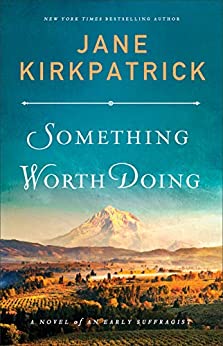
Book Review: Something Worth Doing

Jane Kirpatrick’s historical fiction, Something Worth Doing: A Novel of an Early Suffragist, is the story of Abigail Scott Duniway, a woman with a fierce love of justice and liberty for all. For all, including women. The story covers the years 1853 when Abigail was a 19-year-old school teacher to 1912, when Oregon women finally were granted the right to vote.

When Abigail and Ben Duniway were married, she had to give up her teaching job in Oregon Territory and do what women did: perform the drudgery of housework and child-bearing. She resented that a woman’s life was dictated by men, that she was subject to the will of her husband. A woman could keep no income she made for herself should her husband choose to take it, she could not own property, the lives of their children were dictated by their father. Fathers, husbands, even brothers controlled the women in their lives.

Ben Dumiway was a good man and he dearly loved his wife. Although he made the major decisions about their lives, he recognized Abigail’s dreams and desires. When financial mistakes and a serious injury forced Ben to stop working, Abigail became the primary breadwinner for her growing family. Finally, she realized that perhaps there was something she could do for the plight of women, and she devoted her life fighting for the rights of women, including the right to vote.

Abigail and Ben had six children–all born at home. In addition to helping on the farm, she ran a millinery and a private school, wrote novels, gave speeches, and eventually ran a newspaper supporting women’s suffrage. Through it all, Ben was loving and patient with her absences. In one year, she delivered 296 speeches; in her lifetime, more than 1,500.

Disappointments mounted as referendums for the women’s vote were defeated, but Abigail and her fellow workers pressed on, finally succeeding in 1912 when Oregon women finally were granted the right to vote.

The issues presented in Something Worth Doing will resonate with women of today. Many of us can relate to women not receiving equal pay for equal work, and for the prejudice women encounter when competing in a male-dominated world. Multiple award-winning author Jane Kirkpatrick has written a passionate story of a pioneer for women’s rights. The life of Abigail Scott Duniway shows that courage and devotion to a cause is worth doing, that it can make a difference.