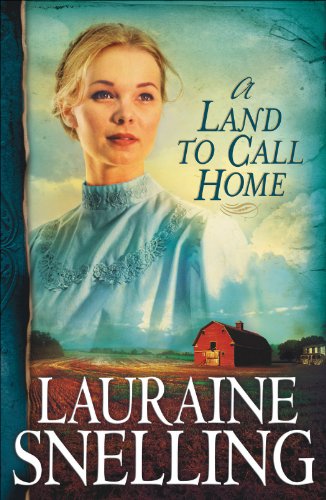
Book Review: A Land To Call Home

A Land to Call Home, the third novel in “The Red River of the North Series” is another exceptional Historical Fiction by Lauraine Snelling. The story takes place in 1884-85 in Dakota Territory, in what would become North Dakota.

The story centers around the families of two sisters-in-law, both widowed and remarried, but includes other neighbors and relatives who fight to survive the struggle of taming the virgin prairie. The adults are originally from Norway and they speak Norwegian, though struggle to learn English. As the pioneers face almost insurmountable challenges to “prove up” their individual homesteads, they also work toward their dream of building a real town.

The immigrants’ homes are made of sod, dwellings that are dark and damp. But the women make colorful quilts to liven their environment. Even the combination church/school building is a sod structure. Helping one another, sharing their meager supplies, and living their strong Christian faith carry them through the hard times.

Reading this series has made me appreciate even more the hardships of our early pioneers. I love reading about how those brave people managed, what they ate and how they spent their time. Their lives were centered around their deeply rooted religion. When their faith was tested, they helped one another through it. I particularly enjoyed the first Christmas program in the new soddy school house. In those days there were no problems celebrating a traditional Christmas pageant with a live baby, donkey, even sheep. The community pitched in with materials to make the program a success.

Lauraine Snelling captures the spirit of our hard-working early settlers. As I’ve followed along with many of the same characters in previous books in the series, I applaud their triumphs and despair their hardships. I admire their deep faith and their ingenuity in finding ways to strive. I love the “Red River of the North” series and look forward to book four.
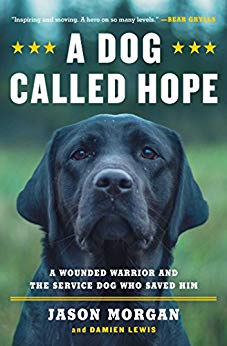
Book Review: A Dog Called Hope

A Dog Called Hope: A Wounded Warrior and the Service Dog Who Saved Him by Jason Morgan and Damien Lewis is a well written, moving true story.

While on an anti-narcotics raid, special forces warrior Jason Morgan parachuted into a Central American jungle. He’d served with the famous Night Stalkers on many such missions, but this assignment ended badly for Morgan. Months later he regained consciousness in a U.S. military hospital, paralyzed from the waist down, in chronic pain, and with no memory of what had happened to him.

In the meantime, Jim Siegfried, a Canine Companion for Independence (CCI) puppy trainer, was assigned a dog to raise and train. In the eighteen months Jim would have Napal, a black Labrador Retriever, the pup learned to respond to thirty commands and be prepared for the next training sessions to meet special-needs recipients. It’s a tremendous sacrifice for puppy trainers. The bond between trainer and pup becomes very strong and giving up the dog is heart-wrenching. Some dogs don’t make the grade, but those who do become a life-line to veterans and the disabled.

Jason Morgan’s life spiraled downward to the point of his having no hope. This once-active career military and family man’s life as he knew it ended with his massive injuries. Jason’s life took a remarkable turn when he learned about CCI. He was given Napal and after the two trained together at a California CCI facility, Jason was able to respond to his family’s needs and know real happiness. Not everything ran smoothly in Jason’s life, but with Napal he was again able to find humor, companionship and meaning in life.

A Dog Called Hope is a remarkable story about the strong bond between man and dog. I learned how intensely trained CCI service dogs are and how they can change lives. Although the dogs cost about $50,000 to raise and train, they are free to the recipients. The book opened my eyes to the challenges a wheel-chair bound person faces. But a canine companion does more than pick up dropped objects and open doors. Their constant presence helps build confidence, open up new possibilities, all the while providing unconditional love and joy. I highly recommend this touching and often humorous book.

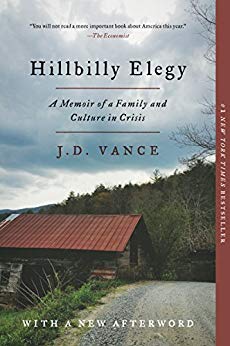
Book Review: Hillbilly Elegy

Hillbilly Elegy: A Memoir of a Family and Culture in Crisis by J.D. Vance is a stark, beautifully written and sometimes humorous memoir about the author’s growing-up years in a troubled family. Vance’s Appalachian family was originally from Jackson, Kentucky, but later moved to the “Rust Belt” of Middletown, Ohio. In his memoir Vance describes the mind-set of poor, white Americans. The memoir is a passionate, personal analysis of a culture in crises.

Vance and his half-sister were mostly raised by loving grandparents. His mother was an addict; he barely knew his father. His mother went from husband to husband, and even though some of these men were decent, they were never around long enough to help a growing boy get a sense of direction for his life.

Vance did poorly in school, had spotty attendance, and often made unwise choices. After barely graduating from high school, a cousin urged him to join the Marines, a choice that made all the difference in the life he subsequently lived. When he enlisted, he was out of shape, had a sour attitude, and couldn’t begin to imagine what he would do with the rest of his life. By working hard—and that not always by choice—he learned his own self-worth, and gained confidence both physically and mentally.

With his new-found confidence, and with the help of the G.I. Bill, Vance attended and graduated from Ohio State University in Columbus. At the University, he learned how other people lived, that he could contribute to society, and that he could be someone he never dreamed possible. He learned that successful people look at the big picture, not just present-day challenges.

He applied and was accepted at Yale Law School. At Yale he met yet a different class of people, and was introduced to other lifestyles and opportunities. His expanding self-worth influenced his future choices.

Hillbilly Elegy is a powerful book. As one who’s “been there,” Vance describes the problems with so many of the working class poor, how their lifestyle reflects bad choices, resulting in the next generation making the same self-defeating decisions. It’s easy to be critical of people like this, but the remedies are complex and often elusive. Hillbilly Elegy is a fascinating study of a profound problem in today’s American culture.

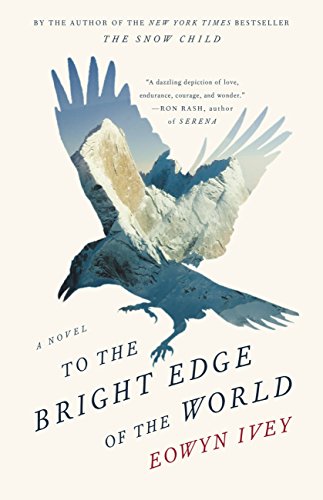
Book Review: To the Bright Edge of the World

To the Bright Edge of the World by Eowyn Ivey is a beautifully written historical novel based on an 1885 exploratory expedition to unmapped Alaska.

Lieutenant Colonel Allen Forrester and his wife Sophie have only been married a short time when he undertakes an assignment to explore regions of Alaska’s Wolverine River Valley. He is accompanied by two other Army men. Along the way they meet up with two trappers and prospectors hoping to locate minerals. A Native woman also joins them whose survival skills prove to be invaluable in their precarious journey.

Forrester’s team experiences harrowing, life-threatening situations, illness and deprivation. While her husband struggles in the wilds of Alaska, Sophie is compelled to remain at their home, an Army post at Vancouver Barracks, Washington Territory. Sophie has always been interested in nature, particularly birds, and discovers within herself a talent for wildlife photography while photography was in its infancy. She converts her pantry into a dark room and manages to learn the art of not only photography, but of developing pictures. Thus, she manages to ease her loneliness, despite the disdain of other army wives who spend their afternoons gossiping at teas.

The diaries and letters of Sophie and Allen Forrester are skillfully paced as they face hardships and conquests. Interspersed with Allen and Sophie’s writings is modern-day correspondence between a pharmacist and a great-nephew of Allen’s who is a curator of an Alaska museum. Also shown are excerpts and illustrations from historical documents which span the time period from the 1880s to the present.

To the Bright Edge of the World is an extraordinary novel, not only in its depiction of “man against nature,” but as a story of love, endurance, and hardships faced with courage and grace.