A Star to Steer By

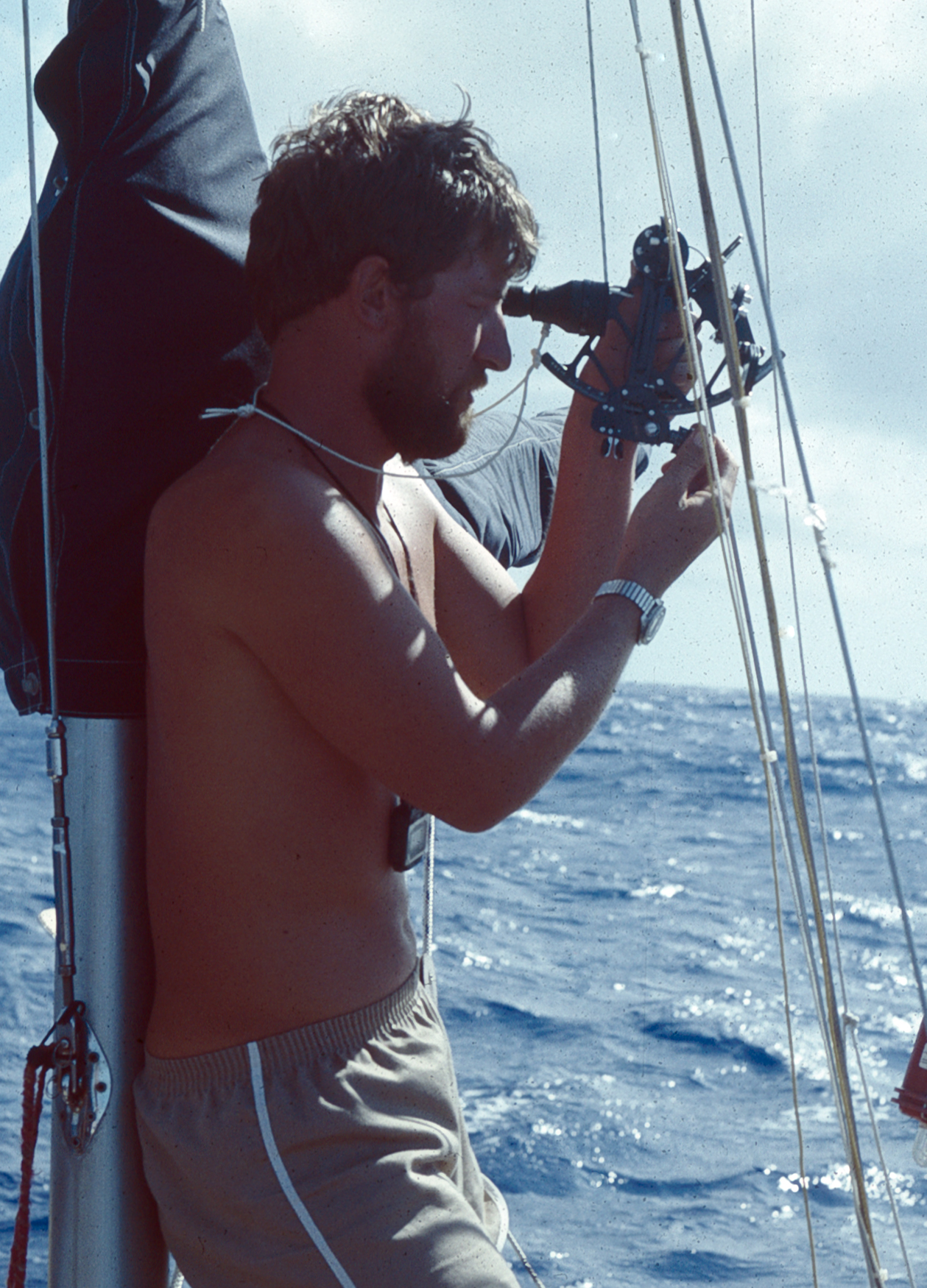
b-sextant-sp_t1_2-cropI must go down to the sea again, to the lonely sea and the sky; and all I ask is a tall ship and a star to steer her by.
……John Masefield

Navigating by electronic devices using GPS (Global Positioning System) is usually accurate and convenient. But what happens if/when the electronic system fails? Before our 13,000-mile trip through the South Pacific, Bruce taught himself celestial navigation, finding our position by the sun and stars using a sextant. It was our primary source of navigation aboard our Bristol-40, Impunity..

Using celestial navigation during the daytime, the sun normally would be our only source of position information, and a sun shot would give a line of position. Bruce knew we were somewhere on that line, which he would draw on the chart.

During morning and evening twilight when Bruce could make out both the horizon and some stars, he could get multiple lines of position, one from each star, and where these lines intersected was our position. When getting a line of position from a star or the sun, Bruce would label the chart with “sun” or the name of the star, such as “Vega.”

Bouncing around on a small boat at sea while taking visual observations using a sextant is not entirely precise, but with care each line of position would be accurate, hopefully within a half mile or less. When many miles from land, that is close enough.

Note: The above was taken in part from my memoir, Sailing with Impunity: Adventure in the South Pacific.

Book Review: And the Mountains Echoed

and-the-mountains

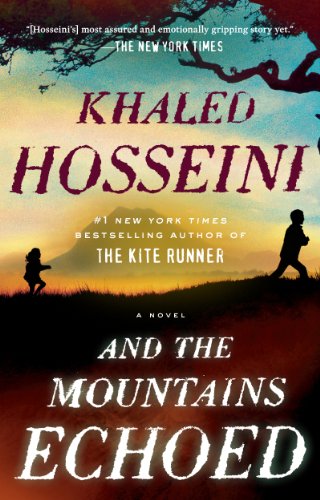
Khaled Hosseini’s sweeping novel, And the Mountains Echoed, captivated me with its powerful prose and layered, complex plot.

Abdullah, ten, accompanies his father as they walk to Kabul, Afghanistan, pulling his four year-old sister, Pari, in a wagon. The father’s poverty necessitates selling his daughter to a childless wealthy couple, an arrangement made by their valet, the father’s brother. Abdullah is heart broken to lose his beloved little sister and hopes some day to be reunited with her.

The little girl’s new mother, vivacious Nila and much older father, Suleiman Wahdati, give their only child all the advantages money can buy. When Suleiman suffers a stroke, Nila takes her daughter to live in France.

Pari often feels there is something missing in her life, an emptiness, but can never quite grasp the mystery. War rages in Afghanistan; the Taliban and Russians play their part, but the story is about the people affected by war, by wrong choices, by their own humanness.

The story takes place over a 50-year period, beginning 1952. At times I was confused by a newly introduced character, but eventually realized its significance to the basic story of loss and separation.

I found the ending a revelation as Hosseini brings this complex tale to its conclusion. Hosseini’s characters are vivid, his descriptions of the various countrysides—Afghanistan, France, Greece, and the United States—and their cultural differences, realistic.

Four on, Four off

Note: The following is taken in part from my memoir, Sailing with Impunity: Adventure in the South Pacific.
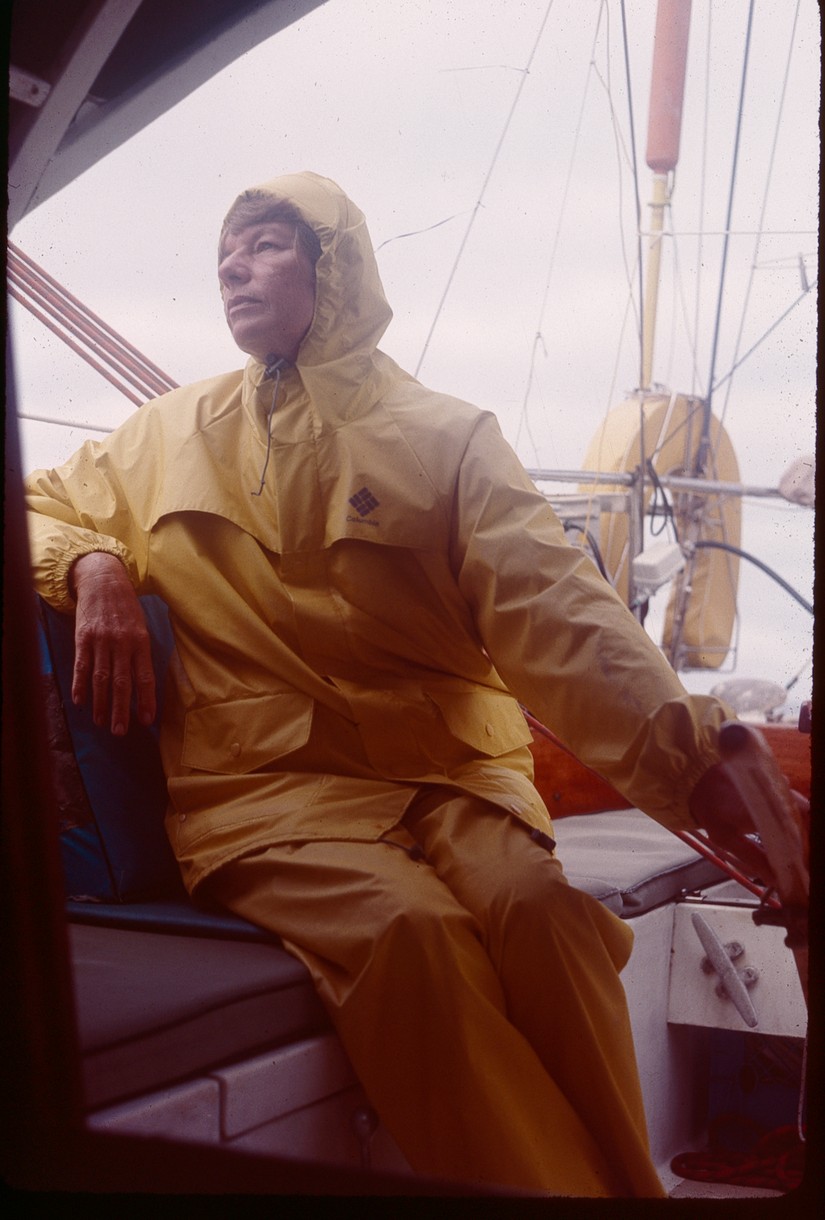
mary-on-watchEarly on, we established a four-hours on, four-hours off watch system while at sea. For safety, someone needs to be on deck at all times. Weather can change in a heartbeat, or another vessel could be on a collision course with your boat.

Although our watch system dictated four hours on, four hours off, sometimes we didn’t even get four hours of sleep. We had a safety rule that if one of us went to the forward deck, the other had to be at least in the cockpit. Although when going to the foredeck we always wore our safety harnesses (well, maybe not in dead calm), there was still a danger of losing our balance and falling off the boat. If that should happen, even tethered to a line, the person in the water could be dragged along and unable to get back onto the boat.

Bruce always tried to have Impunity’s sails set conservatively for the night, but there were times he had to wake me during his night watch so that I could be in the cockpit while he changed a jib or took a reef in the mainsail. The sea doesn’t care what your sleeping schedule is.

One night after a particularly calm, peaceful day, I was sleeping when around three in the morning I not only heard, but felt a loud BANG! It sounded as though we’d hit something. I heard Bruce yell, “Mary! I need you on deck!”

I scrambled out of the midship berth and up to the deck into screaming wind and driving rain. Bruce handed me my safety line and I clipped it on as he made his way to the bow, fighting against a strong wind. He took down the jib and lashed it to the railing with a bungee cord, then made his way back to take a couple of reefs in the mainsail, reducing the effect of wind and calming the boat’s action..

Sudden squalls come without warning and can knock a boat down. Since it was dark, Bruce couldn’t see it coming, but he said moments before the squall was on us that he had noticed a subtle wind shift and felt the temperature drop a few degrees. Then, the wind suddenly picked up and the squall slammed into us. Another reason why a person should always be on deck. Without quick action, we could have been in trouble.

On another occasion, while I stood my 10:00 p.m. to 2:00 a.m. watch, I spotted lights from a large ship on the horizon. Although we were the privileged vessel, because of our position relative to the ship and because we were under sail, I kept my eye on the ship. I took bearings repeatedly and after a period of time could see that we were on a collision course.

I hated to wake Bruce, but it was our rule. In situations like this, he never grumbled about being awakened. We monitored the approaching ship together, and it appeared as though they didn’t see us, even though we’d shown our deck lights. The ship made no attempt to change course.

Bruce called on the VHF radio. “To eastbound ship on my port bow, this is the sailing vessel Impunity. Over.” Nothing.

A few minutes later Bruce called again. “To east-bound ship on my port bow, this is the sailing vessel Impunity. Please state your intentions. Over.” No answer.

A third call and still no response.

Because we were the privileged vessel, we were obligated to maintain course and speed. But finally, when we could see that the ship was not going to change course, we had to alter our course in order to avoid a collision. We tacked and went around and behind the ship.

After the collision danger was past and we were back on course, Impunity received a call on the VHF. The caller spoke in a heavily accented voice. He identified his ship as a Japanese freighter heading for the Panama Canal. The captain, possibly the only English-speaking person on board, was apparently asleep when we first called on the radio. Afterward, Bruce, relieved, joked to me, “I thought they were going to make sushi out of us.” In truth, they could easily have hit us, and it is entirely possible that they would not even have known it. They apparently were keeping neither a visual, nor radar, nor radio watch. To them we might have been merely a bump in the night.

As Bruce often joked, “right-of-way is a matter of tonnage.”

Book Review: Sticks, Stones & Songs: The Corey Story

sticks-stones

Eleanor Corey, the seventh child of ten children, has written a remarkable family history of the Corey family who lived on the Olympic Peninsula in rural Washington State.

Arthur Corey, a preacher, paid $28, the amount of over-due taxes, for an old drafty grange hall he converted into a home. The year was 1937, toward the end of the Depression, and times were tough. He moved his wife, Margaret, and three daughters into the old derelict building situated on rough acreage, and they did what they could to make it into a home, a home without insulated walls, or running water, and with an outside toilet where catalogs were used instead of toilet paper. Despite these hardships, it was a home of love and unbridled faith.

The story takes us through the pains of poverty in terms of money, such as subsisting on canned green beans three days in a row, but also on the richness of accomplishment through faith and hard work. Clothes were made from the material gleaned from missionary barrels, food often received as charity, tools fashioned from bits and pieces. Nevertheless, the Coreys were rich in their faith, in their love for one another, and in their music. Gradually their living conditions improved, the land became bountiful through the family’s grinding toil, most often accompanied by singing.

Through their hard work and dedication, the children became resourceful, leaders of their classes at school, involved in community musical activities, and generous with their time and talents. Their father’s powerful faith and their mother’s constant love and attention instilled in the family the lessons of sharing and serving.

Sticks, Stones & Songs: The Corey Story is an inspiring, well-written account scanning from a 1937 bare-bones beginning to a glorious 1979 family reunion that brought members scattered from six countries, many serving in humanitarian projects, and ending with a 2014 epilogue. I feel enriched having read about the Coreys and I highly recommend this heart-warming family history.

To learn more about the author, visit  http://www.eleanorcorey.com

Anne Schroeder: A Versatile Writer

My guest today is award-winning writer Anne Schroeder. Her latest release, Maria Ines, is a novel about an Indian girl in California who grows up under the tyranny and greed of Spanish, Mexican and Yanqui invaders.

anne-maria-inesfront

anne-cropped


On a lighter note, Anne writes this fun fantasy, “My Inner Fashionista”  about herself as a young girl:

My inner writer is an eight-year-old fashionista. The alarm goes off, the coffee perks and my computer boots to a wardrobe of possibilities. With the first sentence, I’m standing in my mother’s closet, trying on the strapless formal from her nightclub days, her pink high heels and stockings with the lines up the back, the paper rose that she pinned on her collar. I stuff the cups with tissue paper and mull the possibilities. In my mind, my younger sisters are sitting on the bed, watching with bright eyes, believing that I am fearless. The amazing thing is, I feel that way. They watch and wow while I try on Mom’s fur stole, the one with the little fox heads draping down the back. The one that’s so off-limits that they’ve never ever touched it. But I do. I describe its luster in waves of scrumptious adjectives until they overcome their fear and hold out their hands.

They feel the pelt. But I am bored with the little foxes. After all, I am the storyteller and this story has already been told. I can’t wait to skip off to show my dad the grown-up, glamorous version of what I hope to be one day. It doesn’t matter that everything’s still lying in a heap on the floor. I’m on to a new project.

But not so fast. Enter my mom.  Mom looks at my outfit and nods with a slight smile, but all she sees is the mess. She has a dozen ideas about cleaning the mess, and I don’t like any of them.  I sigh dramatically. Mutter beneath my breath, but my complaints fall on unresponsive ears. Eventually I start to work, but I’m not happy.

Cleaning up is tedious. It erodes my fashionista high. My mother’s clothes are no longer stylish or clever; in fact I don’t remember what I even liked about them. They’re stupid, out of date, lame, and I wish I’d never even opened the closet door. I’ll never be voluptuous like my mother; what’s the use? And my audience? My sisters disappeared at the first yelp from my mother’s lungs. I’m left alone to clean up with no one to notice all my hard work. And not even a “thank you” when I finish.

But I hear Daddy at the front door. I emerge from the closet wearing the fox stole and Mom’s favorite high heels and Daddy laughs and says what a clever girl I am, and pulls a five dollar bill from his wallet and hands it to me. I feel exonerated. Someone has noticed. Life is good again.

But Mom still thinks the job isn’t finished. After dinner it’s back to the closet. It’s late, I’m tired and the fun is over. All of my younger sisters are outside, singing, dancing, and buying ice cream from the street vendor, and I’m alone in a stuffy closet with empty hangers.

My sisters return, licking their ice cream cones, asking me to come out and play. But I’m stuck with the job until it’s finished. Mom would say, just fill a few hangers, but I’ve promised myself. I start writing news releases, bios and blogs, and soon the hangars start filling.  I pretend I’m having a great time. Maybe if I can produce a Tom Sawyer motivation, I can get someone to help me. This is too much. A terrible waste of time. Painful.

But as I work, I get another bright idea.  As soon as I finish, I start writing again. I can’t wait. It seems to me that eight is just the most perfect age in the world. The world is bright. I’m clever and wonderfully talented. But then I pick up the strapless formal and I realize that what I REALLY want are curves like Mom. Then I’ll be happy.

For more information about this versatile author, visit http://www.anneschroederauthor.com