Book Review: The Whistling Season

whistling

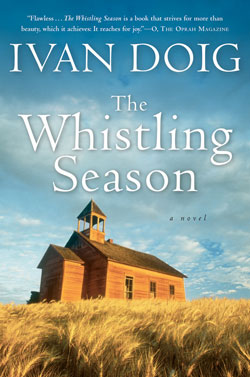
Every once in awhile a book of pure excellence comes along and, for me, Ivan Doig’s The Whistling Season has reached that level.

In 1909 change was in store for the Milliron family. The story is told in the voice of a reminiscing Montana school supervisor when he was 13 years old, The oldest of three sons, Paul is a precocious child who takes his responsibilities seriously. His father counts on him, especially since the boys’ mother died the year before.

The family manages, but the house is usually in disarray. Besides keeping up his farm at Marias Coulee, Montana, the father works as a drayman for a diversion canal under construction, and is president of the local school board. Housework and cooking naturally aren’t at the top of chores that manage to get done. When the father sees a housekeeper’s work wanted ad in the newspaper, the family’s interest is piqued. It is puzzling though when they learn through the ad that the housekeeper, though well qualified, does not cook. Can’t all women cook?

When the new housekeeper Rose and her brother Morrie crash into the Millirons’ lives, immediate change transforms the household. Through a death, serious accident, a vengeful family and a puzzling mystery, every member of the family responds for the good of the whole. These are tough folks, people who must take life as it’s served to them. How they measure up to the challenges shows the caliber of grit it takes to survive the dryland Montana prairie.

The entire book takes place primarily between the Milliron’s modest farmhouse and the one-room schoolhouse that serves grades one through eight.

The Whistling Season unfolds with the flawless assurance of an acclaimed storyteller. The landscape and characters are vivid, as is the emotional depth of the novel. It’s a story guaranteed to pop into readers’ minds with gentle reminders of the book’s every-day situations. The Whistling Season is a masterpiece.

A Precious Gift

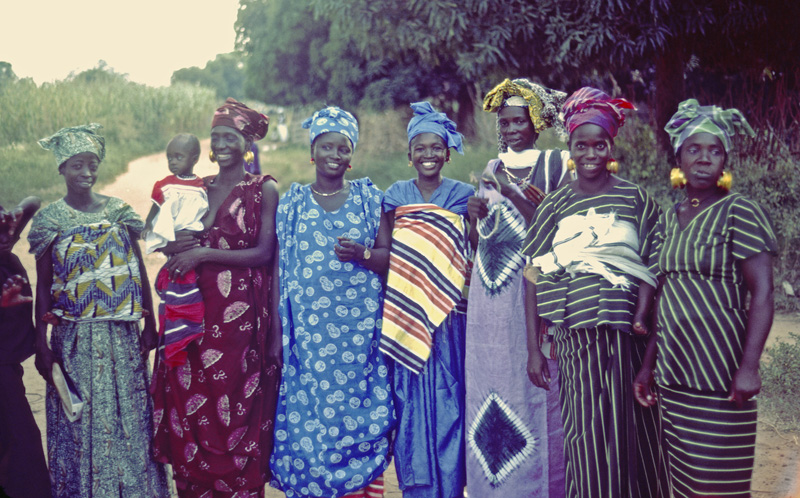
Women Dressed up

From: Tubob: Two Years in West Africa with the Peace Corps

One late afternoon, I sat in my hut reading and heard my name sung out. I stepped outside and opened the gate. A woman I had counseled about good nutrition for her baby smiled at me. She reminded me that her name was Sibo and that I had visited her at her compound. Sibo carried a basin on her head containing a parcel wrapped in cloth.

When women went to market, or made a formal visit to one another, they dressed up for the occasion. In this case, Sibo wore a nice top with a matching wrap-around skirt, and matching head scarf. I found their clothes attractive. Most tubobs I knew couldn’t manage a wrap-around skirt, we just couldn’t keep it secure without buttons, zippers or pins.

I invited Sibo into our house. As she lowered her load to the table, I offered her water, which she accepted. She had walked a distance. Her village was well beyond the Health Centre.

After taking a swallow of water, she opened the cloth to reveal perhaps five pounds of rice. Her family had grown and harvested the rice, she said, and it was a gift to me for caring. I was stunned. This was a gift of sacrifice, representing back-breaking work. Not only was the gift wonderful, but she’d walked miles in the hot sun to deliver it. I barely had the Mandinka vocabulary to express my appreciation. “Abaraka,” I said, with my hand over my heart. Thank you from the bottom of my heart. Repeated several times, it was about the best I could manage. I brought out my enamel bowl and she poured the rice from her cloth into the bowl, not spilling a kernel.

We chatted for awhile, she looked at our wall hangings, snapshots of our family, a U.S. map and a world map. I showed her our home state, then showed her where she lived. She obviously had never seen a map before. I invited her to see my kitchen and she marveled. By American standards it would be primitive, but to her it was luxury. She surprised me by saying my kitchen was good because I didn’t have time to prepare food the way they do, over an open fire.

I heard a motorcycle putter up to our compound, idle while the driver opened the gate, then a quiet rumble as he rode the motorcycle to our door. Many volunteers who lived in outlying areas were issued small motorcycles, some more like motor scooters. The rule was they were to use them only within a fifty mile radius. Dave lived in Fatoto at the eastern tip of the country and often stopped by when in our area. After I introduced them, he launched comfortably into Mandinka with Sibo.

After a short while, Sibo said she must return to her home to prepare dinner for her family. Dave offered to give her a ride on his motorcycle, but she declined, laughing. When I said, “Sibo, why don’t you? It would be so much faster,” she hesitated. Dave turned his motorcycle around and said, “Na.” Come. Much to our amazement, she hiked up her skirt to climb on, covering her legs as best she could. Dave indicated that she had to hang onto him. She stood her basin on end between them, then hung on and they took off at a sedate speed. She grinned back at me. What a sight.

Gambian rice has a rich, nutty flavor and takes a bit longer to cook than our processed rice. We ate it soon because it had limited shelf life. I didn’t want this precious gift to become chicken feed.

**Note: To leave a comment, please click on “Reply” below

Book Review: Home Fires

Home FiresJudith Kirscht’s Home Fires is a noteworthy and timely novel dealing with a family gone awry.

Myra and Derek Benning and their teenage children, Peter and Susan, appear to live a privileged life. Susan has a few social issues, but there’s love and strong bonds between the parents and children, and they’re a happy family. Myra feels blessed to have a handsome, successful husband and thankful for their enduring love. A phone call shatters her serenity and plunges the marriage into chaos.

Guilt, anger, and surmounting worry consume Myra. But then, an even more serious situation surfaces with daughter Susan and immediate action must be taken. Myra does what she must do, but at a price that affects every member of the family.

The story takes place on the Santa Barbara, CA coast and the author beautifully sets the various scenes, making the reader feel as though she breathes the salty air while walking along the beach, strolls quaint streets of the water-front town, or skims along waves while sailing the Santa Barbara Channel.

Although the subject matter is serious, Home Fires is an enjoyable read. Kirscht handles the subject of a complicated dysfunctional family with finesse. The various facets of the story are believable with realistic dialog and situations. Home Fires is an excellent novel, one I enjoyed immensely. Even when I wasn’t reading it, the story was on my mind, trying to second-guess the outcome.

Home Fires is currently available in ebook format, but soon also will be available in paperback. For more information about Judith Kirscht, visit www.JudithKirscht.com

**Note: To leave a comment, please click on “Leave a Reply” below.

Book Review: Think Like Your Dog

ThinkLikeYourDogDogs are not our whole life, but they make our lives whole.
Roger Caras, as quoted in Think Like Your         Dog: and Enjoy the Rewards

Dianna M. Young (with Robert H. Mottram) has shown with undeniable expertise the value of communicating with your dog in a language canines understand. In Think Like Your Dog: and Enjoy the Rewards, Young gives readers the step by step process necessary to have a canine companion to bond with in a rewarding relationship.

The most important lesson to be learned is that in every human and dog team, there is one leader and one follower. In a dog’s eyes, there is no in-between. Young clearly reiterates this principle throughout the book and gives understandable examples of how it can be achieved.

Think Like Your Dog discusses the important steps to take when your pup is first brought home, which ideally is not before eight weeks of age. Those first eight weeks with the pup’s mother assure that the puppy will get a strong foundation in tems of behavioral characteristics it will possess for the rest of its life. The next eight weeks with the new owner are critical in providing socialization skills, exposing him to people, kids, trains, buses, other dogs, noisy places, crowded places. Further, the pup should go through these experiences on his own four feet, not to be scooped up in the protective arms of his owner.

Each chapter in this valuable book discusses how a dog views the various elements of his life. The reader learns how a dog thinks through our verbal and body language, the senses and how all that relates to his comprehension. She discusses the various breeds and how they may differ when it comes to choosing a family pet. She talks about getting a dog as a puppy, or a mature dog and, in either case, how to proceed with meaningful training.

It’s important to have the proper dog equipment and in the book various types are illustrated and explained. Methods of training are outlined, with emphasis on positive reinforcement. The importance of a structured environment, patience and compassion are directly related to a successful dog and handler relationship.

Our chocolate lab Toby is 10 years old, yet I learned techniques in this book that we can use to enhance our family’s relationship with him. Not only that, I’ve learned the mistakes we’ve made, primarily relating to getting him too young, at five weeks, before he had that essential time with his mother.

Think Like Your Dog: and Enjoy the Rewards makes an ideal all-in-one reference book. It’s an enjoyable read with interesting stories and photos emphasizing the various principles Young teaches. For more information about the author and her training and boarding facility on Camano Island, visit: www.HowtoThinkLikeYourDog.com

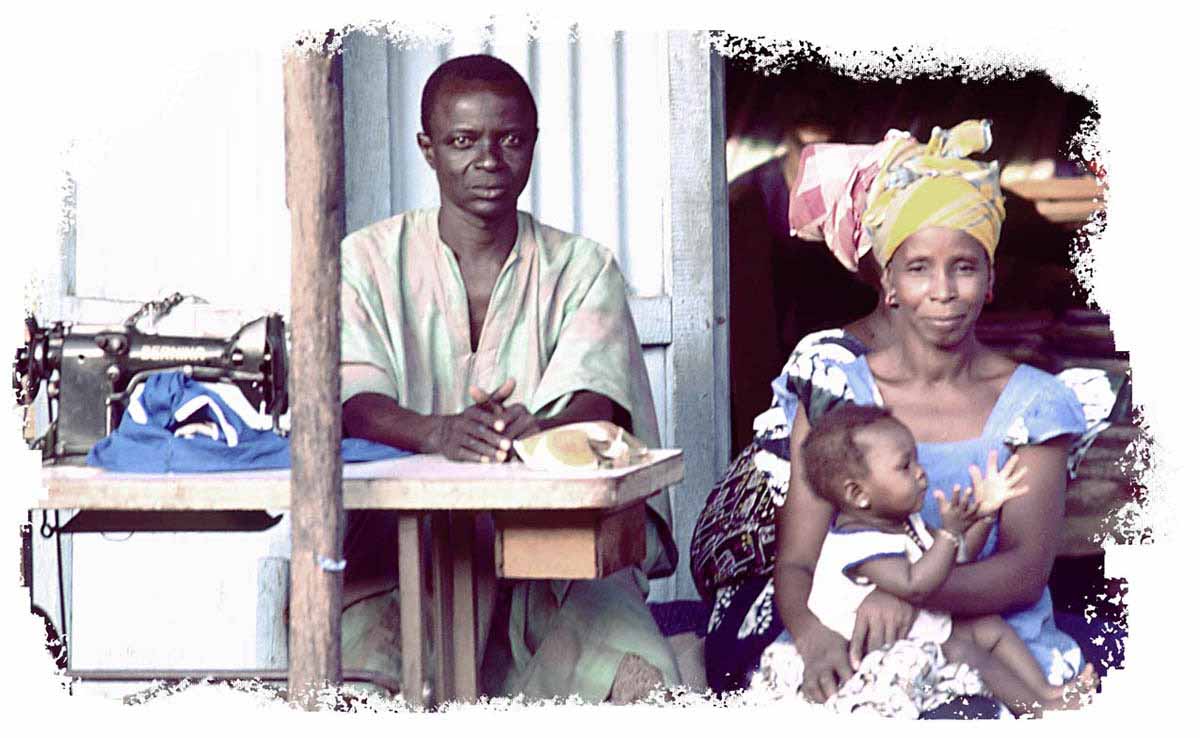
Dawda, the Tailor

Ch-19-RGB 2From: Tubob: Two Years in West Africa with the Peace Corps

The only place we could buy ready-made clothes was in The Gambia’s capitol city, Banjul, so most of my dresses were made to order at nearby Basse. Because of the heat, I preferred loose-fitting dresses and our local tailors were adept at copying a dress pattern from another sample dress, taking measurements of my shoulders and the preferred dress length. I was impressed with the tailors. Interestingly, they always were men. They used foot-operated treadle machines as there was often no electricity in the market place.

Our favorite tailor, Dawda, set up his business at the Basse market, in front of a Mauritanian-owned fabric store. He happened to be the first tailor I went to with one of my friend’s dresses to use as a sample.

Dawda understood the concept of learning. He always had a spare chair next to him and often invited me to sit and we’d chat in Mandinka. At first he talked slowly so that I could understand and often gave me new words that I could use. He was a wonderful man and very skilled on his treadle sewing machine.

I had a large selection of thread sent from the States for Dawda and he was thrilled. The thread that tailors often used was quite breakable, so he was pleased to have strong polyester thread. He had a scrap of material left over from another project and one day while we chatted, he made a triangular head scarf for me, using his new thread.

By this time we could converse fluently and I asked him about a bulubah, a sort of robe, for my husband Bruce. His eyes lit up. “Most tubobs don’t even know what a bulubah is,” he said. We went into the fabric store together to find suitable fabric, something that would look good with Dawda’s wonderful machine embroidery.

The blue and gold garment would come down to Bruce’s ankles, with loose, flowing sleeves and would serve as a robe in the evenings. It would be my Christmas present to him.

Tourist season had started and would continue through February. We occasionally saw tubobs wandering around the market. They were usually so pale, Bruce and I jokingly referred to them as “cadavers.” Most of them arrived by the weekly boat Lady Chilel, slept onboard and were gone when the boat headed back downriver the next day.

A tourist couple stood by while Dawda and I talked. “Listen,” the woman said, “she’s talking their language.”

Dawda and my eyes locked. We totally ignored them.